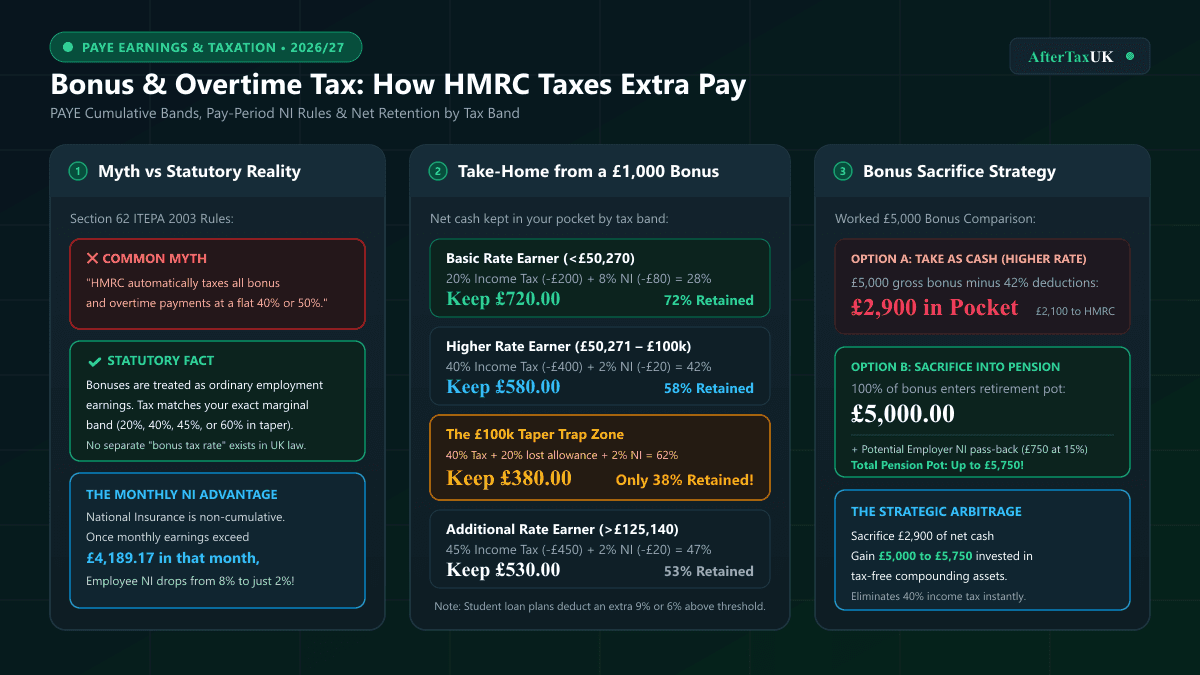
Why Does My Bonus Look Overtaxed in Month of Receipt?
Under HMRC's cumulative PAYE system, payroll software multiplies your monthly gross earnings spike by 12 to project your annual income. If a £5,000 bonus increases your normal £3,000 monthly pay to £8,000, payroll software treats you as an £96,000 earner for that single month, deducting 40% Higher Rate Income Tax immediately.
1. How Cumulative PAYE Taxes Extra Monthly Earnings
In the UK, cash bonuses, overtime payments, and commission are classified as ordinary employment earnings under Section 62 of the Income Tax (Earnings and Pensions) Act 2003. There is no separate "bonus tax rate".
Each month, an employee on standard tax code 1257L receives 1/12th of their statutory allowances:
- Monthly Personal Allowance: £1,047.50 tax-free (£12,570 ÷ 12).
- Monthly Basic Rate Band (20%): Earnings between £1,047.50 and £4,189.17.
- Monthly Higher Rate Threshold (40%): Any monthly earnings exceeding £4,189.17 (£50,270 ÷ 12) are taxed at 40%.
- Monthly Additional Rate Threshold (45%): Earnings over £10,428.33 (£125,140 ÷ 12) are taxed at 45%.
When a lump sum pushes your earnings for that month above £4,189.17, every additional pound is taxed at 40% (or 42% in Scotland). If your total annual income ultimately stays below £50,270, you will have paid too much tax in that month, which is refunded through reduced tax in later months.
2. The National Insurance Advantage: 2% Rate Above the UEL
While Income Tax is annual and cumulative, Class 1 Employee National Insurance is non-cumulative. It is assessed strictly per pay period under the Social Security Contributions and Benefits Act 1992:
Why this saves you money: Because a lump-sum bonus spikes your monthly pay beyond £4,189.17, all earnings above this threshold incur employee NI at only 2% rather than 8%. If your bonus was instead spread as an equal pay rise across 12 months, you might pay 8% NI on the entire amount!
3. Worked Bonus Tax Calculation (2026/27)
To illustrate the exact payslip deductions, consider an employee earning £36,000 basic salary (£3,000 gross per month) who receives a £5,000 bonus in March:
| Payslip Item | Normal Month (£3,000) | Bonus Month (£8,000) | Deduction on £5,000 Bonus |
|---|---|---|---|
| Gross Earnings | £3,000.00 | £8,000.00 | +£5,000.00 |
| PAYE Income Tax | -£390.50 | -£2,152.66 | -£1,762.16 (35.2%) |
| Employee NI (8% / 2%) | -£156.20 | -£327.55 | -£171.35 (3.4%) |
| Student Loan (Plan 2 @ 9%) | -£49.61 | -£499.61 | -£450.00 (9.0%) |
| Net Take-Home Pay | £2,403.69 | £5,020.18 | +£2,616.49 (52.3%) |
Note: In this example, £3,810.83 of the bonus pushed past the £4,189.17 monthly higher rate threshold, attracting 40% income tax in the month. If the worker's total annual earnings remain £41,000 (well within the £50,270 basic band), they will receive an automatic income tax refund of approximately £762 from HMRC.
4. Smart Strategy: Bonus Sacrifice into Pension
If your bonus will push your income into the 40% Higher Rate band, trigger the £60k Child Benefit tax charge, or enter the punitive £100,000 60% tax trap, consider agreeing a bonus sacrifice with your employer before the bonus is declared.
Benefits of Bonus Sacrifice:
- Zero Income Tax: Save 40% or 45% income tax on the sacrificed amount.
- Zero National Insurance: Save 2% employee NI. Employers also save 15.0% Employer NI and may pass some of this saving to your pension.
- Protect Tax Allowances: Keep your Adjusted Net Income below £60,000 (preserving 100% Child Benefit) or below £100,000 (protecting your full £12,570 Personal Allowance).
Model Your Next Bonus or Overtime Payout
Use our interactive calculators to see exact take-home pay based on your annual salary, bonus amount, overtime hours, and pension choices:
Frequently Asked Questions: Bonus & Overtime Tax
Clear answers based on official HMRC rules and statutory guidance.