1. Statutory Framework of the UK Income Tax System
Income Tax in the United Kingdom is a progressive statutory levy charged on individual taxable earnings under the authority of primary parliamentary legislation: the Income Tax (Earnings and Pensions) Act 2003 (ITEPA 2003) for employment income, the Income Tax (Trading and Other Income) Act 2005 (ITTOIA 2005) for business and investment income, and the Income Tax Act 2007 (ITA 2007) for rates, allowances, and computation mechanics.
Administered by HM Revenue & Customs (HMRC), the UK tax year operates on an ancient fiscal calendar running strictly from 6 April of one calendar year to 5 April of the subsequent year. For over 30 million employed British workers, Income Tax is deducted at source before net salary reaches their bank account through the statutory Pay As You Earn (PAYE) system governed by The Income Tax (Pay As You Earn) Regulations 2003 (SI 2003/2682).
2. The Statutory Personal Allowance (£12,570)
Under Section 35 of ITA 2007, every UK individual is entitled to an annual tax-free Personal Allowance. For the 2026/27 tax year, this allowance stands at £12,570, maintained under the statutory multi-year threshold freeze enacted by recent Finance Acts.
Standard Tax Code: 1257L
The numerical prefix 1257 multiplied by 10 denotes your £12,570 annual allowance. The suffix "L" confirms entitlement to the basic personal allowance without adjustments. Under cumulative monthly payroll, your employer delivers £1,047.50 of pay completely tax-free each month.
This means any worker earning up to £12,570 across the tax year pays £0.00 in statutory Income Tax. Tax liabilities only begin to accrue on earnings exceeding this £12,570 floor.
3. UK Tax Bands: England, Wales & Northern Ireland vs Scotland
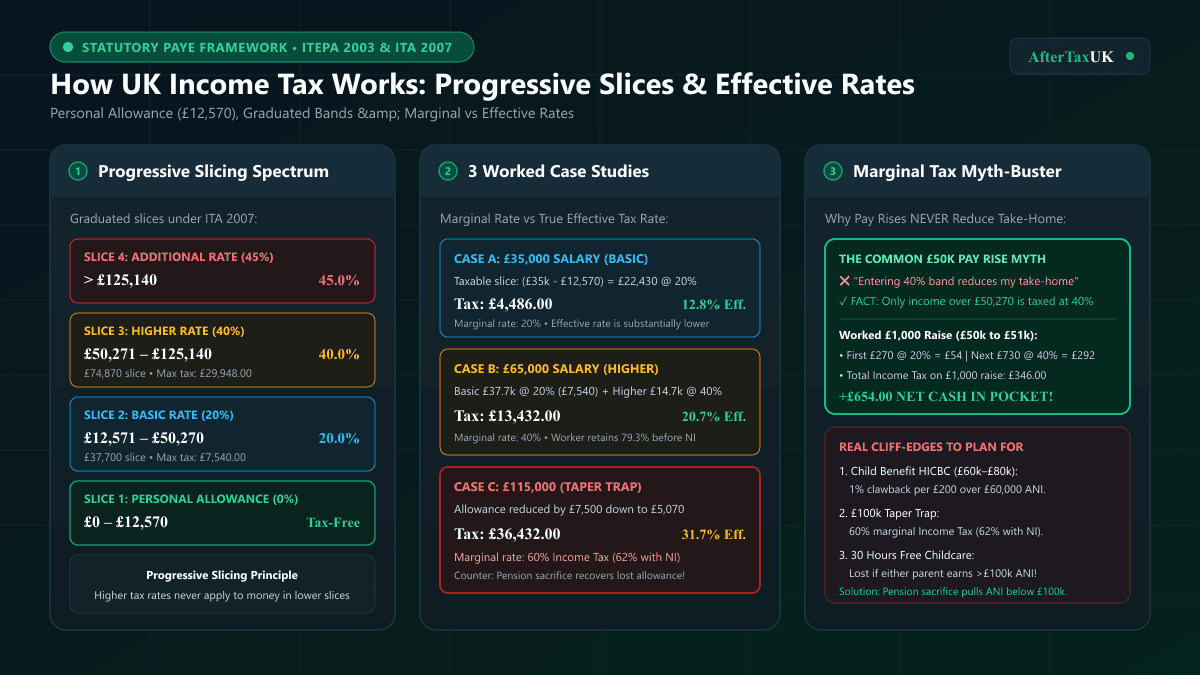
The UK operates a graduated, progressive system: you pay higher percentages only on the portion of income that falls within each progressive band:
| Tax Band | England, Wales & NI | Rate | Scotland (Devolved) | Scottish Rate |
|---|---|---|---|---|
| Personal Allowance | Up to £12,570 | 0% | Up to £12,570 | 0% |
| Starter / Basic Rate | £12,571 to £50,270 | 20% | £12,571 to £16,537 | 19% (Starter) |
| Scottish Basic Rate | — | — | £16,538 to £29,526 | 20% (Basic) |
| Intermediate Rate | — | — | £29,527 to £43,662 | 21% |
| Higher Rate | £50,271 to £125,140 | 40% | £43,663 to £75,000 | 42% |
| Advanced Rate | — | — | £75,001 to £125,140 | 45% |
| Top / Additional Rate | Over £125,140 | 45% | Over £125,140 | 48% |
4. Worked Calculation Models: £35k, £65k & £115k
To demonstrate how income tax bands slice your pay packet in practice, review the worked mathematical deductions across three standard UK salaries:
Case 1: Standard Salary (£35,000)
- First £12,570 @ 0% = £0.00
- Remaining £22,430 (£35,000 - £12,570) @ 20% Basic Rate = £4,486.00
- Monthly Income Tax = £373.83 / mo (Effective tax rate = 12.82%)
Case 2: Higher Rate Salary (£65,000)
- First £12,570 @ 0% = £0.00
- Basic Rate slice (£50,270 - £12,570 = £37,700) @ 20% = £7,540.00
- Higher Rate slice (£65,000 - £50,270 = £14,730) @ 40% = £5,892.00
- Total Income Tax = £13,432.00 / yr (£1,119.33 / mo) (Effective tax rate = 20.66%)
Case 3: Six-Figure Taper Trap Salary (£115,000)
- Adjusted Net Income exceeds £100,000 by £15,000. Under Section 35 ITA 2007, Personal Allowance is reduced by £7,500 down to £5,070.
- Basic Rate slice (£37,700) @ 20% = £7,540.00
- Higher Rate slice (£115,000 - £5,070 PA - £37,700 = £72,230) @ 40% = £28,892.00
- Total Income Tax = £36,432.00 / yr (£3,036.00 / mo) (Effective tax rate = 31.68%)
5. Marginal Tax Rate vs Effective Tax Rate
A common misconception among UK workers is the fear that a pay rise crossing the £50,270 Higher Rate threshold will reduce overall take-home pay because "all my income will be taxed at 40%".
Your marginal tax rate is the percentage deducted from your next pound of earnings. A worker earning £52,000 has a 40% marginal Income Tax rate, but that 40% applies only to the £1,730 above £50,270.
Your effective tax rate is the actual percentage of your total gross salary paid in tax (Total Tax ÷ Gross Income). Because of the £12,570 tax-free allowance and the 20% basic band, the effective rate is always much lower:
| Gross Salary | Annual Income Tax | Marginal Rate | Effective Tax Rate |
|---|---|---|---|
| £25,000 | £2,486.00 | 20% | 9.94% |
| £35,000 | £4,486.00 | 20% | 12.82% |
| £50,270 | £7,540.00 | 20% | 15.00% |
| £75,000 | £17,432.00 | 40% | 23.24% |
| £100,000 | £27,432.00 | 40% | 27.43% |
6. Other Statutory Allowances: Savings, Dividends & Property
In addition to the standard £12,570 Personal Allowance on earned salary, UK tax legislation provides distinct tax-free allowances for savings and investment income:
Personal Savings Allowance (Section 12B ITA 2007)
Basic Rate taxpayers can earn up to £1,000 in bank interest completely tax-free. Higher Rate taxpayers receive £500. Additional Rate taxpayers receive £0.
Dividend Allowance (Section 13A ITA 2007)
The first £500 of dividend income from company shares is tax-free. Above £500, dividends are taxed at 10.75% (Basic), 35.75% (Higher), or 39.35% (Additional).
7. Fiscal Drag: The Multi-Year Threshold Freeze Through 2028
Historically, UK tax bands and the Personal Allowance were index-linked to inflation (measured by the Consumer Prices Index) to protect taxpayers against inflation-driven tax increases. Under recent Finance Acts, HM Treasury froze the statutory Personal Allowance (£12,570) and Higher Rate threshold (£50,270) until at least April 2028.
This policy mechanism is known as fiscal drag(or a "stealth tax"). As workers receive cost-of-living pay rises to keep pace with inflation, their nominal salaries rise while statutory tax thresholds remain stationary. Consequently, millions of middle-income employees—such as senior nurses, experienced teachers, and police sergeants—who were historically basic-rate taxpayers are dragged into the 40% Higher Rate band, dramatically increasing their effective tax burden without any headline rate increases.
8. Statutory Exemptions: What Income Is 100% Tax-Free in the UK?
While UK tax legislation casts a wide net over earned income, primary statutory exemptions shield specific income streams completely from HMRC:
- Individual Savings Accounts (ISAs): Up to £20,000 per adult per tax year can be saved or invested across Cash ISAs and Stocks & Shares ISAs, with tax-free interest, dividends and gains while qualifying investments remain inside the ISA under the Individual Savings Account Regulations 1998 (SI 1998/1870).
- Lottery & Gambling Winnings: UK lottery prizes are generally paid without Income Tax deducted. Tax may apply to later interest or investment income, and other circumstances can differ; see the lottery winnings tax guide.
- Statutory Redundancy Payments: The first £30,000 of qualifying severance or ex-gratia redundancy compensation is completely tax-free under Section 401 of ITEPA 2003.
- Premium Bonds & National Savings:All monthly prize draws won through National Savings and Investments (NS&I) Premium Bonds are 100% tax-exempt.
Frequently Asked Questions About UK Income Tax
Clear answers based on official HMRC rules and statutory guidance.