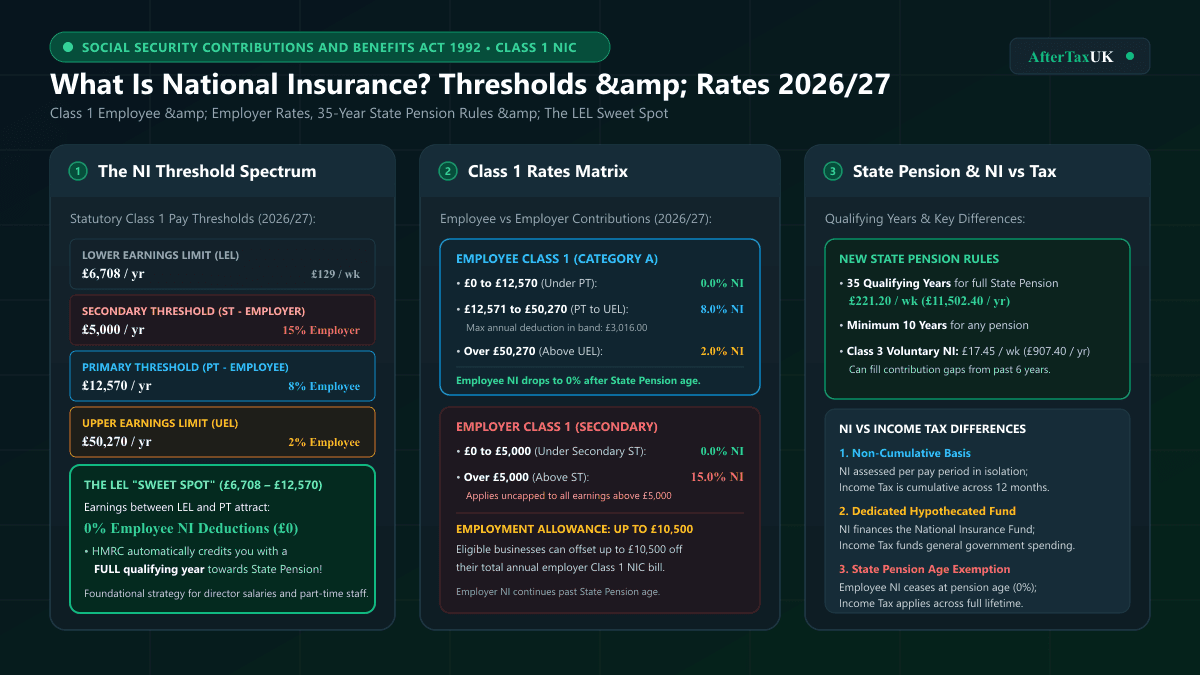
Statutory Framework of UK National Insurance
National Insurance (NI) is a compulsory statutory social insurance levy on earned income governed by the Social Security Contributions and Benefits Act 1992 (SSCBA 1992), the Social Security Administration Act 1992, and the National Insurance Contributions Acts. Originally established under David Lloyd George's landmark National Insurance Act 1911 to create a safety net against sickness and unemployment, modern National Insurance serves two central functions: funding day-to-day statutory state benefits and accumulating individual contributory records.
Unlike general UK Income Tax—which is paid into HM Treasury's Consolidated Fund to finance general public expenditure such as defence, transport, and justice—National Insurance contributions (NICs) are paid into the ring-fenced National Insurance Fund. This dedicated fund directly underwrites the UK contributory benefit system, including the New State Pension, contributory Employment and Support Allowance (new-style ESA), Jobseeker's Allowance (new-style JSA), statutory bereavement support, and provides substantial ring-fenced funding allocations to the National Health Service (NHS).
1. National Insurance vs Income Tax: Key Structural Differences
Many British workers regard National Insurance as simply a second income tax. However, under UK statutory jurisprudence, Income Tax and National Insurance follow completely distinct principles across taxation base, temporal calculation periods, and demographic liabilities:
| Comparison Feature | UK Income Tax (PAYE) | National Insurance (Class 1) |
|---|---|---|
| Taxable Base | All income sources (employment, pensions, interest, property, dividends) | Active employment earnings and self-employed trading profits only |
| Assessment Period | Cumulative across the full tax year (6 April to 5 April) | Non-cumulative per pay period (weekly or monthly basis) |
| Pensioners (State Pension Age) | Liable for income tax on all taxable income above £12,570 | 100% Exempt from employee NI (Category C) |
| Multiple Employments | Personal Allowance shared; second job taxed under BR or 0T | Primary Threshold applies independently to each separate employment |
| Devolved Powers | Devolved to Scottish Parliament (6 non-savings income tax bands) | Reserved power to UK Parliament (strictly identical across England, Scotland, Wales, NI) |
2. Class 1 Employee & Employer Thresholds (2026/27)
Following statutory rate reductions under recent Finance Acts, the main Class 1 employee National Insurance rate stands at 8% on earnings between the Primary Threshold and Upper Earnings Limit, and 2% on all earnings above. Employed workers and their employers face the following statutory thresholds:
| Statutory Threshold | Weekly | Annual Equivalent | Employee Rate (Primary) | Employer Rate (Secondary) |
|---|---|---|---|---|
| Lower Earnings Limit (LEL) | £125 / wk | £6,500 / yr | 0% (Qualifying year credited) | 0% |
| Secondary Threshold (ST) | £96 / wk | £5,000 / yr (£417 / mo) | 0% | 15% (above ST) |
| Primary Threshold (PT) | £242 / wk | £12,570 / yr | 8% (PT to UEL) | 15% |
| Upper Earnings Limit (UEL) | £967 / wk | £50,270 / yr | 2% (above UEL) | 15% |
The Zero-Cost State Pension Sweet Spot (LEL to PT):
Earnings between the Lower Earnings Limit (£6,500 per year or £125 per week) and the Primary Threshold (£12,570 per year or £242 per week) are deemed by law to have paid National Insurance at a rate of 0%. This means a part-time worker earning £10,000 pays zero National Insurance contributions from their pay packet, yet HMRC legally awards them a fully credited qualifying year toward the New State Pension.
3. National Insurance Category Letters Explained
Under Regulation 131 of the Social Security (Contributions) Regulations 2001 (SI 2001/1004), every UK employer must allocate each employee a statutory category letter. This letter determines the exact primary and secondary calculation formula applied by payroll software:
| Category | Workforce Classification | Employee Rate | Employer Rate |
|---|---|---|---|
| Category A | Standard adult employee aged 21 to statutory pension age | 8% / 2% | 15% |
| Category B | Married women and widows holding a valid historic certificate of election | 1.85% / 2% | 15% |
| Category C | Employees who have reached UK statutory State Pension age (currently 66) | 0% (exempt) | 15% |
| Category H | Apprentices on recognized government apprenticeship frameworks aged under 25 | 8% / 2% | 0% up to £50,270 (15% above) |
| Category M | Young employees aged under 21 years of age | 8% / 2% | 0% up to £50,270 (15% above) |
| Category J | Employees with HMRC deferment certificates (paying maximum NI in another job) | 2% / 2% | 15% |
4. Worked National Insurance Deductions Across 5 Salary Benchmarks
To demonstrate how Class 1 employee contributions and employer secondary contributions interact in practical payroll scenarios, the table below details the exact annual and monthly statutory amounts across five benchmark salary levels:
| Gross Salary | Employee NI (Annual) | Employee NI (Monthly) | Employer NI (Annual) | Effective NI Rate |
|---|---|---|---|---|
| £20,000 / yr | £594.40 | £49.53 / mo | £2,250.00 | 2.97% |
| £35,000 / yr | £1,794.40 | £149.53 / mo | £4,500.00 | 5.13% |
| £50,270 / yr | £3,016.00 | £251.33 / mo | £6,790.50 | 6.00% |
| £75,000 / yr | £3,510.60 | £292.55 / mo | £10,500.00 | 4.68% |
| £100,000 / yr | £4,010.60 | £334.22 / mo | £14,250.00 | 4.01% |
Notice the regressive nature of National Insurance: Because the employee marginal rate drops from 8% down to 2% above £50,270, a worker on £100,000 pays an effective NI rate of just 4.01%, compared to 5.13% for someone on £35,000 and 6.00% at the £50,270 peak.
5. Self-Employed Contributions (Class 2 Abolition & Class 4 Rates)
Self-employed sole traders and partners pay National Insurance through annual Self-Assessment returns under Sections 15 to 18 of SSCBA 1992. Recent legislative reforms have significantly restructured these obligations:
Class 4 NI (Profit-Based)
Class 4 is an annual charge assessed on net trade profits after allowable business expenses:
- Profits up to £12,570: 0%
- Profits between £12,570 and £50,270: 6%
- Profits above £50,270: 2%
Class 2 NI (Abolished from April 2024)
The mandatory flat-rate Class 2 contribution (£3.45 per week) was formally abolished by the UK Government. Sole traders with trading profits above the Small Profits Threshold (£6,725) now receive free qualifying pension credits automatically without paying a penny in Class 2 contributions. Those with profits under £6,725 can still choose to pay voluntary Class 2 contributions to protect their record.
6. The 35 Qualifying Years, National Insurance Credits & State Pension
Under the Pensions Act 2014, the UK New State Pension is entirely contributory. Your eligibility and final weekly pension payout depend entirely on the number of qualifying years recorded on your National Insurance record:
How to Earn National Insurance Credits Without Working
If you take time out of the workforce, you do not necessarily lose State Pension entitlement. The UK statutory system awards automatic National Insurance credits under several key circumstances:
- Child Benefit (Children Under 12): A parent or guardian registered for Child Benefit for a child under the age of 12 automatically receives Class 3 credits protecting their State Pension record.
- Carer's Allowance / Carer's Credit:Individuals caring for an ill or disabled person for at least 20 hours per week qualify for Carer's Credit.
- Universal Credit & Jobseeker's Allowance: Claimants actively seeking employment or unfit for work receive Class 1 National Insurance credits automatically each month.
- Statutory Maternity, Paternity & Adoption Pay: Employees receiving statutory parental pay maintain complete qualifying credit continuity during leave.
Plugging Record Gaps with Voluntary Class 3 Contributions
Under Section 13 of SSCBA 1992, individuals who have missing or incomplete years on their record can purchase voluntary Class 3 National Insurance contributions. At the statutory rate of £17.45 per week (£907.40 for a full qualifying year), buying a missing year adds 1/35th of the full State Pension—approximately £328.64 per year in index-linked pension income for life, delivering a remarkably high return on investment.
7. Employer Secondary Contributions & The Employment Allowance
Employers bear a statutory National Insurance obligation that does not appear on employee payslips. For 2026/27, employers generally pay secondary Class 1 contributions at 15%on an employee's earnings above the Secondary Threshold: £96 per week, £417 per month, or £5,000 per year. Special thresholds apply to some employee categories.
The Employment Allowance can reduce an eligible employer's annual employer National Insurance bill by up to £10,500 in 2026/27. The previous £100,000 employer-NI eligibility cap no longer applies. A company cannot claim if its only employee liable for employer National Insurance is its director; other eligibility rules and exclusions still apply. See HMRC's 2026/27 employer rates and thresholds for current figures.
Frequently Asked Questions About National Insurance
Clear answers based on official HMRC rules and statutory guidance.