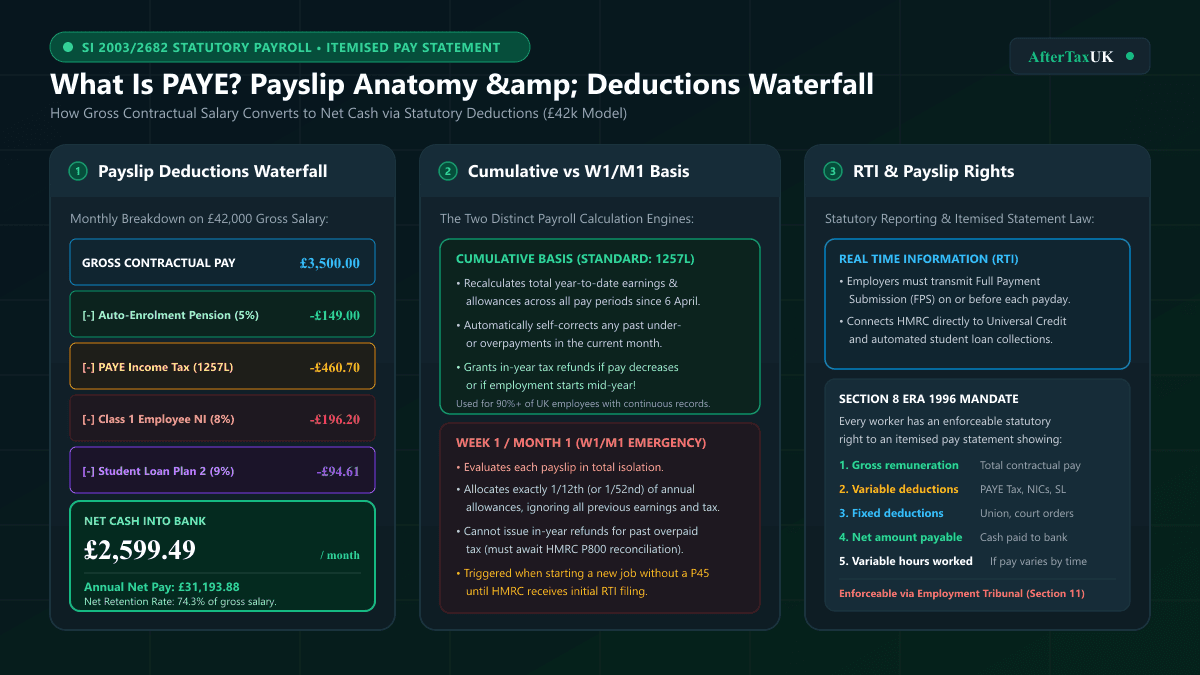
What does PAYE mean on your payslip?
PAYE means Pay As You Earn. It is the system your employer uses to deduct Income Tax from your wages and report your pay to HM Revenue & Customs (HMRC). Your payslip may also list National Insurance, workplace pension contributions, or student-loan repayments as separate deductions; these are not all PAYE Income Tax.
To understand the figures, compare your gross pay, taxable pay, tax code, Income Tax, other deductions, and take-home pay. The amount of tax can change when your pay or tax code changes, or when payroll applies an updated HMRC instruction.
If a deduction looks unexpected, check the tax code on your payslip against your HMRC Personal Tax Account, then ask your employer's payroll team how the payslip was calculated. Read our UK tax-code guide, use the tax-code checker, or estimate deductions with the PAYE calculator.
1. Statutory Authority & History of UK PAYE
PAYE (Pay As You Earn) is the statutory deduction mechanism governed by Part 11 of the Income Tax (Earnings and Pensions) Act 2003 (ITEPA 2003) and The Income Tax (Pay As You Earn) Regulations 2003 (SI 2003/2682). Under these regulations, every employer in England, Scotland, Wales, and Northern Ireland is legally mandated to operate as an unpaid tax collector for HM Revenue & Customs (HMRC), deducting Income Tax and National Insurance contributions directly from employee remuneration at source before net salary is disbursed.
Devised in 1944 during the Second World War by Sir Paul Chambers to finance the British war effort without placing crippling lump-sum annual tax burdens on working citizens, PAYE revolutionized public finance. Today, PAYE accounts for over 70% of all UK Income Tax collected, ensuring smooth, predictable, and automated revenue collection across more than 30 million British workers.
2. Real Time Information (RTI) & Digital Payroll Reporting
Since April 2013, the UK payroll ecosystem has operated under Real Time Information (RTI). Under Regulations 67B and 67E of SI 2003/2682, employers cannot simply submit end-of-year reconciliations. Instead, every employer must file digital returns directly to HMRC's central servers on or before each pay date:
Full Payment Submission (FPS)
Submitted on or before the day employees are paid. Details gross remuneration, statutory tax code, taxable pay to date, Income Tax deducted, employee and employer Class 1 National Insurance, student loan repayments, and pension salary sacrifice figures for every individual on the payroll.
Employer Payment Summary (EPS)
Used to report reductions to employer PAYE liabilities, including recoverable statutory payments. Eligible employers can claim Employment Allowance of up to £10,500 in 2026/27. Check the current HMRC rates and thresholds and reporting deadlines for your payroll.
Under Schedule 55 of the Finance Act 2009, failure to submit timely Full Payment Submissions triggers automated statutory penalties ranging from £100 to £400 per month depending on workforce headcount.
3. Cumulative vs Non-Cumulative (W1/M1) Calculation Mechanics
The defining genius of the UK PAYE system is its cumulative tax calculation mechanism. By law, the tax year (6 April to 5 April) is divided into 12 monthly or 52 weekly pay periods:
How the Cumulative Rule Protects Workers
In Month 1 (April), you receive 1/12th of your Personal Allowance (£1,047.50). In Month 6 (September), payroll evaluates your cumulative gross pay over the past six months against 6/12ths of your annual Personal Allowance (£6,285.00) and 6/12ths of the Basic Rate tax band (£18,850.00). It calculates total tax due from 6 April to date, subtracts the cumulative tax you already paid in Months 1 through 5, and deducts only the difference.
Non-Cumulative (Week 1 / Month 1) Emergency Basis
When you commence a new employment without presenting a valid Form P45, HMRC instructs your employer to operate an emergency tax code suffixed with W1, M1, or X(e.g. `1257L W1`). Under this emergency basis, payroll calculates tax purely in isolation on that single pay packet, assuming your annual income is exactly 12 times that month's pay. It cannot backdate unused allowances, often causing temporary over-taxation until HMRC issues an updated cumulative coding notice.
4. Payslip Deductions Waterfall: Worked Salary Breakdown
Under Section 8 of the Employment Rights Act 1996 (ERA 1996), every UK worker has an enforceable statutory right to an itemised pay statement. The following table is an annualised estimate of monthly deductions for an employee earning £42,000 per year (£3,500.00 gross per month) on standard tax code 1257L with a Plan 2 student loan and a net-pay pension contribution of 5% of qualifying earnings (£6,240–£50,270). It assumes England, Wales or Northern Ireland and regular pay. Actual payroll rounding and pay-period thresholds can differ:
| Payslip Line Item | Statutory Basis | Monthly Amount | Annual Equivalent |
|---|---|---|---|
| Gross Contractual Salary | Contract of Employment | £3,500.00 | £42,000.00 |
| Workplace Pension (5% qualifying) | Pensions Act 2008 Auto-Enrolment | -£149.00 | -£1,788.00 |
| PAYE Income Tax (Basic Rate 20%) | ITEPA 2003 / ITA 2007 (Code 1257L) | -£460.70 | -£5,528.40 |
| National Insurance (Class 1 @ 8%) | SSCBA 1992 (PT £1,047.50/mo) | -£196.20 | -£2,354.40 |
| Student Loan (Plan 2 @ 9%) | Teaching & Higher Education Act 1998 | -£94.61 | -£1,135.35 |
| Net Take-Home Pay | Paid to Employee Bank Account | £2,599.49 | £31,193.85 |
5. Statutory PAYE Documents: P45, P60 & Form P11D
Throughout your UK employment career, three primary statutory tax documents govern your administrative relationship with HMRC under SI 2003/2682:
Issued immediately upon termination of employment. Contains 4 parts: Part 1 is electronically transmitted to HMRC via RTI; Part 1A is retained by you; Parts 2 & 3 must be delivered to your new employer to prevent emergency W1/M1 taxation.
Statutory certificate provided by employers to every worker employed on 5 April. Must be delivered by 31 May. Documents total taxable pay, tax deducted, and final tax code. Crucial for mortgage applications and loan verification.
Filed by 6 July for employees receiving non-cash perks (company cars, private health cover, interest-free director loans). Details cash equivalent values and determines employer Class 1A National Insurance obligations.
The Future of PAYE: Mandatory Payrolling of Benefits in Kind (PBIK)
Historically, employers reported taxable employee perks (such as private health cover or company cars) annually on paper Form P11D, causing HMRC to adjust the employee's tax code the following year to claw back the tax. HMRC is transitioning all UK employers to statutory Payrolling of Benefits in Kind (PBIK) under Regulation 61A of SI 2003/2682. Under PBIK, the cash equivalent value of benefits is divided by the number of pay periods and taxed in real time through regular monthly payroll, eliminating delayed tax code changes and surprise end-of-year tax debts.
6. Tax Code Prefixes and Suffixes Decoded
Your PAYE tax code translates your statutory personal allowance and circumstance adjustments into an actionable formula for payroll software:
| Code Format | Tax Meaning | Workplace Scenario |
|---|---|---|
| 1257L | Standard £12,570 tax-free Personal Allowance | Standard single-job employed worker |
| BR | Flat 20% Basic Rate deduction with 0% allowance | Second job or pension where primary allowance is used |
| D0 / D1 | Flat 40% (D0) or 45% (D1) deduction | Second employments for higher or additional rate earners |
| 0T | Zero personal allowance; banded progressive rates | Personal Allowance fully depleted or unallocated |
| K Codes (e.g. K450) | Negative allowance; increases taxable pay | Company car BIK or historic tax debt exceeding £12,570 |
| S or C Prefix | Scottish (S) or Welsh (C) devolved rates apply | Resident taxpayers in Scotland or Wales |
7. Resolving Overdeductions: P800 Calculations & HMRC Repayments
If your tax code or reported earnings look wrong, check your payslips and HMRC record. HMRC may issue a P800 tax calculation or another notice after checking your position. An unexpected deduction does not by itself prove an overpayment.
Follow the instructions on your notice and use the current GOV.UK guidance on tax overpayments and underpayments. Repayment methods and processing times vary; this guide cannot confirm an amount or completion date.
Frequently Asked Questions About PAYE
Clear answers based on official HMRC rules and statutory guidance.