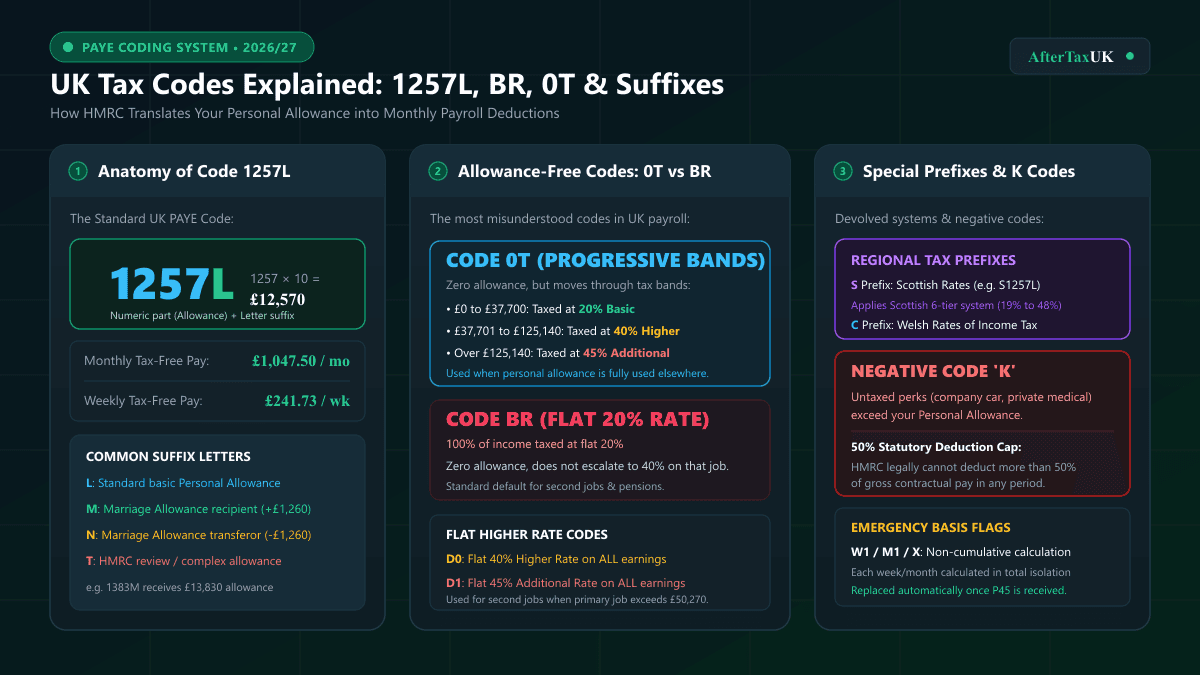
Key Takeaways: Reading Your 2026/27 Payslip Code
- 1257L is the standard tax code for 2026/27, granting the statutory £12,570 tax-free Personal Allowance.
- Tax codes only control Income Tax. They do not dictate Class 1 National Insurance contributions, which are calculated independently per pay period.
- BR taxes all earnings at a flat 20%, whereas 0T applies no Personal Allowance but runs income through standard progressive tax bands (20%, 40%, 45%).
- K codes indicate negative allowances—where taxable perks or prior underpayments exceed your Personal Allowance.
- Emergency codes (W1, M1, X) calculate tax on an isolated pay-period basis, which payroll recalculates once your full tax record arrives.
The 3-Step Methodology: How to Read Any UK Tax Code
Every tax code on a UK payslip follows a statutory structural formula governed by Section 62 of the Income Tax (Earnings and Pensions) Act 2003 (ITEPA 2003). You can decode virtually any alphanumeric code in three straightforward steps:
The Numbers (Allowance)
Multiply the digits by 10 to see your annual tax-free Personal Allowance. For example, 1257 means £12,570 of earnings before Income Tax is applied. A code of 800L indicates an allowance of £8,000.
The Suffix Letter
The trailing letter modifies how your allowance is applied. L grants basic entitlement, M or N reflect Marriage Allowance transfers, and T means your code includes complex manual calculations.
Prefixes & Markers
Prefixes define jurisdiction or debt: S for Scottish tax rates, C for Welsh, and K for negative allowances. Suffixes like W1, M1, or X denote emergency non-cumulative status.
Master UK Tax Code Lookup Table (2026/27)
The table below outlines the statutory meaning, tax-free allowance allocation, and common scenarios for all standard UK PAYE tax codes in operation for the 2026/27 tax year:
| Tax Code | Personal Allowance | Statutory Meaning | Common Circumstance |
|---|---|---|---|
| 1257L | £12,570 | Standard UK statutory tax-free Personal Allowance. | Single employment or main income source with no untaxed benefits. |
| BR | £0 | Basic Rate: flat 20% Income Tax deducted on all earnings. | Second job or pension where Personal Allowance is fully used elsewhere. |
| 0T | £0 | Zero allowance, but earnings are taxed progressively (20%, 40%, 45%). | Starting a new job without a P45, or income exceeds £125,140 taper limit. |
| K Codes (e.g. K500) | Negative (£5,000 deemed) | Untaxed benefits exceed allowance; number x 10 is added to taxable pay. | Substantial company car BIK, private medical benefits, or underpaid tax. |
| D0 | £0 | Higher Rate: flat 40% Income Tax deducted on all income. | Second job or pension where total earnings exceed £50,270. |
| D1 | £0 | Additional Rate: flat 45% Income Tax deducted on all income. | Secondary income source when main earnings exceed £125,140. |
| M / N | £13,830 / £11,310 | Marriage Allowance transferred under Section 55A ITA 2007. | M = partner receiving 10% allowance (£1,260); N = partner transferring it. |
| S Prefix (e.g. S1257L) | £12,570 | Scottish Income Tax bands applied (19%, 20%, 21%, 42%, 45%, 48%). | Taxpayers whose principal home is in Scotland. |
| C Prefix (e.g. C1257L) | £12,570 | Welsh Income Tax bands (currently aligned with England & NI rates). | Taxpayers whose principal home is in Wales. |
| W1 / M1 / X | Non-cumulative | Emergency non-cumulative marker; tax calculated per pay period in isolation. | New job with missing previous pay history or mid-year tax code revision. |
| NT | Exempt | No tax is deducted from this specific income source. | Certain overseas earnings, bankruptcies, or statutory exemptions. |
Worked Payslip Comparison: £35,000 Under 1257L vs BR vs 0T
To see how much your tax code genuinely impacts your take-home pay, let us examine an employee earning the UK median salary of £35,000 per year (£2,916.67 gross per month) in England during the 2026/27 tax year.
| Deduction Metric | Standard: 1257L | Second Job: BR | Emergency / No P45: 0T |
|---|---|---|---|
| Gross Annual Salary | £35,000.00 | £35,000.00 | £35,000.00 |
| Personal Allowance | £12,570.00 | £0.00 | £0.00 |
| Taxable Pay | £22,430.00 | £35,000.00 | £35,000.00 |
| Annual Income Tax | £4,486.00 | £7,000.00 | £7,000.00 |
| Class 1 National Insurance | £1,794.40 | £1,794.40 | £1,794.40 |
| Total Annual Deductions | £6,280.40 | £8,794.40 | £8,794.40 |
| Net Annual Take-Home | £28,719.60 | £26,205.60 | £26,205.60 |
| Net Monthly Take-Home | £2,393.30 | £2,183.80 | £2,183.80 |
Why is National Insurance Identical Across All Three Codes?
Notice that Class 1 National Insurance remains strictly £1,794.40 (£149.53/month) under all three codes. National Insurance is governed by the Social Security Contributions and Benefits Act 1992 (SSCBA 1992). It operates on its own statutory primary threshold (£12,570) and is completely unaffected by your PAYE tax code.
The £209.50 Monthly Difference: Under code BR or 0T, you pay an extra £2,514.00 per year (£209.50 every month) in Income Tax because no Personal Allowance is allocated. While this is mathematically correct if your £12,570 allowance is already allocated to another job, receiving BR or 0T on your sole employment represents a substantial temporary cash-flow penalty that requires immediate HMRC correction.
Crucial Distinction between BR and 0T Above £37,700: At £35,000, both codes produce identical £7,000 tax bills. However, if your salary rises to £55,000, code 0T will tax earnings above £37,700 at the 40% Higher Rate band. Code BR will continue deducting a flat 20% on all earnings, creating an unexpected year-end underpayment debt with HMRC.
Emergency Tax Codes: W1, M1, and Non-Cumulative Payroll
An emergency tax code occurs when HMRC does not possess sufficient information about your prior earnings in the current tax year. This typically happens when you start a new role without providing a P45 from your previous employer, or when transitioning from self-employment to PAYE.
Emergency codes are indicated by W1 (for weekly pay), M1 (for monthly pay), or X (non-cumulative marker). In standard cumulative PAYE, your tax liability is calculated on your total year-to-date earnings and allowances since 6 April. Under an emergency non-cumulative basis:
- Payroll treats each pay cycle in complete isolation, as if it were the first pay period of the tax year.
- You receive exactly 1/12th of the Personal Allowance (£1,047.50) if paid monthly, or 1/52nd (£241.73) if paid weekly.
- Any unused Personal Allowance from months you were unemployed earlier in the tax year is ignored.
Once HMRC receives your P45 or starter declaration, they issue a cumulative tax code notice to your employer. On your next payslip, payroll will automatically recalculate your tax from 6 April to date and refund any overpayment directly into your bank account.
K Codes and Negative Personal Allowances
A K codeis effectively a "negative tax allowance". It is assigned when your untaxed income or taxable employer-provided benefits in kind exceed your annual Personal Allowance of £12,570.
For example, if you earn £60,000 and receive a company car with a Benefit-in-Kind (BIK) value of £16,570, your benefits exceed your £12,570 allowance by £4,000. HMRC will issue code K400. Your employer multiplies 400 by 10 (£4,000) and adds this amount to your taxable earnings, deducting tax on £64,000 rather than £60,000.
How to Fix an Incorrect Tax Code with HMRC
If you suspect your payslip displays the wrong tax code, do not wait for the tax year to end. You can resolve coding discrepancies directly through HMRC using official channels:
- Check your HMRC Personal Tax Account:Log into GOV.UK using your Government Gateway ID or the HMRC mobile app. Under "Pay As You Earn (PAYE)", you can view your current coding notice, active employers, and estimated annual income.
- Update Your Employment Details: If an old employer is still listed as active, or if your estimated earnings are incorrect, submit updated details online. You can also reallocate your £12,570 Personal Allowance across multiple employers.
- Contact HMRC by Telephone: If your situation involves complex company benefits or earlier year underpayments, phone HMRC on 0300 200 3300 (have your National Insurance number and latest payslip to hand).
- Automatic Employer Notification: Once resolved, HMRC will issue an electronic P6 (in-year) or P9(annual) coding notice directly to your employer's payroll software. Your employer cannot manually change your tax code without HMRC instruction.
Verify Your Tax Code on Our Interactive Calculator
Want to see the exact penny impact of changing your tax code from 1257L to BR, 0T, or a custom K code? Use our free 2026/27 Tax Code Checker to simulate single-payslip and annual take-home pay.
Frequently Asked Questions About UK Tax Codes
Frequently Asked Questions
Clear answers based on official HMRC rules and statutory guidance.
Primary Statutory Authorities & Official References
All statutory thresholds, tax bands, and payroll formulas in this guide adhere to the latest HMRC guidance and UK legislation:
- GOV.UK: Tax Codes Explained • Official HMRC Guidance
- GOV.UK: Emergency Tax Codes • Non-Cumulative W1 and M1 Rules
- GOV.UK: Claim an HMRC Tax Refund • P800 Tax Calculation
- Income Tax (Earnings and Pensions) Act 2003 (ITEPA 2003):Section 62 (PAYE Regulations & Coding).
- Income Tax Act 2007 (ITA 2007): Section 35 (Personal Allowance) and Section 55A (Transferable Tax Allowance for Married Couples).