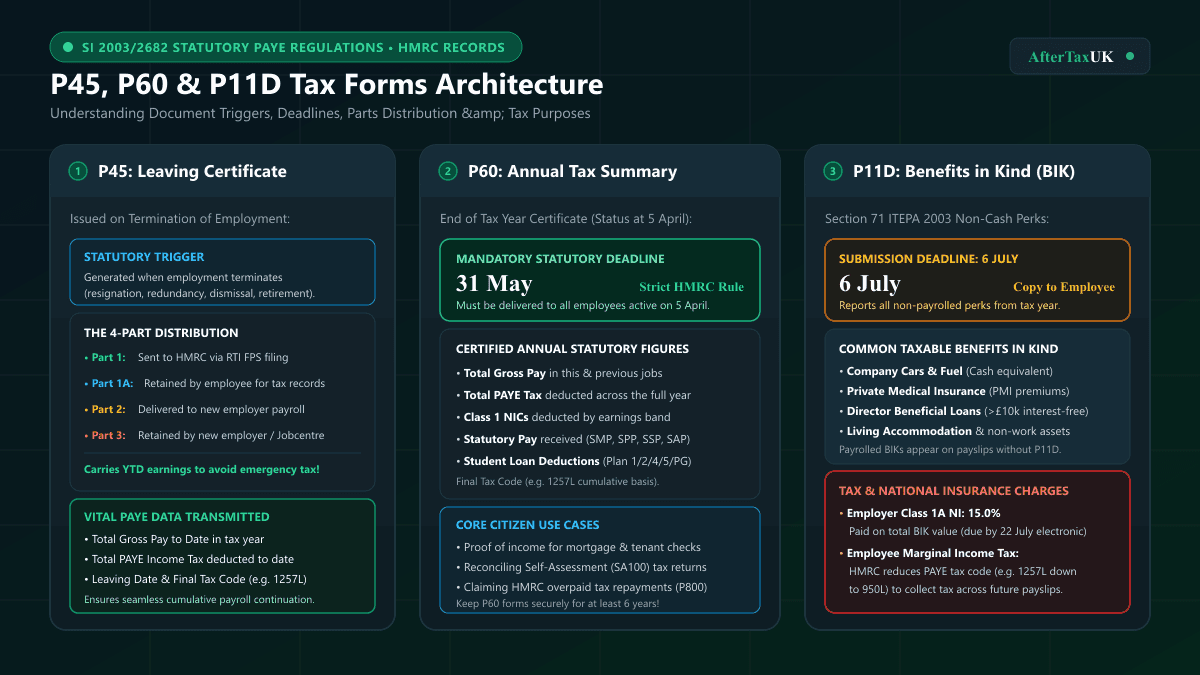
P45: leaving a job
Your employer should give you a P45 when you leave. It records relevant pay, tax and the code used. Give the required information to the next employer so the starting payroll position can be established correctly.
If a P45 is unavailable, follow the starter-checklist process rather than inventing figures. Keep payslips and check HMRC’s employment records. A missing P45 can affect the initial PAYE treatment, but it does not by itself establish a refund.
P60: the year-end employment record
If you are working for an employer on 5 April, that employer should normally provide a P60 by 31 May following the end of the tax year. It summarises relevant pay and deductions. A person with several year-end employments may receive several P60s.
For 2026/27, the tax year ends on 5 April 2027 and the corresponding normal P60 deadline is 31 May 2027. Check the document against payslips and retain it as evidence of employment income; other income may need separate records.
P11D: benefits are separate from cash pay
Where a P11D is required, it reports relevant expenses or benefits such as certain company cars or private medical cover. It is normally supplied by 6 July after the tax year. Benefits reported through payroll may be handled differently; ask the employer what has been payrolled.
A P11D value is not automatically a cash tax bill. The taxable benefit affects the tax calculation under the applicable rules. Employer Class 1A NI is separate from the employee’s Income Tax charge. Check the arrangement and current reporting guidance.
Using the forms to check your tax
Compare the tax year, employer details, pay, tax and benefits with your payslips and Personal Tax Account. Ask the employer to correct document errors and use HMRC’s current process where recorded income or tax codes are wrong.
These forms can support a Self Assessment return or a repayment enquiry, but they do not establish every reporting requirement. Keep additional records for dividends, interest, pensions, property and self-employment where relevant. Do not assume all future benefit-reporting changes have already taken effect.
Explore the next step
Check the tool's supported scenario and assumptions before using its estimate.
Explore a tax-code estimateFrequently asked questions
Frequently Asked Questions
Clear answers based on official HMRC rules and statutory guidance.
Sources and further checks
Check the source that applies to your circumstances and effective period. Official guidance can change.