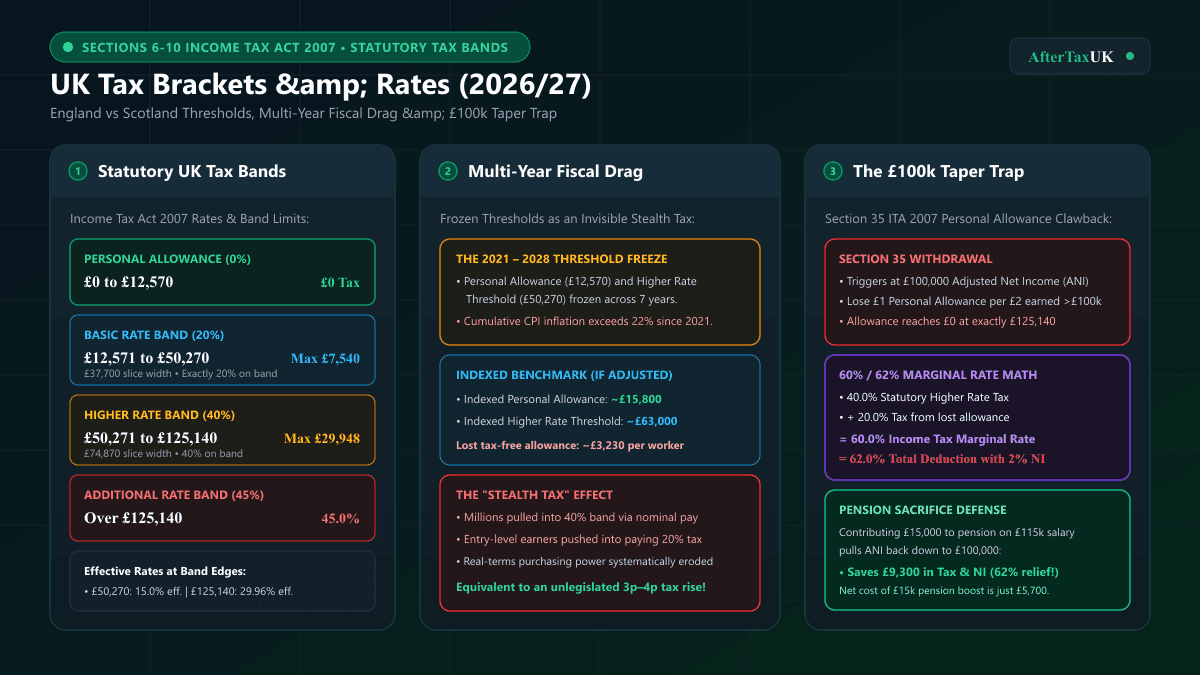
Statutory Architecture: Tax Bands vs Tax Brackets
Under the UK tax system, individual earnings are assessed using progressive marginal tiers. While colloquial language and search engines frequently refer to these tiers as tax brackets, HM Revenue & Customs (HMRC) and primary legislation—principally the Income Tax Act 2007 (ITA 2007) and the Income Tax (Earnings and Pensions) Act 2003 (ITEPA 2003)—statutorily define them as tax bands.
The UK operates on a progressive taxation principle: entering a higher tax band does not mean your entire salary is taxed at that higher rate. Only earnings that fall within that specific band boundary are subject to the corresponding marginal rate. Your first £12,570 remains entirely tax-free under the standard statutory Personal Allowance (Tax Code 1257L), unless reduced by high-income tapering.
Interactive Tax Band Comparison (2026/27)
Toggle between the Rest of UK 3-tier structure and Scotland's devolved 6-tier system, or test any gross salary to compare the exact income tax difference.
UK Tax Bands: England/Wales/NI vs Scotland
Interactive comparison of the 3-tier Rest of UK system and Scotland's devolved 6-tier system.
| Tax Band | Taxable Income Range | Marginal Rate | Max Tax in Band |
|---|---|---|---|
| Personal Allowance | £0 to £12,570 | 0% | £0.00 |
| Basic Rate | £12,571 to £50,270 | 20% | £7,540.00 |
| Higher Rate | £50,271 to £125,140 | 40% | £29,948.00 |
| Additional Rate | Over £125,140 | 45% | Uncapped |
1. England, Wales & Northern Ireland Income Tax Bands (2026/27)
For the 2026/27 tax year (running from 6 April 2026 to 5 April 2027), non-savings employment income for residents in England, Wales, and Northern Ireland is taxed across three primary bands established under Section 6 of the Income Tax Act 2007:
| Statutory Tax Band | Taxable Income Threshold | Marginal Rate | Maximum Tax in Band |
|---|---|---|---|
| Personal Allowance | £0 to £12,570 | 0% | £0.00 |
| Basic Rate Band | £12,571 to £50,270 | 20% | £7,540.00 |
| Higher Rate Band | £50,271 to £125,140 | 40% | £29,948.00 |
| Additional Rate Band | Over £125,140 | 45% | No upper cap |
Fiscal Drag & Threshold Freezes:
The Basic Rate limit (£37,700 of taxable income above the Personal Allowance) and the Higher Rate threshold (£50,270 gross pay) remain legally frozen under Finance Act provisions through April 2028. According to the Office for Budget Responsibility (OBR), this threshold freeze brings millions of UK workers into the 40% Higher Rate band despite modest nominal wage growth.
2. Scottish Devolved Income Tax Bands (2026/27)
Under powers devolved by the Scotland Act 2016, the Scottish Parliament sets independent income tax rates and band thresholds for Scottish taxpayers (identified by an S prefix on payslip tax codes, such as S1257L). Scotland maintains a 6-tier progressive income tax framework:
| Scottish Band | Taxable Income Range | Marginal Rate | Maximum Tax |
|---|---|---|---|
| Personal Allowance | Up to £12,570 | 0% | £0.00 |
| Starter Rate | £12,571 to £16,537 | 19% | £753.73 |
| Scottish Basic Rate | £16,538 to £29,526 | 20% | £2,597.80 |
| Intermediate Rate | £29,527 to £43,662 | 21% | £2,968.56 |
| Higher Rate | £43,663 to £75,000 | 42% | £13,161.96 |
| Advanced Rate | £75,001 to £125,140 | 45% | £28,219.50 |
| Top Rate | Over £125,140 | 48% | No upper cap |
The Scottish Tipping Point (£33,493): Scottish residents earning below £33,493 pay slightly less tax than their English counterparts due to the 19% Starter Rate. However, those earning above £33,493 pay progressively higher income tax in Scotland, facing a 42% Higher Rate starting at £43,663 (compared to 40% at £50,271 in England).
The £100,000 Taper Trap: Effective 60% Marginal Rate
How high earners lose £1 of tax-free allowance for every £2 earned over £100,000, creating the UK's steepest marginal tax spike.
At £125,140 Adjusted Net Income, the entire £12,570 statutory Personal Allowance is completely wiped out.
On every £100 earned over £100k, HMRC collects £40 in standard Higher Rate Income Tax.
You also lose £50 of tax-free allowance, exposing an extra £50 to 40% tax = £20 extra tax.
Class 1 employee NI adds 2% above the UEL, taking your combined marginal deduction to 62% (69.5% in Scotland).
Crossing £100,000 Adjusted Net Income by just £1 triggers the immediate and total cancellation of Tax-Free Childcare (worth up to £2,000 per child per year) and the 30 hours free childcare scheme for 3 and 4-year-olds. For a family with two pre-school children, earning £100,001 can instantly leave them over £10,000 per year worse off in net living standards.
Contributing bonus or salary into an eligible registered workplace pension or SIPP reduces Adjusted Net Income (ANI) pound-for-pound. A £10,000 pension contribution made between £100k and £110k recovers £5,000 of Personal Allowance and saves up to £6,200 in tax and NI—meaning a £10,000 pension boost costs only £3,800 in take-home pay, an effective relief rate of 62%.
4. High Income Child Benefit Charge & Student Loan Deductions
Income tax bands do not operate in isolation. In the modern UK tax architecture, two other statutory levies interlock directly with marginal income bands:
High Income Child Benefit Charge (HICBC) — £60,000 to £80,000
Under Sections 681B–681H of ITEPA 2003 (reformed under Finance Acts), the threshold where Child Benefit is clawed back stands at £60,000. Between £60,000 and £80,000, 1% of the total Child Benefit received is repaid via Self-Assessment for every £200 of Adjusted Net Income over £60k. The additional effective deduction depends on the Child Benefit actually received and the number of eligible children. The charge may be paid through PAYE where HMRC permits or through Self Assessment; check current HMRC instructions.
Student Loan Repayments (Plan 1, 2, 4, 5 & Postgraduate)
Graduates repay 9% of earnings above statutory plan thresholds (e.g. Plan 2: £29,385, Plan 5: £25,000) and 6% for Postgraduate loans (above £21,000). For an employee in the 40% Higher Rate tax band who also holds Plan 2 and Postgraduate student loans, their marginal deduction rate reaches a staggering 57% (40% Income Tax + 2% NI + 9% Plan 2 + 6% Postgrad). Inside the £100k taper zone, this marginal deduction peaks at 77%.
5. Class 1 National Insurance Contributions (NICs)
National Insurance is levied on gross employment earnings under the Social Security Contributions and Benefits Act 1992 (SSCBA 1992). Unlike Income Tax, which is assessed on an annual cumulative basis, Class 1 employee NI is calculated on each discrete pay period (weekly or monthly):
| Threshold | Annual Level | Monthly Level | Employee Rate |
|---|---|---|---|
| Lower Earnings Limit (LEL) | £6,500 / yr | £542 / mo | 0% (Builds State Pension credits) |
| Primary Threshold (PT) | £12,570 / yr | £1,048 / mo | 8% (PT to UEL) |
| Upper Earnings Limit (UEL) | £50,270 / yr | £4,189 / mo | 2% (Earnings above UEL) |
6. Worked Payslip Models Across Common UK Salaries
The table below models total statutory deductions for a standard full-time employee residing in England, Wales, or Northern Ireland on Tax Code 1257L with no student loan or pension deductions:
| Gross Salary | Income Tax | National Insurance | Total Deductions | Net Annual Pay | Effective Tax Rate |
|---|---|---|---|---|---|
| £25,000 | £2,486.00 | £994.40 | £3,480.40 | £21,519.60 | 13.92% |
| £45,000 | £6,486.00 | £2,594.40 | £9,080.40 | £35,919.60 | 20.18% |
| £75,000 | £17,432.00 | £3,510.60 | £20,942.60 | £54,057.40 | 27.92% |
| £105,000 | £30,432.00 | £4,110.60 | £34,542.60 | £70,457.40 | 32.90% |
| £130,000 | £44,703.00 | £4,610.60 | £49,313.60 | £80,686.40 | 37.93% |
7. Statutory Tax Reliefs & Planning Strategies
Salary Sacrifice Pension
An eligible pension salary-sacrifice arrangement reduces contractual cash pay and may save Income Tax and employee NI. The amount depends on which bands the contribution crosses, allowance tapering, minimum-wage protections and pension limits.
Marriage Allowance (Sec 55A ITA 2007)
Transfer up to £1,260 of unused Personal Allowance from a non-taxpaying spouse to a Basic Rate taxpayer, generating an annual tax rebate of up to £252.
Personal Savings Allowance (PSA)
Basic Rate taxpayers earn £1,000 in bank interest tax-free; Higher Rate taxpayers receive £500; Additional Rate taxpayers receive £0 tax-free savings allowance.
Trading Allowance
The trading allowance may cover up to £1,000 of gross trading income per tax year, subject to eligibility and exceptions. Other circumstances or a notice from HMRC can still require a tax return; check GOV.UK guidance before deciding whether to register.
Frequently Asked Questions About UK Tax Brackets
Clear answers based on official HMRC rules and statutory guidance.