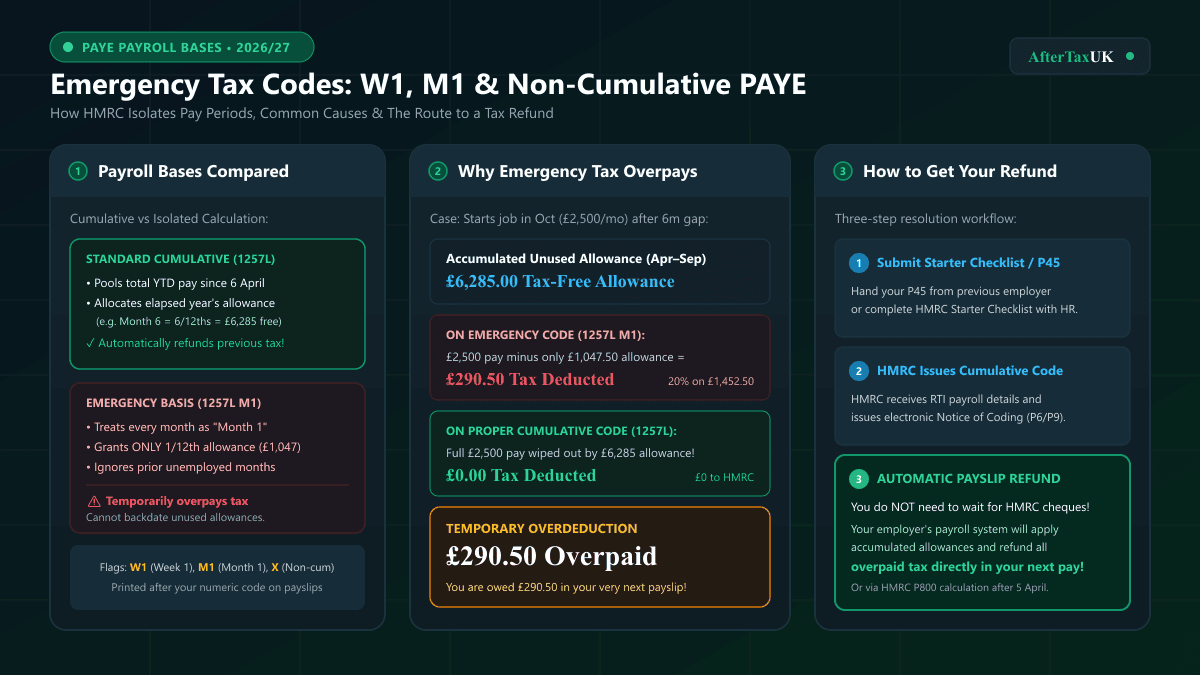
Why the first payslip can look different
A new employer may initially lack the information needed for the appropriate cumulative code. Your P45 or starter declaration helps establish the starting payroll position, while HMRC can issue updated instructions after receiving information.
Check both the code and its basis on your payslip. 1257L M1 and cumulative 1257L need not produce the same deduction for somebody with earlier income. BR and 0T have separate meanings; neither should be casually described as equivalent to W1 or M1.
What a comparison can show
A calculator can compare one pay period under clearly stated assumptions, such as no allowance versus a standard allowance. It cannot infer the final annual tax liability without all relevant income, allowances, tax paid and year-to-date information.
For example, somebody who had months without earnings before a new job may be due an adjustment when cumulative information is used. Someone with another taxable source may have a different outcome. Do not treat every difference from a 1257L scenario as recoverable money.
How to check or update your details
Compare the latest payslip with your Personal Tax Account and check that employments, pensions, estimated earnings and benefits are recorded correctly. Give the employer a P45 when available and complete the requested starter information accurately.
Use HMRC’s current online process or contact instructions if details are wrong. Ask payroll whether it has applied the latest code notice. Processing and payroll timing vary; there is no universal promise of a corrected code or repayment within a fixed number of days.
Refunds and reconciliation
A correction can sometimes be reflected in later payroll deductions, or HMRC may reconcile the year after it ends. Other refund routes depend on the reason for overpayment, such as leaving work or receiving pension income.
Follow the GOV.UK refund guidance for your circumstances and retain relevant records. Avoid submitting duplicate claims or assuming a calculator result is an HMRC decision. HMRC will not establish a repayment solely from the name of a tax code.
Explore the next step
Check the tool's supported scenario and assumptions before using its estimate.
Compare a single-pay-period estimateFrequently asked questions
Frequently Asked Questions
Clear answers based on official HMRC rules and statutory guidance.
Sources and further checks
Check the source that applies to your circumstances and effective period. Official guidance can change.