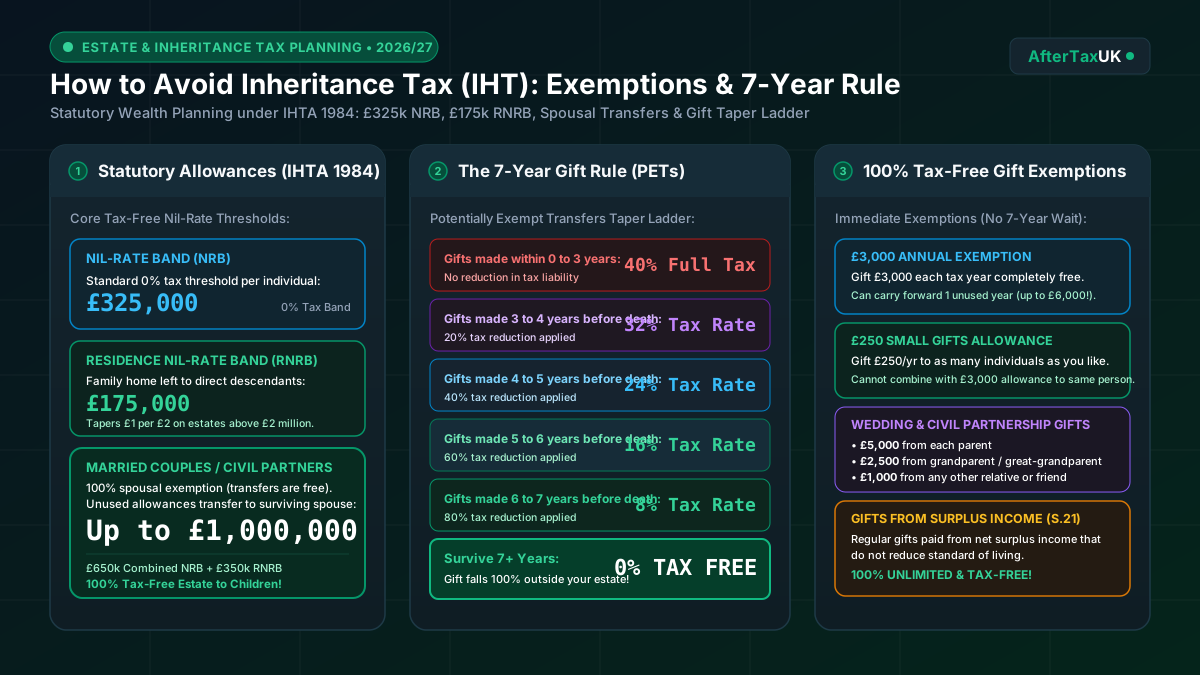
1. Understanding the Core Inheritance Tax Allowances
Inheritance Tax is not paid on every estate. It applies strictly to the net value of worldwide assets (property, cash, investments, vehicles, and personal possessions minus qualifying debts and funeral costs) that exceeds your statutory nil-rate thresholds:
| Statutory Allowance | Individual Limit | Married / Civil Partners |
|---|---|---|
| Nil-Rate Band (NRB) | £325,000 | £650,000 (Transferred) |
| Residence Nil-Rate Band (RNRB) | £175,000 | £350,000 (Transferred) |
| Total Tax-Free Estate | Up to £500,000 | Up to £1,000,000 |
The 100% Spousal Exemption (Section 18 IHTA 1984)
Under UK law, transfers of assets between legally married spouses or registered civil partners who are UK domiciled are 100% exempt from Inheritance Tax, regardless of size.
Furthermore, under Section 8A IHTA 1984, any unused percentage of the first spouse's Nil-Rate Band and Residence Nil-Rate Band transfers automatically to the surviving spouse on death. This allows a surviving spouse to shield up to £1,000,000 of family wealth when passing assets to children or grandchildren.
Residence Nil-Rate Band Taper Above £2 Million
The £175,000 Residence Nil-Rate Band is subject to a statutory taper test under Section 8D IHTA 1984. If the net value of an estate exceeds £2,000,000, the RNRB is withdrawn by £1 for every £2 of estate value above £2m, disappearing entirely on estates worth £2.35 million or more (£2.7m for a married couple).
2. The 7-Year Rule: Potentially Exempt Transfers (PETs)
One of the most effective methods to legally eliminate Inheritance Tax is gifting capital assets during your lifetime. Under Section 3A of the Inheritance Tax Act 1984, gifts to individuals are designated as Potentially Exempt Transfers (PETs):
- Survive 7 Full Years: If you live for 7 years from the date of the gift, the entire gift becomes 100% tax-free and is completely excluded from your estate calculation.
- Death Within 7 Years: If you die within 7 years of making the gift, it is pulled back into your estate for tax assessment.
How Taper Relief Reduces Tax on Gifts
If you pass away within 7 years and the total gifts made exceed the £325,000 Nil-Rate Band, taper relief reduces the 40% tax rate payable on the excess gifts according to a statutory graduated ladder:
| Time Between Gift & Death | Tax Reduction Applied | Effective IHT Tax Rate |
|---|---|---|
| 0 to 3 years | 0% (Nil) | 40% (Full Rate) |
| 3 to 4 years | 20% reduction | 32% |
| 4 to 5 years | 40% reduction | 24% |
| 5 to 6 years | 60% reduction | 16% |
| 6 to 7 years | 80% reduction | 8% |
| 7 or more years | 100% Exempt | 0% (Completely Free) |
3. Immediate Statutory Gift Exemptions (No 7-Year Wait)
HMRC grants several statutory gift exemptions that fall outside your estate immediately with zero tax and no requirement to survive 7 years:
£3,000 Annual Exemption
You can gift up to £3,000 each tax year to one person or split among multiple people. Any unused exemption can carry forward for exactly one tax year (enabling up to £6,000). A married couple can give away £6,000 annually (£12,000 with carry-forward).
£250 Small Gifts Allowance
You can gift up to £250 per tax year to as many individuals as you like (e.g. grandchildren, nieces, nephews, friends), provided you have not used another exemption on the same recipient in that tax year.
Wedding & Civil Partnership Gifts
Gifts made prior to marriage are tax-free up to statutory limits:
- £5,000 from each parent.
- £2,500 from each grandparent or great-grandparent.
- £1,000 from any other relative or friend.
Charity & Political Party Gifts
Gifts to registered UK charities, qualifying political parties, and national bodies (such as the National Trust) are 100% exempt. Leaving 10% or more of your net estate to charity also reduces your overall IHT rate from 40% to 36%.
4. The Ultimate Strategy: Gifts Out of Normal Surplus Income
The single most powerful yet underutilised provision in the UK tax code is Section 21 of the Inheritance Tax Act 1984("Normal expenditure out of income").
Under Section 21 IHTA 1984, gifts of any size are immediately exempt from Inheritance Tax without triggering the 7-year rule, provided you can prove three statutory tests to HMRC:
- It is regular or habitual: The gift forms part of an established pattern (e.g. paying school fees, monthly allowances, or regular savings deposits for children).
- Paid out of income, not capital: The funds come from current net after-tax income (such as salary, pension income, dividends, or rental yield)—not from accumulated savings or property capital.
- Standard of living maintained: After making the gifts, you retain sufficient net income to maintain your customary standard of living.
To claim this exemption, executors submit HMRC Form IHT403 detailing your annual income and living expenditure over several years. Keeping meticulous accounting records is essential.
5. Advanced Estate Planning: Pensions, Trusts & Life Insurance
Beyond direct gifting, three structural mechanisms provide substantial estate protection:
Workplace & Personal Pensions (2026/27 Rules)
Defined contribution pensions held under discretionary trust remain outside your taxable estate under current 2026/27 rules. Pension pots pass directly to your nominated beneficiaries free of Inheritance Tax.
Death before 75: Beneficiaries receive the pension pot 100% tax-free (both IHT-free and Income Tax-free).
Death after 75: No IHT is due, but beneficiaries pay Income Tax at their personal marginal rate when drawing funds.
Life Insurance Written in Trust
If your estate will inevitably incur an Inheritance Tax liability (for instance, due to illiquid property assets), you can take out a Whole of Life insurance policy written in an irrevocable trust.
Because the policy is held in trust, the payout does not form part of your legal estate. Upon death, the cash lump sum is paid directly and tax-free to your beneficiaries within weeks, providing immediate liquidity to pay HMRC without selling the family home.
Business Property Relief (BPR)
Under Section 104 IHTA 1984, Business Relief provides up to 100% exemption from Inheritance Tax on qualifying trading businesses, unquoted trading company shares (including certain Alternative Investment Market - AIM - shares), and partnership interests held for at least two years.
Plan Long-Term Investment Wealth
Calculate net returns after Dividend Tax, Capital Gains Tax, and Income Tax to model generational wealth.
Launch the After-Tax Investment Calculator →Frequently Asked Questions
Clear answers based on official HMRC rules and statutory guidance.
Statutory Citations & HMRC Guidance
Verified against primary UK estate planning statutes: