What is the UK Minimum Wage Annual Salary for 2026/27?
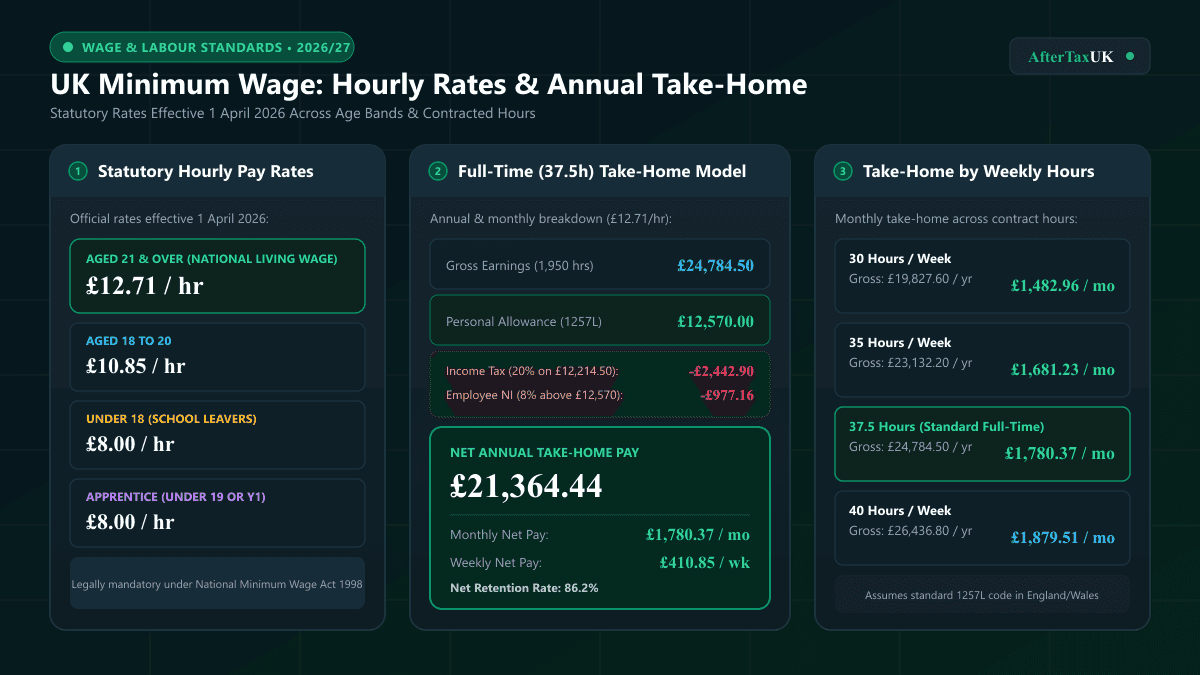
From 1 April 2026, the UK National Living Wage for workers aged 21 and over is £12.71 per hour. Based on 52 paid weeks per year, the statutory gross annual salary is:
Net take-home estimates assume standard tax code 1257L in England, Wales, or Northern Ireland, 52 paid weeks, zero student loan, and zero pension salary sacrifice. Scottish residents pay devolved Scottish Income Tax rates. Check our £25,000 salary after tax or £24,000 salary after tax for exact payslip itemisations.
UK Minimum Wage Take-Home Pay Matrix by Age Tier
Compare gross statutory earnings across standard full-time hours (37.5 and 40 hours per week) against estimated net monthly take-home pay after PAYE Income Tax, employee Class 1 National Insurance, and standard 5% auto-enrolment pension contributions.
| Age Tier & Rate | 37.5 Hours (Gross) | 40 Hours (Gross) | Net Take-Home Pay (40h) |
|---|---|---|---|
| Age 21 and Over£12.71 / hr (National Living Wage) | £24,784.50 | £26,436.80 | £21,940 / yr£1,828 / month net |
| Aged 18 to 20£10.85 / hr (Youth Rate) | £21,157.50 | £22,568.00 | £19,630 / yr£1,635 / month net |
| Under 18 / Apprentice£8.00 / hr (Statutory Minimum) | £15,600.00 | £16,640.00 | £15,110 / yr£1,259 / month net |
*Net take-home pay is based on standard tax code 1257L in England, Wales, or Northern Ireland, 52 paid weeks per year, standard PAYE Income Tax, employee Class 1 NI, and statutory 5% auto-enrolment workplace pension deductions.
Customise Your Working Hours, Age & Deductions
Model your exact payslip by selecting your age bracket, entering custom weekly hours, pension contributions, student loan plan, or accommodation offset charges:
- National Living Wage (21+):£12.71 / hr
- Youth Rate (18–20):£10.85 / hr
- Under 18 & Apprentice:£8.00 / hr
- Accommodation Offset Limit:£10.66 / day (£74.62 / wk)
Rate complies with the statutory £12.71/hr minimum for Age 21 and Over.
| Deduction Item | Weekly | Monthly | Annual |
|---|---|---|---|
| Gross Salary Earnings | £476.63 | £2,065.42 | £24,785.00 |
| Personal Allowance (£12,570 tax-free) | £241.73 | £1,047.50 | £12,570.00 |
| PAYE Income Tax (20% Basic Rate) | -£42.21 | -£182.93 | -£2,195.15 |
| Class 1 National Insurance (8%) | -£16.89 | -£73.17 | -£878.06 |
| Workplace Pension Contribution | -£23.83 | -£103.27 | -£1,239.25 |
| Total Statutory Deductions | -£82.93 | -£359.37 | -£4,312.46 |
| Net Take-Home Pay | £393.70 | £1,706.05 | £20,472.54 |
Statutory Framework of the UK Minimum Wage
The National Living Wage (NLW) and National Minimum Wage (NMW) are statutory pay floors established under the National Minimum Wage Act 1998 and governed by the National Minimum Wage Regulations 2015 (SI 2015/621). Enforced across England, Scotland, Wales, and Northern Ireland by HM Revenue & Customs (HMRC), these rates establish the minimum remuneration an employer can legally pay per hour worked.
All UK workers—including full-time employees, part-time staff, casual agency workers, zero-hours contract workers, and gig economy workers with worker status—are legally entitled to the statutory wage rate corresponding to their age band.
1. Statutory Minimum Wage Rates by Age Tier (2026/27)
Rates below apply from 1 April 2026. The tax year runs from 6 April 2026 to 5 April 2027; minimum wage rates change each April.
| Category & Age Tier | Statutory Rate | Statutory Scope | Annual Equiv. (37.5h) |
|---|---|---|---|
| Aged 21 & Over (National Living Wage) | £12.71 / hr | Eligible workers aged 21 and over | £24,784.50 |
| Aged 18 to 20 (Development Rate) | £10.85 / hr | Workers aged 18 to 20 | £21,157.50 |
| Under 18 Rate | £8.00 / hr | Eligible workers under 18 | £15,600.00 |
| Apprentice Rate | £8.00 / hr | Under 19 or in 1st year of apprenticeship | £15,600.00 |
Apprentice rate: It applies if the apprentice is under 19 or aged 19+ and in the first year. After the first year, apprentices aged 19+ are entitled to the rate for their age. Annual equivalents assume 52 paid weeks at the same rate and do not represent a guaranteed salary.
2. Annual, Monthly & Weekly Take-Home Pay by Contracted Hours
Because full-time employment contracts in the UK vary between 35, 37.5, and 40 contracted hours per week, the table below illustrates the exact annual, monthly, and weekly gross income alongside estimated take-home pay after Income Tax and employee National Insurance. Assumptions: 2026/27, tax code 1257L, England/Wales/Northern Ireland, no pension or student-loan deductions, and 52 paid weeks. Scotland has different Income Tax rates; actual payroll can vary.
| Contracted Hours | Gross Annual Pay | Gross Monthly | Total Deductions | Net Monthly Pay | Net Weekly Pay |
|---|---|---|---|---|---|
| 30 hrs/wk | £19,827.60 | £1,652.30 | £169.34 / mo | £1,482.96 | £342.22 |
| 35 hrs/wk | £23,132.20 | £1,927.68 | £246.45 / mo | £1,681.23 | £387.98 |
| 37.5 hrs/wk | £24,784.50 | £2,065.38 | £285.01 / mo | £1,780.37 | £410.85 |
| 40 hrs/wk | £26,436.80 | £2,203.07 | £323.56 / mo | £1,879.51 | £433.73 |
3. 37.5-hour take-home estimate
At £12.71 per hour for 37.5 paid hours each week, gross annual pay is £24,784.50. Using the assumptions above, the shared tax calculator estimates annual Income Tax of £2,442.90 and employee National Insurance of £977.16, leaving £21,364.44 a year (about £1,780.37 a month or £410.85 a week). These are annualised estimates; actual payslips depend on payroll periods and circumstances.
4. How Deductions and Costs Can Affect Minimum Wage
Minimum-wage entitlement is assessed under specific rules for the worker’s pay reference period. Age, apprentice status, hours that count, and certain deductions or work-related costs can affect the calculation. A headline hourly rate alone does not confirm compliance; use the official GOV.UK calculation guidance.
Mandatory Uniforms & Dress Codes
Required work clothing and equipment costs can affect the minimum-wage calculation. The treatment depends on the particular cost and circumstances; check the official guidance.
Unpaid Travel & Mandatory Waiting Time
Which time counts as working time varies by job and working arrangement. Check the official guidance for the relevant work type rather than assuming every journey or waiting period is treated the same way.
Till Shortages & Walkouts
Deductions from pay and shortages may affect minimum-wage pay calculations differently. The rules depend on the reason for the deduction and the worker’s pay reference period.
Tips, Gratuities & Tronc Allocation
Tips and service charges are governed by separate rules and do not replace an employer’s obligation to pay the applicable minimum wage. See the government guidance for details.
Check your rate and pay
Minimum wage entitlement depends on age, apprentice status, hours that count for minimum-wage purposes, and deductions. Use the official guidance to check the rules that apply to your situation.
Frequently Asked Questions
Clear answers based on official HMRC rules and statutory guidance.