Key Statutory Takeaways
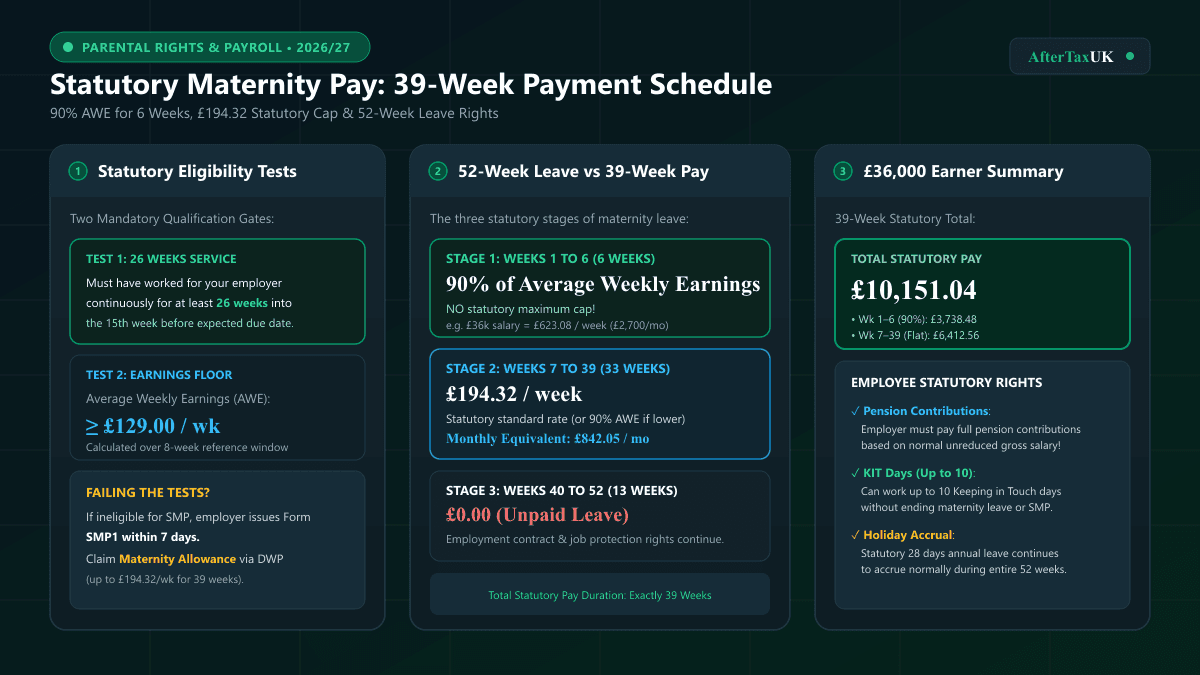
- 39 Weeks Duration: SMP is paid for up to 39 weeks of your statutory 52 weeks of maternity leave.
- First 6 Weeks: 90% of your average gross weekly earnings with no statutory maximum cap.
- Next 33 Weeks: Up to £194.32 per week (or 90% of average weekly earnings, whichever is lower).
- Tax Treatment: Paid via employer PAYE with standard Income Tax and Class 1 NI rules applied.
1. Statutory Authority: The 52-Week Leave vs 39-Week Pay Structure
In the United Kingdom, statutory maternity entitlements are established under Part VIII of the Employment Rights Act 1996 (ERA 1996), while statutory remuneration is governed by Part XII of the Social Security Contributions and Benefits Act 1992 (SSCBA 1992) and The Statutory Maternity Pay (General) Regulations 1986 (SI 1986/1960).
Under UK employment law, all pregnant employees have an absolute statutory right to up to 52 weeks of Statutory Maternity Leave, irrespective of how long they have worked for their employer:
- Ordinary Maternity Leave (OML): The first 26 weeks. You have the statutory right to return to the exact same job with the same terms.
- Additional Maternity Leave (AML): The subsequent 26 weeks. You have the right to return to the same job, or a suitable and appropriate alternative role if not reasonably practicable.
It is vital to distinguish between leave and pay: Statutory Maternity Pay (SMP) lasts for exactly 39 weeks. The remaining 13 weeks of leave are completely unpaid under statutory guidelines, although many employers offer enhanced occupational maternity schemes.
2. 2026/27 Statutory Maternity Pay Rates
Statutory Maternity Pay is split into two distinct financial phases under Section 166 of SSCBA 1992:
90% of Average Weekly Earnings
Paid at 90% of your gross earnings before tax. There is no upper statutory ceiling. If your average weekly pay was £900, you receive £810 per week.
£194.32 per week
Paid at £194.32 per week or 90% of your average weekly earnings, whichever is lower. £194.32 is the 2026/27 maximum weekly rate.
3. Worked 39-Week Cashflow Model: £36,000 Annual Salary
To visualize how maternity pay flows into your bank account, consider an employee earning a contractual salary of £36,000 per annum (£3,000 gross per month or £692.31 per week):
| Maternity Period | Weekly Gross Pay | Monthly Equivalent | PAYE Tax & NI Impact |
|---|---|---|---|
| Weeks 1 to 6 (90% AWE) | £623.08 / wk | £2,699.98 / mo | PAYE tax and NI depend on your circumstances and pay period |
| Weeks 7 to 39 (Flat Rate) | £194.32 / wk | £842.05 / mo | Usually below weekly tax and employee NI thresholds; payroll rules apply |
| Weeks 40 to 52 (Unpaid Leave) | £0.00 / wk | £0.00 / mo | Unpaid statutory leave (employment contract continues) |
PAYE and take-home pay:
SMP is paid through payroll. Tax depends on your tax code and year-to-date pay, and employee National Insurance is assessed by pay period. A change in maternity pay does not guarantee a refund; ask payroll or HMRC if you think deductions are wrong.
4. The Two Statutory Qualifying Tests for SMP
To receive SMP directly through your employer's payroll, you must satisfy two strict statutory tests assessed in the "Qualifying Week" (the 15th week before your expected week of childbirth):
Test 1: The Continuous Employment Rule
Under Section 164(2)(a) of SSCBA 1992, you must have been continuously employed by the same employer for at least 26 weeks extending into any day of the Qualifying Week. In practical terms, you must have started working for your employer by approximately the 15th week of pregnancy.
Test 2: The Average Weekly Earnings (AWE) Test
Under Regulation 21 of SI 1986/1960, your average weekly earnings must be at least £129 per week for 2026/27. The relevant earnings calculation period and qualifying week are defined by the statutory rules; ask your employer to confirm your AWE calculation.
5. Keeping in Touch (KIT) Days: Rules & Pay
Under Regulation 9A of SI 1986/1960, an employee on statutory maternity leave can work up to 10 Keeping in Touch (KIT) days without bringing their maternity leave or Statutory Maternity Pay to an end.
KIT days are entirely voluntary for both parties: an employer cannot demand that you work, and an employee cannot insist on working. Working even 30 minutes counts as one full statutory KIT day against your 10-day allowance. Remuneration is mutually agreed between employee and employer, but standard UK practice is to pay your normal contractual hourly or daily rate, offset against statutory SMP for that day.
6. Workplace Pension Contributions During Maternity Leave
One of the most vital statutory protections under UK employment equality legislation concerns workplace pensions:
Equality Act 2010 (Schedule 5) & Pensions Act 2008:
During paid maternity leave, employer pension contributions are generally based on your normal salary, not the reduced maternity pay you receive. Scheme rules and pay arrangements can affect the detail; confirm with your employer or pension provider.
Your own pension contributions are generally based on the maternity pay you actually receive. Employer contributions during paid maternity leave are generally based on normal salary. Scheme rules and pay arrangements can affect the detail; confirm with your employer or pension provider.
7. Maternity Allowance (MA): The Alternative for Self-Employed Mothers
If you do not satisfy the 26-week continuous employment test, recently changed employers, or work as a self-employed sole trader or freelancer, your employer must issue form SMP1 detailing why you do not qualify for employer SMP.
You can then submit form SMP1 to Jobcentre Plus to claim Maternity Allowance (MA) under Section 35 of SSCBA 1992:
- Amount: Depends on your work and earnings history, up to the 2026/27 maximum of £194.32 per week. Check GOV.UK for current eligibility and payment details.
- Tax: Maternity Allowance is not treated the same as SMP for tax. See GOV.UK guidance or check with HMRC about your circumstances.
- State Pension Credits: You receive automatic Class 1 National Insurance credits for each week you receive Maternity Allowance, protecting your 35-year State Pension qualifying record.
Frequently Asked Questions
Clear answers based on official HMRC rules and statutory guidance.