How this comparison was prepared
Published scheme information and HMRC guidance. We have not priced a live personal quote or tested provider service. Employer eligibility, vehicles and protections must be confirmed in the specific agreement.
Provider links are supplied for further research. Inclusion is not an endorsement or a personalised recommendation. Check the latest terms and your own circumstances before acting.
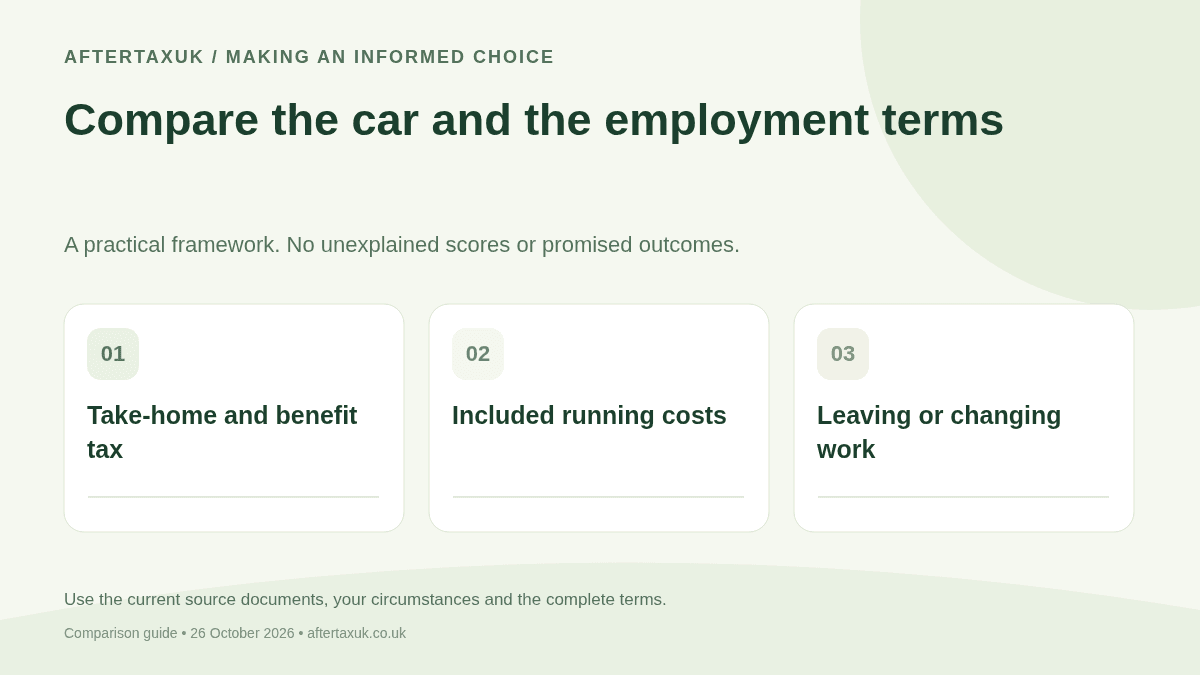
Start with these three checks
- Get like-for-like quotes for the same car, term, mileage and inclusions through the scheme your employer actually offers.
- Compare net pay before and after sacrifice, benefit tax, pensionable pay and effects on other pay-related benefits.
- Read early-termination, redundancy, parental-leave, excess-mileage and damage terms before signing. Ask which costs are insured and which remain yours.
Options to investigate and what to check
This is a research shortlist, not an ordered league table. Compare the same needs and assumptions in each case.
Octopus Electric Vehicles
An employer or employee investigating an electric-car scheme.
Check: Check the employer agreement, charger and energy offers if relevant, insurance excesses and conditions attached to leaving protection.
Published informationTusker
An employee whose employer offers the provider’s salary-sacrifice arrangement.
Check: Compare the actual quote and included services, plus mileage, damage and early-exit terms in the agreement.
Published informationZenith
An employer comparing salary-sacrifice scheme administration and vehicles.
Check: Check available vehicles, contractual responsibilities, driver support and how employment changes affect the lease.
Published informationNHS Fleet Solutions
A worker checking access through a participating employer.
Check: Eligibility is employer-specific. Ask payroll how the agreement affects pensionable pay and pay-related entitlements rather than applying a private-sector assumption.
Published informationCalculate the net change, not a headline percentage
Salary sacrifice changes contractual cash pay. An employer-provided car can also create a taxable benefit. These are separate elements: a reduction in gross salary is not the same as the reduction in take-home pay. Use the applicable company-car rules and rate for each tax year of the proposed term.
A quote should identify the car’s taxable list price, benefit percentage, monthly sacrifice and how benefit tax is collected. Avoid using the car’s discounted lease price as the taxable list price. If a quote crosses tax years, a fixed benefit percentage across the whole term may be misleading.
The comparison should use your actual payroll circumstances: region, tax code, pension method and student loan where relevant. A monthly quote based only on your highest tax rate can miss threshold and allowance effects.
Employment protections can matter more than a small price difference
Early-return policies are conditional. Ask about waiting periods, exclusions, claim limits, resignation, redundancy, long-term illness and parental leave. A product labelled protected is not an unconditional promise that every exit is free.
Look at practical costs too: servicing, tyres, breakdown cover, insurance excesses, charging, excess mileage and fair-wear standards. Compare home-charging installation or energy offers only where you can use them and the conditions are acceptable.
Salary sacrifice must not reduce cash pay below the applicable National Minimum Wage. Statutory pay and some benefits may use earnings measures affected by sacrifice. Ask payroll for a worked example where that matters.
Public-sector pensions need a separate check
Do not assume a private-sector pension calculation represents an NHS or another public-service scheme. Pensionable earnings, contribution tiers and benefit accrual can be affected differently. Ask the scheme and payroll how the quoted arrangement works for your membership.
Compare the total employment package, not just the next payslip. A lower monthly cash cost can be outweighed by pension or benefit changes. Where those effects are material or unclear, obtain appropriate independent advice.
Only sign after receiving the complete quote and terms. Store a copy of the assumptions and any explanations from payroll so you can reconcile the first payslip and later changes.
An illustrative way to compare a quote
These invented figures demonstrate the structure only; they are not a vehicle quote or a tax calculation. Assume all figures are monthly and represent the same car and term.
| Element | Illustrative amount | Question to resolve |
|---|---|---|
| Take-home reduction from sacrifice | £280 | Does payroll include pension and loan effects? |
| Additional car benefit tax | £45 | Is this already included in the quoted reduction? |
| Charging not covered by the scheme | £40 | Does it match your realistic mileage? |
| Total shown by this example | £365 | Do not add benefit tax twice if the quote includes it. |
Compare against the full cost of your alternative car arrangement. Early-exit, mileage, damage and pension effects are not priced into this simplified example.
Sources and further checks
Use these official guidance pages alongside the provider pages linked above. Published charges and terms can change; a quote and full contract are needed for a personal decision.
- HMRC: tax on company cars
- HMRC: salary sacrifice and employer obligations
- GOV.UK: National Minimum Wage rates
Found a changed term or an error? Send a correction with the page URL and the relevant source.
Questions about this comparison
Practical points to check before choosing a product or service.