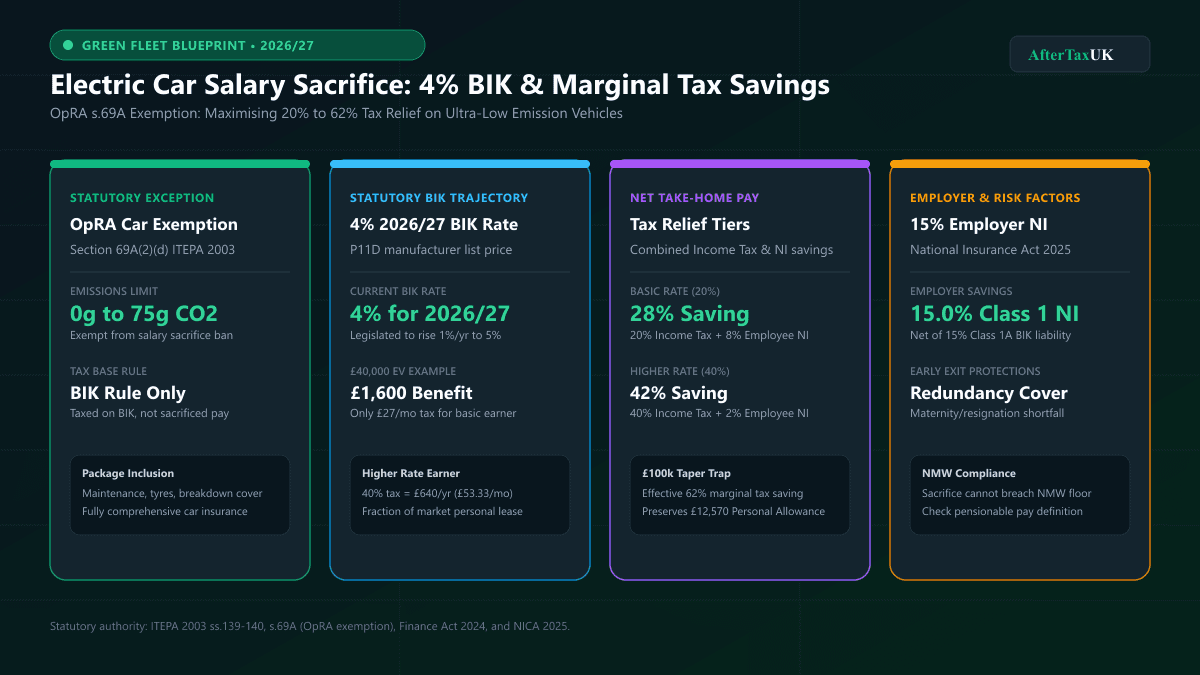
1. Statutory Framework: OpRA Exemption for Zero-Emission Vehicles
In April 2017, the UK Government overhauled salary sacrifice rules through the introduction of Optional Remuneration Arrangements (OpRA) under Sections 69A and 69B of the Income Tax (Earnings and Pensions) Act 2003 (ITEPA 2003). For standard perks, HMRC taxes employees on the higher of the cash salary given up or the statutory benefit value, eliminating most tax benefits.
However, to accelerate the decarbonisation of British transport, Parliament enacted a permanent statutory carve-out for ultra-low emission vehicles emitting 75g/km CO2 or less. Under Section 120A of ITEPA 2003, pure electric vehicles (0g/km CO2) are completely exempt from OpRA comparison rules.
Instead of paying Income Tax and Class 1 National Insurance contributions on the sacrificed gross salary, you are only assessed on the official Benefit in Kind (BIK) value of the company car. For 2026/27, the BIK percentage is just 4% of the vehicle's P11D list price, leaving the vast remainder of your sacrificed salary entirely tax-free.
2. The 2026/27 4% BIK Rate & Future Trajectory
The statutory BIK rate for pure electric company cars was frozen at 2% between 2022/23 and 2024/25, before rising to 3% in 2025/26 and 4% in 2026/27. The Treasury has legislated predictable 1% annual increases through 2029/30:
| Tax Year | Zero-Emission EV BIK | Annual Tax (£45k EV, 20% Band) | Annual Tax (£45k EV, 40% Band) |
|---|---|---|---|
| 2024/25 | 2% | £180 / yr (£15 / mo) | £360 / yr (£30 / mo) |
| 2025/26 | 3% | £270 / yr (£22.50 / mo) | £540 / yr (£45 / mo) |
| 2026/27 (Current) | 4% | £360 / yr (£30 / mo) | £720 / yr (£60 / mo) |
| 2027/28 | 5% | £450 / yr (£37.50 / mo) | £900 / yr (£75 / mo) |
| 2028/29 & 2029/30 | 6% & 7% | £540 / yr & £630 / yr | £1,080 / yr & £1,260 / yr |
Notice that even at 4% in 2026/27, a Higher Rate taxpayer driving a £45,000 executive EV pays just £60.00 per month in Benefit in Kind tax, while saving hundreds of pounds in Income Tax and National Insurance.
3. All-Inclusive Fleet Packages: The Pre-Tax Multiplier
A primary reason EV salary sacrifice consistently outperforms retail PCP deals is that corporate fleet schemes bundle routine vehicle ownership expenses into a single monthly deduction taken from gross salary:
Fully Bundled Costs
- Brand new electric vehicle lease with zero upfront deposit
- Comprehensive motor insurance including glass and personal effects
- Routine servicing, inspections, and all mechanical maintenance
- Unlimited tyre replacements for fair wear and tear
Financial Protections
- 24/7 RAC or AA nationwide breakdown assistance
- Annual Vehicle Excise Duty (VED) administration
- Early Termination Insurance (ETI) for life change events
- No credit check on personal credit score records
When you lease a car privately, you pay for expensive motor insurance (often £1,000 to £1,800 annually for high-performance EVs) with post-tax earnings. Under salary sacrifice, insurance is paid with pre-tax income, shielding it from both Income Tax and Class 1 NIC.
4. Worked Comparison: £45,000 EV vs Retail Personal Lease
Consider an employee acquiring an electric family SUV with a P11D list value of £45,000. The corporate lease requires a gross monthly salary sacrifice of £650.00 (£7,800.00 annually):
| Payroll Metric | Basic Rate (20%) | Higher Rate (40%) | £100k Taper (60%) |
|---|---|---|---|
| Gross Salary Sacrificed | £650.00 / mo | £650.00 / mo | £650.00 / mo |
| Income Tax Saved | -£130.00 (20%) | -£260.00 (40%) | -£390.00 (60%) |
| Employee NIC Saved | -£52.00 (8%) | -£13.00 (2%) | -£13.00 (2%) |
| 4% BIK Tax Charge | +£30.00 / mo | +£60.00 / mo | +£90.00 / mo |
| Net Take-Home Reduction | £498.00 / mo | £437.00 / mo | £337.00 / mo |
Commercial Benchmark Comparison:
To lease that same £45,000 vehicle privately with no deposit, comprehensive insurance, servicing, breakdown cover, and tyres would require approximately £720 to £780 per month out of net take-home pay. A Higher Rate taxpayer saves roughly £300 every month—amounting to over £10,000 in net savings across a 36-month lease!
5. Employer National Insurance & Minimum Wage Restrictions
The scheme provides a symmetrical financial benefit for employers. Under the National Insurance Contributions (Secondary Class 1 Contributions) Act 2025, the secondary employer contribution rate is 15.0%.
When an employee sacrifices £650 per month, the business saves £97.50 monthly (£1,170 annually) in Secondary Class 1 NIC. Meanwhile, the employer pays Class 1A NIC at 15.0% on the vehicle's 4% BIK value (£1,800 × 15% = £270/yr, or £22.50/mo). The net employer cash saving is £75.00 per month per vehicle (£900 annually), which employers often use to offset scheme administration and Early Termination Insurance.
As with all salary sacrifice arrangements, UK employment law strictly prevents an employee's contractual cash wages from dropping below the National Minimum Wage. From 1 April 2026, the National Living Wage is £12.71 per hour. For a 37.5-hour work week, gross pay cannot drop below £24,784.50. High-value EV leases are therefore unavailable to employees whose earnings sit near the statutory wage threshold.
6. Strategic Weapon Against the £100k Taper Trap
Under Section 35 of the Income Tax Act 2007 (ITA 2007), earners with Adjusted Net Income exceeding £100,000 lose £1 of their £12,570 Personal Allowance for every £2 of income over £100,000, creating an effective 60% marginal Income Tax rate between £100,000 and £125,140.
Because an EV salary sacrifice agreement legally amends your contractual salary downwards, it directly reduces your Adjusted Net Income. For an executive earning £110,000 who sacrifices £8,000 gross for a high-performance EV, their taxable income drops back towards £102,000, reclaiming £4,000 of lost tax-free Personal Allowance. Combined with 2% employee NIC, the net effective subsidy from the Exchequer can reach an extraordinary 62% of the lease cost.
Frequently Asked Questions
Clear answers based on official HMRC rules and statutory guidance.