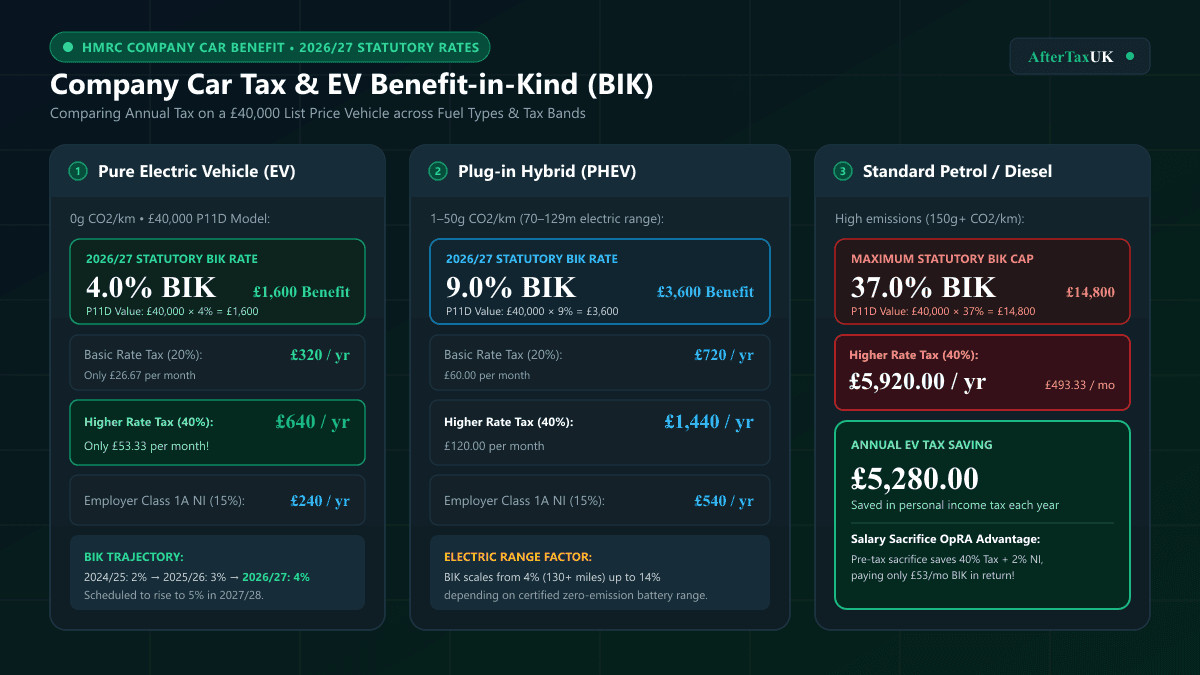
Calculate the taxable benefit first
Broadly, annual car benefit starts with the car’s relevant list price and accessories, multiplied by the appropriate percentage. Availability, qualifying employee contributions and other adjustments can change the charge. The purchase price or monthly lease payment is not necessarily the relevant list price.
For example, a fully available zero-emission car with a relevant list price of £40,000 and no adjustments has a £1,600 annual taxable benefit at 4%. If the whole benefit falls in a 20% Income Tax band, the tax is £320 a year; at 40%, it is £640. Allowance withdrawal or other interactions can change the marginal cost.
Rates depend on the specific vehicle
Use HMRC’s 2026/27 appropriate-percentage table for the car’s CO2 figure, electric range where relevant, fuel type and registration details. A plug-in hybrid does not automatically qualify for the same percentage as a zero-emission car.
Rates are tax-year specific. Do not apply the 3% zero-emission percentage from 2025/26 to a 2026/27 calculation or assume a current percentage remains fixed throughout a multi-year lease.
Salary sacrifice is a separate calculation
In an eligible arrangement, you agree a contractual reduction in cash salary in return for the benefit. Cars with CO2 emissions of 75g/km or less have a specific exception from the optional-remuneration valuation rules. Eligibility does not mean the vehicle is tax-free.
Compare the net salary reduction, tax on the car benefit, employee contributions, scheme fees, insurance, mileage conditions and exit charges. Check effects on pensionable pay, statutory pay and other benefits with the employer. Minimum-wage protections also apply.
Do not ignore the benefit when checking income limits
Taxable benefits can form part of adjusted net income. Reducing a £115,000 cash salary by £15,000 does not, by itself, prove adjusted net income is £100,000: the taxable car benefit and other income must also be considered.
The car calculator is an estimate of the stated scenario. Obtain the employer’s scheme quote and the car details before comparing a company car with a private vehicle.
Explore the next step
Check the tool's supported scenario and assumptions before using its estimate.
Estimate company car taxFrequently asked questions
Frequently Asked Questions
Clear answers based on official HMRC rules and statutory guidance.
Sources and further checks
Check the source that applies to your circumstances and effective period. Official guidance can change.