1. Statutory Authority: Optional Remuneration Arrangements (OpRA)
A salary sacrifice arrangement (often termed "salary exchange") is a formal contractual variation governed by UK employment law and the Income Tax (Earnings and Pensions) Act 2003 (ITEPA 2003). Under such an agreement, an employee contractually relinquishes a portion of their gross cash remuneration in exchange for their employer providing a designated non-cash statutory benefit.
Optional Remuneration Arrangement rules affect how many benefits are valued when provided instead of cash pay. The higher of the salary given up or the normal taxable benefit can apply. Some arrangements have specific exclusions and conditions; an exclusion does not mean the benefit has no tax charge.
Check the HMRC salary-sacrifice guidance for your arrangement. Pension contributions, qualifying cycle-to-work arrangements, eligible childcare arrangements and low-emission company cars have different rules. A company car can still create a taxable benefit.
2. The Statutory Lower Boundary: National Minimum Wage Floor
While HMRC does not enforce an arbitrary upper percentage limit on how much salary an employee can sacrifice, UK law imposes an absolute, non-negotiable lower floor under minimum-wage legislation and the rules for calculating pay in each relevant pay reference period.
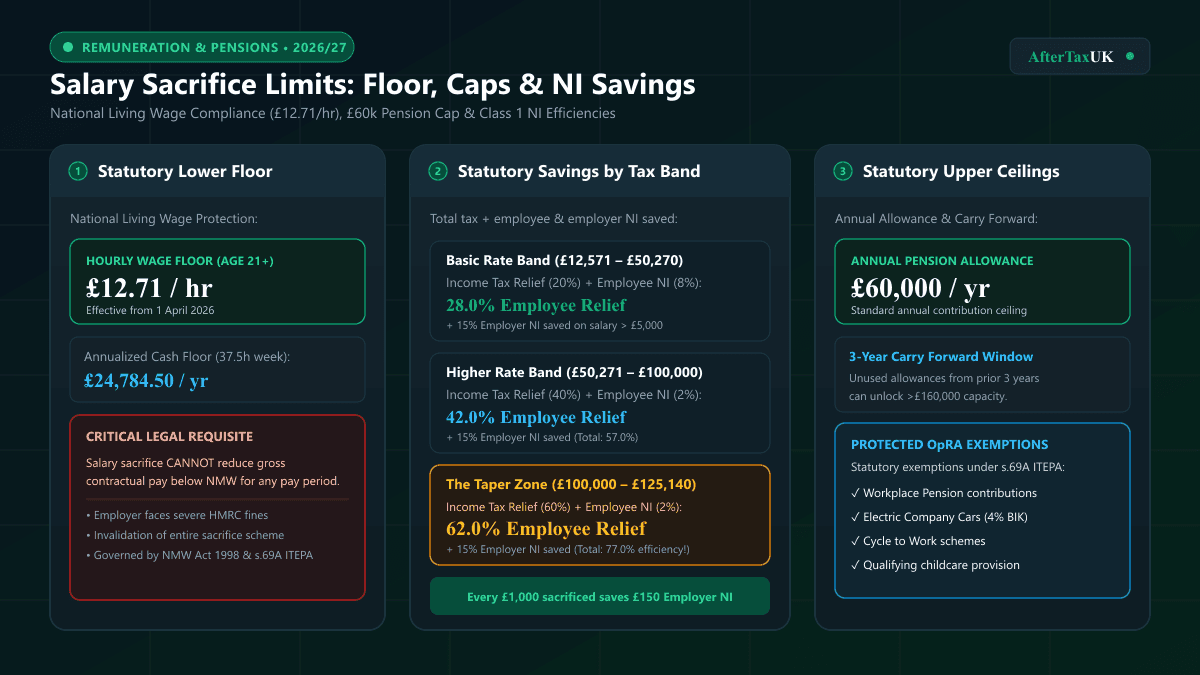
Salary sacrifice must be checked against the worker’s applicable minimum wage rate for the relevant pay reference period. For workers aged 21 and over, the National Living Wage is £12.71 per hour from 1 April 2026; lower age bands and some apprentices have different rates.
For illustration only, a worker aged 21+ paid for 37.5 hours in each of 52 weeks would have gross pay of:
At £26,000 annual pay, the arithmetic difference is £1,215.50. This is not a guaranteed annual sacrifice limit: minimum-wage compliance is assessed using the relevant pay reference period and the hours/pay that count under the rules. Use the GOV.UK minimum wage calculation guidance to check a specific arrangement before changing contractual pay.
3. The Upper Pension Ceiling: HMRC Annual Allowance (£60,000)
When salary is exchanged for employer pension contributions, the payments enter your pension pot as employer contributions under Section 308 of ITEPA 2003. While there is no percentage limit, contributions are constrained by the statutory Pension Annual Allowance under Section 218 of the Finance Act 2004:
Standard Annual Allowance
£60,000 / yr
The statutory limit on total gross pension contributions (employee sacrifice, employer contributions, and personal SIPP payments) across all registered schemes without incurring an annual tax charge.
Tapered Annual Allowance
£10,000 Min
Under Section 228ZA of the Finance Act 2004, high earners with "Threshold Income" over £200,000 and "Adjusted Income" over £260,000 see their allowance tapered by £1 for every £2 down to £10,000.
Carry Forward Relief (Section 228A Finance Act 2004):
If you wish to make a massive salary sacrifice exceeding £60,000 in a single tax year, you can utilise statutory "Carry Forward" rules. This allows you to absorb unused annual allowances from the three previous tax years, potentially enabling an eligible employee to sacrifice over £160,000 into their pension in a single year without tax penalties.
4. Exact Statutory Savings: Relief-at-Source vs Salary Sacrifice
In a standard relief-at-source workplace pension, contributions are deducted from net pay and Income Tax relief is added to the pension. Under a valid salary sacrifice arrangement, contractual cash pay is reduced before National Insurance is calculated; the employee and employer NI saving depends on the applicable thresholds and the amount sacrificed. For 2026/27, the standard employer rate is 15% above the £5,000 annual secondary threshold. See GOV.UK employer rates and thresholds.
| Taxpayer Band | Income Tax Relief | Employee NI Saving | Employer NI Relief | Illustrative Employee Saving |
|---|---|---|---|---|
| Basic Rate (£12,571–£50,270) | 20.0% | 8.0% | 15% | 28.0% (employee saving; employer contribution separate) |
| Higher Rate (£50,271–£100,000) | 40.0% | 2.0% | 15% | 42.0% (employee saving; employer contribution separate) |
| £100k–£125k Taper Zone | 60.0% (PA recovery) | 2.0% | 15% | 62.0% (employee saving; employer contribution separate) |
| Additional Rate (>£125,140) | 45.0% | 2.0% | 15% | 47.0% (employee saving; employer contribution separate) |
Student Loan Bonus: Automatic 9% Relief on Sacrificed Earnings
Eligible salary sacrifice can reduce earnings used for student-loan repayments. The current cash deduction may fall when earnings remain above the relevant plan threshold; the saving depends on the amount sacrificed and your circumstances. Lower current repayments do not automatically reduce the eventual cost of the loan.
Employer NIC Reinvestment Schemes
For pay that would otherwise incur the standard 15% employer NI rate, a £1,000 salary sacrifice can reduce employer NI by £150 before any other adjustments. The employer may choose to share some or all of a saving, subject to its scheme terms; an employee is not automatically entitled to it.
5. Worked Multi-Salary Comparison: Taking Cash vs Salary Sacrifice
The table below shows the net cost to an employee's take-home pay when exchanging £5,000 of cash salary for a £5,000 workplace pension investment across four benchmark income tiers:
| Gross Salary | Sacrificed Amount | Income Tax Saved | Employee NI Saved | Net Cost in Take-Home |
|---|---|---|---|---|
| £30,000 / yr | £5,000.00 | £1,000.00 (20%) | £400.00 (8%) | £3,600.00 (72% cost) |
| £55,000 / yr | £5,000.00 | £2,000.00 (40%) | £100.00 (2%) | £2,900.00 (58% cost) |
| £110,000 / yr | £5,000.00 | £3,000.00 (60%) | £100.00 (2%) | £1,900.00 (38% cost) |
| £160,000 / yr | £5,000.00 | £2,250.00 (45%) | £100.00 (2%) | £2,650.00 (53% cost) |
6. Impact on Mortgages, Life Cover & Statutory Maternity Pay
While salary sacrifice provides extraordinary tax efficiency, reducing your formal contractual salary carries subtle structural implications:
- Mortgage Borrowing Capacity:Some conservative high-street lenders assess borrowing limits (typically 4.5× income) against your post-sacrifice salary on Form P60. Most mainstream lenders will accept your pre-sacrifice "reference salary" if confirmed in writing by your employer.
- Statutory Maternity Pay (SMP): Under the Social Security Contributions and Benefits Act 1992 (SSCBA 1992), SMP during the first six weeks is paid at 90% of your Average Weekly Earnings (AWE) earned between weeks 17 and 25 of pregnancy. Sacrificing salary during this specific 8-week calculation window reduces your statutory maternity pay.
- Death in Service / Life Assurance: Ensure your employment contract explicitly states that workplace life cover multiples (e.g. 4× salary) are pegged to your nominal reference salary rather than post-sacrifice pay.
Frequently Asked Questions
Clear answers based on official HMRC rules and statutory guidance.