How this comparison was prepared
Desk research using provider descriptions and HMRC guidance. We have not performed road tests or measured detection accuracy, battery use or customer support; no numerical product scores are assigned.
Provider links are supplied for further research. Inclusion is not an endorsement or a personalised recommendation. Check the latest terms and your own circumstances before acting.
Start with these three checks
- Identify your use case: an employee using a personal vehicle, a self-employed business, a company car or a fleet. The relevant tax calculation is not identical.
- Trial a short local journey, a multi-stop work trip and a personal journey on your own phone. Check missed trips, edits and the evidence included in an export.
- Check the current subscription, export limits, location permissions, retention and cancellation process. Keep a backup you can read independently of the app.
Options to investigate and what to check
This is a research shortlist, not an ordered league table. Compare the same needs and assumptions in each case.
MileIQ
Someone investigating automatic trip capture and business/personal classification.
Check: Trial classification and exports on your phone. Confirm the correct currency, current subscription and how business purposes are recorded.
Published informationDriversnote
Someone comparing automatic logging with reporting tools.
Check: Check report fields, device compatibility, any additional hardware and the current limits of the plan you intend to use.
Published informationTripcatcher
Someone investigating a mileage tool alongside bookkeeping.
Check: Confirm supported accounting integrations, report content, vehicle types and the actual UK subscription before adopting it.
Published informationAccounting software with mileage features
Someone already paying for a bookkeeping product.
Check: Check the exact UK product and plan. A feature advertised for another country or a discontinued product should not be assumed to exist in your subscription.
Published informationStart with the claim, not the product badge
HMRC’s employee-vehicle guidance lists a 55p flat rate for the first 10,000 qualifying car or goods-vehicle miles from 6 April 2026, with 25p for miles above that level. The same table distinguishes the earlier 45p rate before 6 April 2026. Motorcycles and bicycles have separate rates. Select the appropriate tax year rather than reusing a historical graphic.
For an employee using their own vehicle, relief normally concerns qualifying business mileage less relevant employer reimbursements. The approved expense amount is not itself the tax refund. Ordinary commuting is not automatically a qualifying journey because an app records it.
HMRC’s current self-employed simplified-expenses vehicle guidance also lists 55p for the first 10,000 car or goods-vehicle miles in 2026/27, with 25p above that level. Eligibility, the way costs are deducted and the treatment of a vehicle already claimed under another method are separate questions. Company-car fuel and electricity have different rules. The employee example below is not a substitute for those checks.
What a useful mileage record needs to show
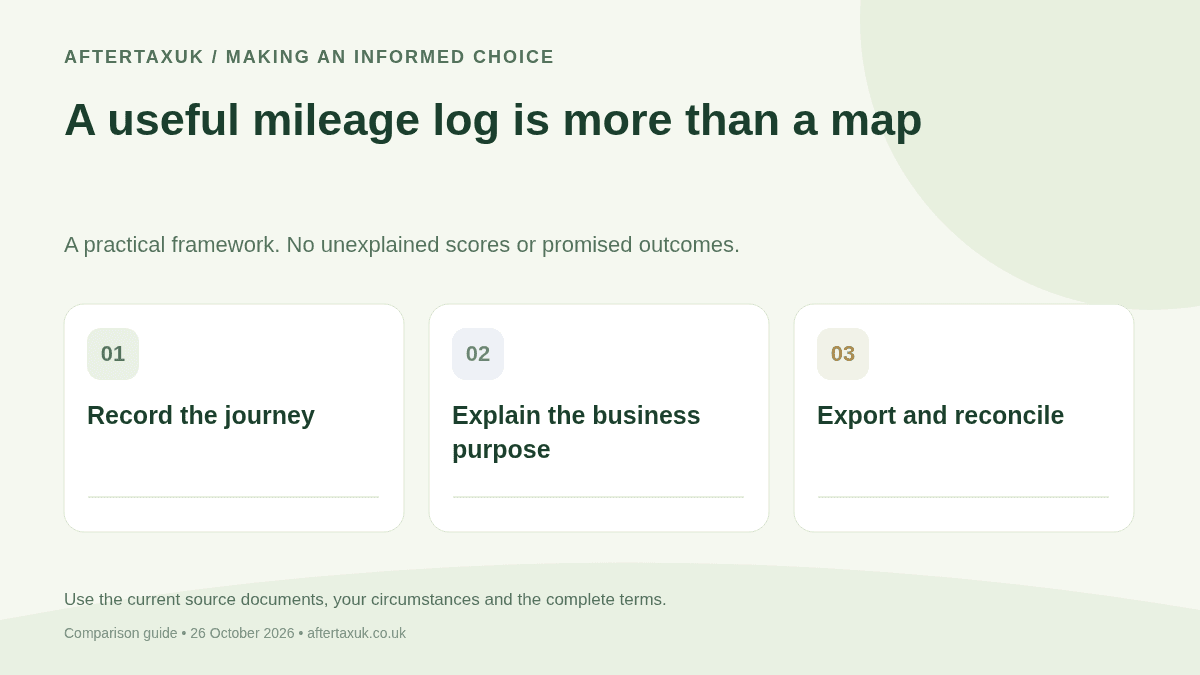
Record the journey date, distance, business reason and start/end information. HMRC’s employee claim guidance asks for mileage logs including the reason and start/end postcodes. Keep employer reimbursements and totals for each employment distinguishable.
An app should let you correct a missed trip without concealing the fact that a correction was made. Compare the export with your diary, client appointments, odometer records and expense payments. A map trace can support a record, but does not prove the trip was business travel.
Before renewing, export a complete period and read it on another device. Check whether the export includes your business explanation and enough detail to support a claim, rather than just a monthly total.
Run your own documented trial
Use the same handful of real journeys on each shortlisted app, with a written reference distance and date. Note missed trips, how easily you classify a personal journey and whether a multi-stop route is split sensibly. Repeat a trip when location permission or low-power mode changes.
Review location access and deletion controls. Some automatic logging relies on background access; that may be convenient but has privacy and battery implications. Decide whether a manual log is a better fit for infrequent business travel.
This guide does not label any app HMRC-approved or guarantee acceptance of a claim. Keep the evidence and apply the tax rules even when software advertises tax-ready reports.
Worked employee example: expense amount versus tax relief
Assume 6,000 qualifying personal-car business miles in 2026/27, an employer payment of 30p per mile and a worker able to obtain 20% Income Tax relief on the whole eligible shortfall.
| Step | Calculation | Amount |
|---|---|---|
| Approved amount using current employee rate | 6,000 × £0.55 | £3,300 |
| Employer reimbursement | 6,000 × £0.30 | £1,800 |
| Potential deductible shortfall | £3,300 − £1,800 | £1,500 |
| Illustrative Income Tax relief | £1,500 × 20% | £300 |
The £1,500 shortfall is not a £1,500 cash refund. Actual relief depends on qualifying journeys, reimbursements, tax paid and the applicable rules; this is not a self-employed or company-car calculation.
Sources and further checks
Use these official guidance pages alongside the provider pages linked above. Published charges and terms can change; a quote and full contract are needed for a personal decision.
- HMRC: employees using their own vehicles
- HMRC: travel, mileage and fuel allowances
- HMRC: simplified vehicle expenses
Found a changed term or an error? Send a correction with the page URL and the relevant source.
Questions about this comparison
Practical points to check before choosing a product or service.