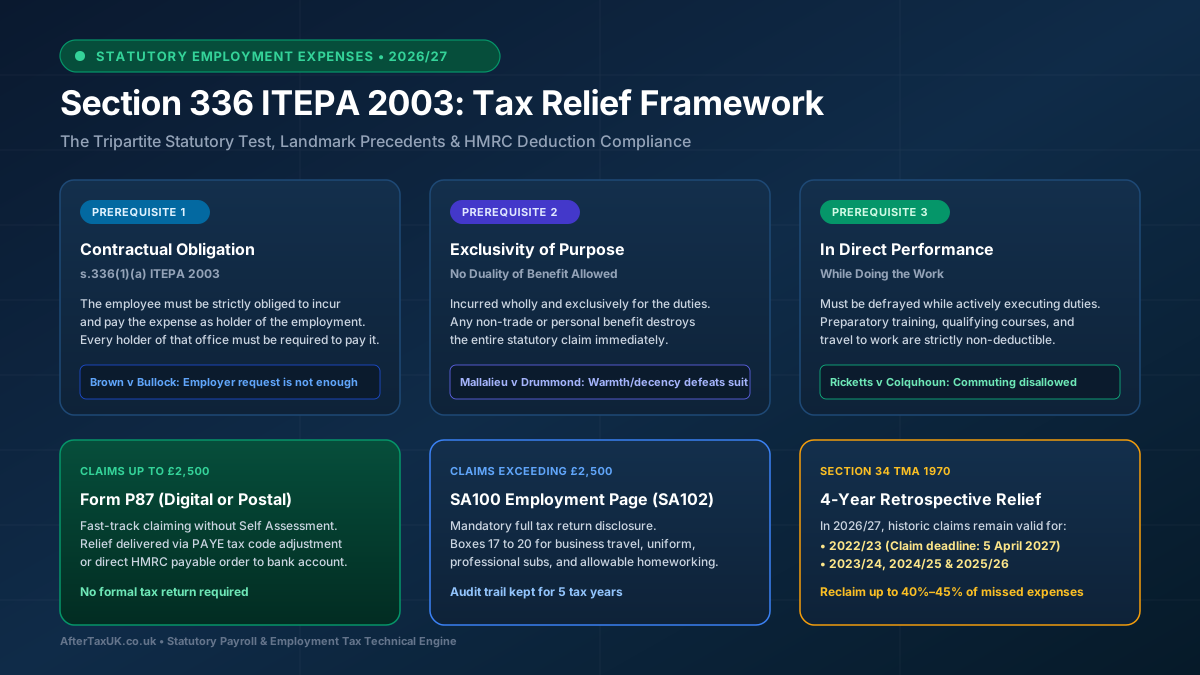
The Statutory Foundation of Section 336 ITEPA 2003
Under UK tax law, the default presumption is that all employment earnings are subject to PAYE Income Tax and Class 1 National Insurance contributions without deduction. Relief for expenses incurred by an employee is strictly an exception to this rule. Section 336(1) of the Income Tax (Earnings and Pensions) Act 2003 (ITEPA 2003) sets out the statutory gatekeeper:
"The general rule is that a deduction from earnings is allowed for, or for the part of, any amount in respect of an expense to which this section applies if:
(a) the employee is obliged to incur and pay it as holder of the employment, and
(b) the amount is incurred wholly, exclusively and necessarily in the performance of the duties of the employment."
Employment vs Self-Employment: The Asymmetry of UK Tax Law
To understand why Section 336 is notorious among tax practitioners, one must contrast it with the deduction rules applicable to sole traders and partners under Section 34 of the Income Tax (Trading and Other Income) Act 2005 (ITTOIA 2005).
Under Section 34 ITTOIA 2005, a self-employed business owner may deduct any revenue expense incurred "wholly and exclusively for the purposes of the trade". In sharp contrast, Section 336 ITEPA 2003 imposes two formidable statutory hurdles that do not exist in trade taxation:
Trade Purpose Standard
- Must be incurred "wholly and exclusively".
- Does not need to be "necessarily" incurred.
- Covers costs that assist, prepare, or expand the business (e.g. marketing, CPD, discretionary client hospitality within limits).
- Apportionment of identifiable dual-purpose costs is widely permitted.
Performance Standard
- Must be "wholly, exclusively and necessarily".
- Must be incurred "in the performance of the duties", not in preparation for them or to put the worker in a position to work.
- Objective necessity: Every holder of that post must be obliged to incur it.
- Duality of purpose almost invariably destroys the entire deduction.
Deconstructing the Tripartite Statutory Test & Landmark Case Law
Decades of binding judicial precedents in the High Court, Court of Appeal, and House of Lords have crystallised Section 336 into three strict, cumulative limbs. If an expense fails any single limb, relief is entirely denied by HMRC.
"Obliged to Incur and Pay it as Holder of the Employment"
The requirement to incur the expense must be an objective feature of the job itself, not a personal preference or a subjective condition imposed upon a specific individual. The legal test asks: Would each and every person appointed to this post be obliged to incur this exact expense to carry out the duties?
A Midland Bank branch manager was required by his employer to join a prestigious club in order to entertain and acquire commercial clients. His employer paid half the fee, and he claimed tax relief on the remainder. The Court of Appeal rejected the claim. Lord Evershed MR held that an employer's contractual instruction or insistence does not make an expense necessary for tax purposes. The test is not what the employer demands, but whether the duties of the office intrinsically require the expenditure. Another manager could perform the branch duties without club membership.
"Wholly, Exclusively and Necessarily"
The adverb "exclusively" operates as a statutory guillotine. If an expense provides any private, personal, or non-employment benefit—even subconsciously or incidentally—the entire expense fails the exclusivity test. This is known as the doctrine of duality of purpose.
A female barrister sought tax relief on sober black clothing required by Bar Council court etiquette. The House of Lords held that clothing inescapably fulfills the personal human functions of warmth and decency. Even though she only bought the clothes to satisfy professional rules, the subconscious personal benefit created an incurable duality of purpose.
An army officer claimed deductions for mess subscriptions, ceremonial dress uniform, and mandatory mess guest expenses. The High Court disallowed the mess dues and uniform, reaffirming that expenses conferring social, domestic, or customary benefits possess duality of purpose and cannot qualify as "wholly and exclusively" necessary.
"In the Performance of the Duties of the Employment"
This phrase is the narrowest constraint of all. The expenditure must be defrayed while actively performing the contractual duties of the job. It is not enough that the expense puts the employee in a position to perform duties, improves their qualifications, or allows them to travel to their base of work.
A London-based barrister held the judicial post of Recorder of Portsmouth. He claimed travel expenses between London and Portsmouth, hotel accommodation, and conveyance of his court robes. The House of Lords unanimously disallowed all deductions. Viscount Cave LC established the enduring rule:
"The expenses must be each and all of those which each and every occupant of the office is necessarily obliged to incur in the performance of his duties... They are incurred not in the course of performing those duties, but partly before he enters upon them, and partly after he has fulfilled them."
The travel expenses arose not from the office of Recorder itself, but from the holder's personal choice to live and practise in London.
A headmaster attended a residential weekend course on history to improve his teaching quality. The High Court disallowed the course fees because attending the course was preparatory to teaching. He was acquiring knowledge to enable him to teach better, not teaching in the performance of his duties.
Allowable vs Disallowed Expenses: The Statutory Matrix
HMRC scrutinises employee expense claims with algorithmic flags. The following statutory comparison matrix illustrates how Section 336 and allied provisions treat the most common workplace outlays in the 2026/27 tax year:
| Expense Category | Statutory Status | Relevant Legislation | Conditions & Audit Rules |
|---|---|---|---|
| Professional Fees & Subscriptions | Allowable | Section 343 & 344 ITEPA 2003 | Must be on HMRC's statutory "List 3" of approved bodies (e.g. GMC, SRA, ICE, NMC, ACCA) and directly relevant to the duties of employment. |
| Ordinary Work Attire & Business Suits | Strictly Disallowed | Section 336(1)(b) & Mallalieu | Everyday garments fail exclusivity due to personal warmth/decency. Cannot be claimed even if employer mandates a formal business dress code. |
| Protective Clothing & Specialised Uniforms | Allowable | Section 336 & HMRC flat-rate rules ITEPA 2003 | High-vis gear, steel-toe boots, or branded uniforms permanently carrying an inseparable company logo. Can claim actual laundry costs or HMRC Flat Rate Expenses. |
| Ordinary Commuting (Home to Permanent Workplace) | Strictly Disallowed | Section 338 ITEPA 2003 & Ricketts | Travel between an employee's home and their permanent base is ordinary commuting, regardless of distance, unsocial hours, or lack of public transport. |
| Travel to Temporary Workplaces | Allowable | Section 337 & 338 ITEPA 2003 | Allowed provided the assignment does not exceed or is not expected to exceed 24 months, and the employee spends < 40% of their working time there. |
| Mileage Allowance Relief (MAR) Shortfall | Allowable | Section 231 ITEPA 2003 | If the employer pays less than Approved Mileage Allowance Payments (55p for first 10,000 miles, 25p thereafter), the employee can claim tax relief on the difference. |
| Voluntary / Hybrid Home Working Costs | Disallowed (Post-2022) | Section 336 & HMRC Guidance | Disallowed if the employer provides accessible office facilities. Relief requires objective necessity (e.g. contractual homeworker with no employer facilities). |
| Specialist Trade Tools & Equipment | Allowable (Capital) | Part 2 Capital Allowances Act 2001 | Mechanics, technicians, and carpenters obliged to supply their own diagnostic kit or hand tools claim Annual Investment Allowance (AIA) / capital allowances. |
| General Training & Degree Courses | Disallowed | Section 336 & Humbles v Brooks | Disallowed if the course merely improves general employability or qualifies the worker for promotion. Only allowable if training is an intrinsic duty of the role. |
Working from Home in 2026/27: Section 336 vs Section 316A
During the COVID-19 pandemic, HMRC introduced temporary relaxations that allowed millions of hybrid workers to claim flat-rate tax relief for working from home. Those relaxations have been abolished. For the 2026/27 tax year, the strict statutory test under Section 336 applies in full force.
Under HMRC Statement of Practice and Employment Income Manual (EIM32760), an employee can only deduct household expenses under Section 336 if all four conditions are met:
- The duties performed at home are substantive duties of the employment.
- The duties cannot be performed by the employee at the employer's premises without the employee incurring unreasonable expense or because the employer has no available facilities.
- At all times during which the duties are performed at home, the employee is not merely choosing to work at home as a matter of personal convenience.
- The employer does not reimburse the employee the full cost incurred.
Crucial Distinction: Section 316A Reimbursement vs Section 336 Deduction
Many taxpayers confuse what an employer can pay them tax-free with what an employee can deduct on their own tax return:
Employer Voluntary Payment
An employer may pay an employee up to £6 per week (£26 per month) completely tax-free to cover additional household costs under a formal homeworking arrangement, without requiring receipts.
Key rule: If your employer chooses NOT to pay this allowance, you CANNOT claim £6/wk from HMRC under Section 336 unless you satisfy the strict 4-point test above.
Employee Tax Deduction
If you legally qualify as a mandatory home worker, you can deduct the actual, incremental household costs (additional gas, electricity, metered water, and business phone calls).
Mortgage interest, council tax, rent, and standard home broadband cannot be claimed because they represent fixed domestic costs with duality of purpose.
Mileage Allowance Relief (MAR) & Business Travel Rules
Business travel is one of the highest-value areas for legitimate employee tax deductions. Under Sections 337 and 338 of ITEPA 2003, relief is granted for travel in the performance of duties or travel to a "temporary workplace".
Approved Mileage Allowance Payments (AMAP) & Relief Shortfall
Under Section 231 ITEPA 2003, HMRC establishes statutory statutory mileage rates that an employee is entitled to receive tax-free when using their private vehicle for business journeys:
| Vehicle Type | First 10,000 Business Miles | Each Business Mile Above 10,000 |
|---|---|---|
| Cars and Vans | 55p per mile | 25p per mile |
| Motorcycles | 24p per mile | 24p per mile |
| Bicycles | 20p per mile | 20p per mile |
Suppose an IT field engineer drives 12,000 business miles per year in their personal car to client sites. Their employer reimburses them at a flat rate of 25p per mile:
The 24-Month Rule & 40% Test for Temporary Workplaces
Under Section 338 ITEPA 2003, a workplace is legally classified as a "temporary workplace" only if the employee attends it for the purpose of performing a task of limited duration or for a temporary purpose. However, a workplace ceases to be temporary the moment:
- The employee has spent, or is expected to spend, continuous work lasting more than 24 months at that site; and
- They spend 40% or more of their total working time at that site.
Crucially, the rule triggers as soon as the expectation changes. If a 12-month contract is extended to 30 months in month 10, travel expenses become non-deductible immediately from month 10, not when month 24 is reached.
How to Claim: Form P87 vs Self-Assessment SA100
HMRC enforces strict jurisdictional boundaries depending on the total quantum of expenses claimed across all categories within a single tax year:
Form P87 (Digital or Postal)
For employees claiming £2,500 or less in allowable expenses who are not otherwise required to complete a Self-Assessment tax return.
- Submitted via HMRC Personal Tax Account using Government Gateway ID.
- Paper P87 available for postal filing if digital ID verification fails.
- Relief delivered via a PAYE tax code uplift (e.g. tax code 1257L increased to 1357L for £1,000 of expenses) or direct payable order/BACS refund.
- Typically processed by HMRC within 4 to 8 weeks.
Self-Assessment SA100 / SA102
Mandatory if your allowable employment expenses exceed £2,500 in total, or if you are already registered for Self-Assessment (e.g. high earner over £150k or child benefit taper).
- Reported on the Employment Supplementary Page (SA102):
- Box 17: Business travel and subsistence expenses
- Box 18: Fixed deductions for expenses (flat-rate uniforms)
- Box 19: Professional fees and subscriptions
- Box 20: Other expenses and capital allowances
- Full documentation must be archived for 5 years after 31 January filing deadline.
The 4-Year Statutory Backdating Window & Record Retention
Many employees fail to realise that unclaimed expenses are not lost at the end of the tax year. Under Section 34 of the Taxes Management Act 1970 (TMA 1970), a taxpayer is entitled to claim statutory tax relief up to four years from the end of the relevant tax year:
| Tax Year | Tax Period | Strict Claim Deadline | Status for 2026/27 Filers |
|---|---|---|---|
| 2022/23 | 6 April 2022 to 5 April 2023 | 5 April 2027 | Final Year to Reclaim |
| 2023/24 | 6 April 2023 to 5 April 2024 | 5 April 2028 | Open for Claim |
| 2024/25 | 6 April 2024 to 5 April 2025 | 5 April 2029 | Open for Claim |
| 2025/26 | 6 April 2025 to 5 April 2026 | 5 April 2030 | Open for Claim |
| 2026/27 (Current) | 6 April 2026 to 5 April 2027 | 5 April 2031 | Active Tax Year |
Evidential Standards for HMRC Inquiries
Under Section 12B of the TMA 1970, individuals claiming employment deductions must keep adequate records until at least the fifth anniversary of 31 January following the tax year. In the event of an HMRC compliance check, you must be prepared to present:
- Itemised VAT receipts and invoices identifying the exact items purchased.
- Proof of non-reimbursement from your employer (e.g. employee handbook or expense rejection notice).
- Contemporaneous vehicle mileage logs detailing date, destination, business purpose, and starting/ending odometer readings.
- Employment contracts confirming mandatory professional memberships or tool requirements.
HMRC Red Flags: What Triggers an Employment Expense Investigation?
HMRC deploys automated risk scoring across PAYE real-time information (RTI) and Self-Assessment filings. Submitting invalid claims exposes employees not only to clawback of tax relief with interest, but also statutory inaccuracy penalties under Schedule 24 of the Finance Act 2007 (up to 30% for careless errors and up to 70% for deliberate misstatements).
Claims submitted for neat round numbers (e.g. exactly £1,000, £2,000, or £2,500) immediately trigger algorithmic audit flags. Legitimate expenses are virtually always odd, itemised sums with pence.
Attempting to claim train tickets, fuel, or bus passes between home and a regular workplace under the guise of "business travel". HMRC routinely matches travel dates against contractual base locations.
Claiming dry cleaning or purchase costs for office attire, blazers, or designer clothing under the pretext that the firm requires professional presentation. This flatly breaches Mallalieu v Drummond.
Claiming tax relief on outlays that were already reimbursed tax-free by the employer. HMRC audits cross-reference employer P11D returns and payroll data to detect dual claims.
Action Checklist: Maximising Legitimate Relief in 2026/27
Follow this sequential procedure to ensure your employment expense claims are fully substantiated, supported by records, and financially optimised:
Audit Your Qualifying Subscriptions
Check HMRC's statutory List 3 for every professional body you pay annual dues to (e.g. GMC, NMC, SRA, RICS, ACCA). If your role requires or benefits from that membership, gather annual renewal receipts.
Reconcile Mileage Against AMAP Rates
Calculate all business journeys to temporary client sites or training events. If your employer pays less than 55p for the first 10,000 miles, calculate your Mileage Allowance Relief shortfall.
Inspect Flat-Rate Job Expenses (FRE)
Check HMRC agreed occupational flat rates for your occupation (e.g. healthcare staff, airline crew, mechanics, construction trades). Flat rates can be claimed without individual laundry receipts.
Determine the Correct HMRC Route
If your total claim is £2,500 or less, submit Form P87 via the HMRC app or Government Gateway. If your claim exceeds £2,500, register for Self-Assessment before 5 October following the end of the tax year and complete Employment Page SA102.
Review 4-Year Retrospective Claims
Do not stop at 2026/27. Collate allowable expenses for the 2022/23, 2023/24, 2024/25, and 2025/26 tax years. Backdating four years can produce an instant rebate worth hundreds or thousands of pounds directly to your bank account.
Frequently Asked Questions
Clear answers based on official HMRC rules and statutory guidance.
Recommended Resources
Related Calculators, Salaries & Guides
Explore connected UK tax tools, popular salary benchmarks, and statutory HMRC guidance.
Related Calculators
All CalculatorsTake-Home Pay Calculator UK
Calculate your exact net pay after statutory PAYE income tax, National Insurance, and expense deductions.
HMRC Tax Refund Calculator
Model your PAYE tax rebate following successful Form P87 or Self-Assessment employment expense claims.
Advisory Fuel Rate Calculator UK
Calculate statutory mileage reimbursement rates and fuel deductions under HMRC Section 231 rules.
Tax Breakdown Calculator
Visualise your income tax brackets, marginal tax relief, and net payslip impact for the 2026/27 tax year.
Compare Common UK Salaries
All Salary BracketsStatutory Tax Guides & Blog
Visit Blog HubP45, P60 & P11D Forms Explained
Understand employer benefits in kind, reimbursed expenses, and year-end payroll tax documentation.
Self-Assessment Checklist 2026/27
Everything you need to claim employment expenses exceeding £2,500 on SA100 and Employment Page SA102.
Best Mileage Tracker Apps UK
Track business journeys to substantiate Section 337 and AMAP travel expense claims against HMRC audits.