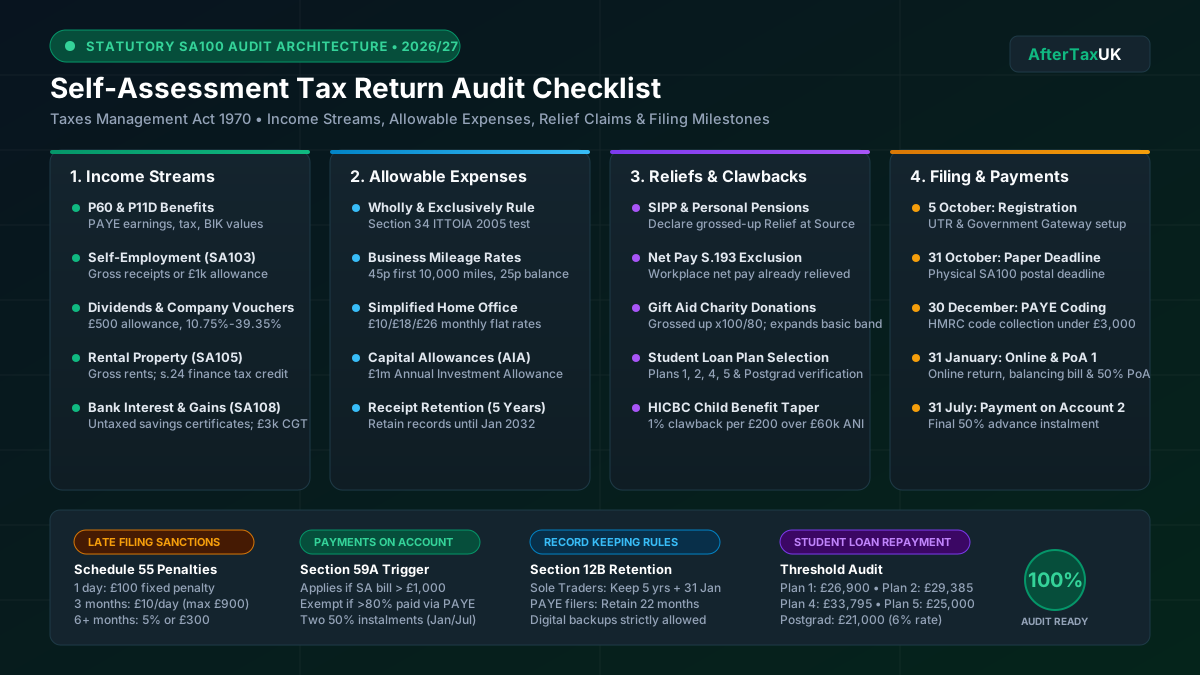
1. Statutory Filing Triggers: Who Must Submit an SA100 Return?
Under Section 7 and Section 8 of the Taxes Management Act 1970 (TMA 1970), individuals with untaxed income or specific statutory circumstances have a mandatory duty to notify HM Revenue & Customs (HMRC) and submit an annual Self-Assessment tax return. For the 2026/27 tax year (running from 6 April 2026 to 5 April 2027), you must file an SA100 return if any of the following statutory triggers apply:
| Statutory Category | Statutory Threshold / Condition | Applicable SA Schedule |
|---|---|---|
| Self-Employed Sole Trader | Gross trading turnover exceeded £1,000 (Section 23ZB ITTOIA 2005) | SA103S / SA103F |
| Business Partner | Nominated partner or general partner in a trading partnership | SA104S / SA104F |
| Residential Landlord | Gross rental receipts over £1,000 or net taxable rental profit over £2,500 | SA105 (Property) |
| High Income Child Benefit Charge | Adjusted Net Income over £60,000 while claiming Child Benefit (ITEPA 2003 s.681B) | SA100 Core (Page TR4) |
| Untaxed Savings & Dividends | Savings interest exceeding PSA (£1,000/£500) or dividends over £500 Nil Rate | SA100 Core (Page TR3) |
| Chargeable Capital Gains | Gains exceeding £3,000 Annual Exempt Amount or asset disposal proceeds > £50,000 | SA108 (Capital Gains) |
| Personal Allowance Taper Trap | Adjusted Net Income exceeding £100,000 with complex reliefs, gift aid, or untaxed earnings | SA100 Core + Schedules |
2. Step 1: Pre-Filing Credentials and Digital Registration Audit
Before calculating figures or opening HMRC software, ensure your statutory registration credentials are active and accessible:
- 10-Digit Unique Taxpayer Reference (UTR):Assigned by HMRC upon registration under the Taxes Management Act 1970. Found on previous tax returns, 'Notice to File' letters, or inside your HMRC online personal tax account.
- National Insurance Number (NINO): Formatted as two letters, six digits, and a suffix letter (e.g. QQ 12 34 56 A). Mandatory for identity verification and Class 2 / Class 4 National Insurance record linking.
- Government Gateway Account & Multi-Factor Authentication: Verify login credentials and ensure your authentication phone number or app is operational. First-time registration requires an activation code sent by post, which takes 7 to 10 working days to arrive.
- Statutory Registration Deadline (5 October): If you commenced self-employment or received new untaxed income during the tax year, you must register for Self-Assessment with HMRC by 5 October following the end of that tax year.
3. Step 2: Income Streams Checklist and Statutory Documentation
Self-Assessment requires full disclosure of all worldwide income earned during the statutory tax year (6 April to 5 April). Audit your paperwork against each applicable schedule:
Employment and Directorships (SA102 Supplementary Schedule)
Every employment held during the tax year requires separate disclosure:
- Form P60 (End of Year Certificate): Enter total taxable pay and total PAYE tax deducted from Box 1 and Box 2.
- Form P45 (Details of Employee Leaving Work): If you left an employer during the tax year, enter figures from Part 1A.
- Form P11D (Expenses and Benefits): Statutory benefits in kind under ITEPA 2003 (company cars, private medical insurance, employer-provided accommodation, beneficial loans).
- Redundancy & Termination Settlements: Ensure the £30,000 statutory exemption under Section 401 ITEPA 2003 is correctly applied; PILON (Pay in Lieu of Notice) is fully taxable.
Sole Trader and Partnership Profits (SA103 Schedule)
Self-employment income must be declared on either the SA103S (short form for turnover under £90,000) or SA103F (full form):
- Gross Business Turnover: Total invoices, merchant gateway receipts, and client fees invoiced (accruals basis) or received (cash basis). Note that the cash basis is the statutory default.
- Trading Allowance vs Actual Expenses: If your allowable expenses are under £1,000, claim the flat £1,000 statutory allowance under Section 23ZB ITTOIA 2005. You cannot claim both actual expenses and the allowance.
- Construction Industry Scheme (CIS) Deductions: Collect all monthly CIS deduction statements from principal contractors. Reconcile total gross payments, material costs, and tax withheld at 20% or 30% to ensure full tax credit offset on your final SA100 calculation.
Property and Rental Receipts (SA105 Schedule)
Residential and commercial property income must be reported under UK property rules:
- Rental Income & Tenant Fees: Total gross rents collected across all properties during the tax year.
- Property Allowance (£1,000): Can be elected instead of actual repairs, insurance, and management fees if allowable costs are below £1,000.
- Section 24 Mortgage Finance Restriction: Under Section 24 ITTOIA 2005, residential mortgage interest and finance fees are not deductible expenses against rental profit. Instead, declare finance costs in Box 44 to claim a 20% basic rate tax credit deduction.
Dividends, Company Distributions and Investment Income
Declared on the core SA100 return (Page TR3):
- Dividend Counterfoils / Vouchers: Company director distributions and equity portfolio dividends. The Dividend Nil Rate is £500; dividends above this are taxed at 10.75% (Basic), 35.75% (Higher), and 39.35% (Additional).
- Bank & Building Society Interest: Annual tax interest certificates detailing gross untaxed interest. The Personal Savings Allowance (PSA) is £1,000 for Basic Rate taxpayers, £500 for Higher Rate taxpayers, and £0 for Additional Rate taxpayers.
- Exempt Assets (Do Not Report): Income earned within ISAs (Cash or Stocks & Shares) and NS&I Premium Bonds prizes are 100% tax-free and must never be entered on your SA100 return.
Capital Gains and Digital Assets (SA108 Schedule)
Disposals of property, cryptoassets, unlisted shares, and valuable chattels:
- Annual Exempt Amount: Capital gains are tax-free up to £3,000 per individual. Net gains above £3,000 are subject to Capital Gains Tax under the Taxation of Chargeable Gains Act 1992 (TCGA 1992).
- 60-Day UK Residential Property Returns: If you sold a UK residential property that was not fully covered by Private Residence Relief (PRR), you must have submitted a 60-day digital return and paid advance CGT. Enter these figures on the SA108 to reconcile final tax.
4. Step 3: Allowable Business Expenses and Receipt Integrity
Claiming valid business expenses lowers your net taxable trading profit, directly reducing your Income Tax and Class 4 National Insurance liabilities. However, every claim must satisfy strict statutory standards:
The Statutory "Wholly and Exclusively" Rule
Under Section 34 ITTOIA 2005, no deduction is allowed for any expenditure not incurred wholly and exclusively for the purposes of the trade or profession. Dual-purpose expenses (items with both business and personal benefit, such as ordinary clothing or general everyday meals) are legally prohibited unless a distinct, identifiable business proportion can be established (e.g. itemised business mobile phone calls).
Simplified Flat-Rate Allowances vs Actual Accounting Costs
Sole traders can choose between tracking actual itemised costs or using HMRC simplified flat rates:
- Business Mileage (Approved Mileage Allowance Payments - AMAP): 55p per mile for the first 10,000 business miles in cars or vans, and 25p per mile thereafter (24p for motorcycles, 20p for bicycles). Covers all fuel, insurance, depreciation, and repairs. Detailed journey logs with dates, postcodes, and business purposes are mandatory.
- Working from Home Flat Rate: £10 per month (25 to 50 hours worked from home per month), £18 per month (51 to 100 hours), or £26 per month (101 or more hours). Does not cover internet or telephone costs, which may be apportioned separately.
Capital Allowances and Equipment Relief
Purchases of business plant, machinery, tools, and computer equipment qualify for capital deductions:
- Annual Investment Allowance (AIA): Up to £1,000,000 of 100% first-year tax write-off on qualifying plant and machinery.
- Cash Basis Capital Deductions: Under simplified cash basis rules, most equipment purchases can be deducted immediately as allowable expenses rather than pooled across multiple years.
Mandatory Five-Year Record Retention (TMA 1970 s.12B)
Under Section 12B of the Taxes Management Act 1970, self-employed individuals and landlords must preserve all business records (invoices, expense receipts, bank statements, and mileage records) for at least 5 years after the 31 January submission deadline. For the 2026/27 tax year, records must be retained until at least 31 January 2033. HMRC imposes statutory penalties of up to £3,000 for failing to maintain adequate records.
5. Step 4: Pension Tax Relief, Gift Aid and Statutory Allowance Declarations
Millions of pounds in legitimate tax relief are left unclaimed every year because filers confuse pension contribution structures or fail to gross up charitable donations:
Pension Tax Relief: Net-Pay vs Relief at Source (RAS)
The golden rule of UK pension tax reporting:
- Net-Pay Arrangements (Section 193 Finance Act 2004): Used in most traditional workplace occupational schemes. Contributions are deducted directly from your gross salary before PAYE tax is calculated. Do not enter these contributions on your SA100 return, as you have already received 100% of your tax relief through your payslip.
- Relief at Source (RAS) Schemes (SIPP & Personal Pensions): Contributions are paid from your net bank account. The scheme provider automatically claims 20% basic rate relief from HMRC (e.g. you deposit £800, and the provider adds £200 to credit £1,000 into your pension fund).
SIPP and Personal Pension Higher Rate Tax Reclaim
If you are a Higher Rate (40%) or Additional Rate (45%) taxpayer (or 42%/45%/48% in Scotland), you must declare your Relief at Source contributions on Page TR4 (Box 1) of the SA100. Enter the grossed-up contribution (£1,000 in the example above). HMRC recalculates your tax computation by expanding your Basic Rate tax band by £1,000, delivering an extra £200 (for 40% taxpayers) or £250 (for 45% taxpayers) in reduced tax or cash rebate.
Gift Aid Declarations (Finance Act 2004 s.414)
Donations made under Gift Aid allow charities to reclaim 20% basic tax relief. Higher-rate and additional-rate taxpayers can reclaim the difference on their SA100. Enter the net donations grossed up by 100/80 (e.g. an £80 donation is entered as £100 gross). This expands your basic rate band, reducing your higher-rate tax liability by 20% (£20) of the gross donation.
Marriage Allowance Transfer (ITA 2007 s.55A)
Under Section 55A of the Income Tax Act 2007, an individual earning below the £12,570 Personal Allowance can transfer 10% (£1,260) of their allowance to their civil partner or spouse, provided the recipient pays tax at the 20% Basic Rate. This saves up to £252 per tax year. Ensure this election is active or confirmed on your SA100 return.
6. Step 5: Student Loan Repayments and High Income Child Benefit Charge
Student loan repayments and family benefit charges represent two of the most frequent sources of HMRC automatic assessment adjustments:
Student Loan Repayment Plan Verification (2026/27 Thresholds)
If you hold a student loan administered by the Student Loans Company (SLC), you must tick the correct plan checkbox on Page TR5 of your SA100 return. Repayments are calculated on your total earned income above the following statutory thresholds:
- Plan 1: £26,900 threshold, 9% deduction rate.
- Plan 2: £29,385 threshold, 9% deduction rate.
- Plan 4 (Scottish Borrowers): £33,795 threshold, 9% deduction rate.
- Plan 5 (English Courses Starting 2023+): £25,000 threshold, 9% deduction rate.
- Postgraduate Loan: £21,000 threshold, 6% deduction rate (runs concurrently with undergraduate plans).
Crucial PAYE Offset: If your employer already deducted student loan repayments through your payslip, enter that exact deduction figure from your P60 in Box 3. HMRC will credit this deduction against your overall student loan liability, preventing double charges.
High Income Child Benefit Charge (HICBC) Reconciliation
Under Sections 681B–681H of ITEPA 2003 (as reformed by the Finance Act 2024), the High Income Child Benefit Charge applies if your Adjusted Net Income (ANI) exceeds £60,000:
- Taper Band: The charge equals 1% of the total Child Benefit received for every £200 of ANI between £60,000 and £80,000.
- Full Clawback at £80,000: At £80,000 of ANI or above, 100% of the Child Benefit received by the household must be repaid via your SA100 return.
- Adjusted Net Income Calculation: Taxable earnings minus gross personal pension contributions and gross Gift Aid donations. Strategic pension contributions can bring your ANI below £60,000 to completely eliminate the charge.
7. Step 6: Statutory Deadlines, Payments on Account and Penalties
Self-Assessment operates under rigorous statutory milestones governed by the Taxes Management Act 1970 and the Finance Act 2009:
The Three Critical Filing and Payment Deadlines
Physical SA100 postal deadline
File online for debts under £3,000
Digital filing & payment deadline
Payments on Account Architecture (TMA 1970 s.59A)
If your balancing tax bill (Income Tax and Class 4 National Insurance) exceeds £1,000, and less than 80% of your total tax was deducted at source via PAYE, Section 59A of TMA 1970 requires advance payments towards next year's bill:
- First Payment on Account (50%): Due on 31 January alongside your balancing payment.
- Second Payment on Account (50%): Due on 31 July.
- Form SA303 Reduction: If you expect your untaxed income to fall significantly during the subsequent tax year, you can submit form SA303 to reduce your Payments on Account. Caution: if your income does not decrease, HMRC charges statutory interest on the underpayment from the original due dates.
Late Filing and Late Payment Penalty Structure
Under Schedule 55 and Schedule 56 of the Finance Act 2009, HMRC enforces progressive statutory sanctions for delays:
- 1 Day Late: Fixed £100 late filing penalty (applied automatically even if no tax is due).
- 3 Months Late: Daily penalties of £10 per day for up to 90 days (maximum £900).
- 6 Months Late: Additional 5% of tax liability or £300 (whichever is greater).
- 12 Months Late: Further 5% of tax liability or £300 (can rise to 100% of tax due for deliberate evasion).
- Late Payment Surcharges: 5% of unpaid tax charged at 30 days, 6 months, and 12 months late, alongside daily statutory interest charged at the Bank of England base rate plus 2.5%.
8. Step 7: Master 25-Point SA100 Pre-Submission Audit Checklist
Review every item before clicking "Submit" on your HMRC online tax return or commercial filing software:
| No. | Audit Checkpoint | Primary Source Document | Verification Status |
|---|---|---|---|
| Part A: Registration & Identification Credentials | |||
| 01 | 10-Digit Unique Taxpayer Reference (UTR) confirmed | HMRC Online Account / Welcome Letter | ✓ Verified |
| 02 | National Insurance Number (NINO) matches official records | P60 / National Insurance Card | ✓ Verified |
| 03 | Government Gateway 2FA active and accessible | Mobile App / SMS Authentication | ✓ Verified |
| Part B: Employment & Statutory Benefits (SA102) | |||
| 04 | Total pay and PAYE tax reconciled from all employments | P60 (or P45 for leaving employments) | ✓ Verified |
| 05 | Benefits in kind (car, medical insurance, loans) recorded | Form P11D (Section A through M) | ✓ Verified |
| 06 | Redundancy payments over £30,000 exemption separated | Compromise / Settlement Agreement | ✓ Verified |
| Part C: Self-Employment & Business Receipts (SA103) | |||
| 07 | Gross business turnover reconciled with bank deposits | Sales Invoices / Merchant Gateways | ✓ Verified |
| 08 | Election between £1,000 trading allowance or actual costs | Expense Ledger vs s.23ZB ITTOIA | ✓ Verified |
| 09 | CIS tax deductions suffered reconciled against statements | Monthly CIS Payment Certificates | ✓ Verified |
| 10 | Motor vehicle mileage logged (55p first 10,000 miles) | Business Travel Log / GPS Trackers | ✓ Verified |
| Part D: Property, Dividends & Savings (SA105 & SA100 Core) | |||
| 11 | Rental income and property service charges tallied | Tenancy Statements / Letting Agent Reports | ✓ Verified |
| 12 | Mortgage interest entered in Box 44 (Section 24 20% credit) | Annual Mortgage Statements | ✓ Verified |
| 13 | Company dividend vouchers gathered (£500 allowance) | Dividend Vouchers / Board Minutes | ✓ Verified |
| 14 | Untaxed savings interest declared; ISA gains excluded | Bank Interest Tax Certificates | ✓ Verified |
| 15 | Capital gains over £3,000 allowance or residential sales (SA108) | Completion Statements / Broker Reports | ✓ Verified |
| Part E: Tax Reliefs, Pension & Charitable Claims | |||
| 16 | SIPP / Personal pension Relief at Source gross contributions | Pension Annual Statement (Box 1 TR4) | ✓ Verified |
| 17 | Workplace Net-Pay pension contributions strictly excluded | P60 / Final March Payslip | ✓ Verified |
| 18 | Gift Aid donations grossed up by 100/80 declared | Charity Receipts / Bank History | ✓ Verified |
| 19 | Marriage Allowance transfer checked (ITA 2007 s.55A) | HMRC Online Marriage Election | ✓ Verified |
| Part F: Student Loans & Statutory Clawbacks | |||
| 20 | Correct Student Loan plan selected (Plan 1, 2, 4, 5, Postgrad) | Student Loans Company Correspondence | ✓ Verified |
| 21 | PAYE student loan deductions entered from P60 | P60 Box 'Student loan deductions' | ✓ Verified |
| 22 | High Income Child Benefit Charge calculated (ANI > £60k) | Child Benefit Bank Payments History | ✓ Verified |
| Part G: Submission, Calculation & Record Retention | |||
| 23 | HMRC computation audited for Payments on Account (s.59A) | HMRC Tax Calculation Summary | ✓ Verified |
| 24 | Online submission confirmation code and IR Mark archived | HMRC Submission Receipt PDF | ✓ Verified |
| 25 | Full audit trail and receipts archived for 5 statutory years | Cloud Storage / Digital Archive (to 2033) | ✓ Verified |
Model Your Sole Trader Tax & National Insurance
Calculate your exact Income Tax, Class 4 National Insurance, and take-home pay on your self-employed profits before filing your SA100 return.
Open the Self-Employed Tax Calculator (2026/27) →Frequently Asked Questions
Clear answers based on official HMRC rules and statutory guidance.
Statutory Citations & Official HMRC Links
Verified against primary UK tax legislation and HM Revenue & Customs manuals: