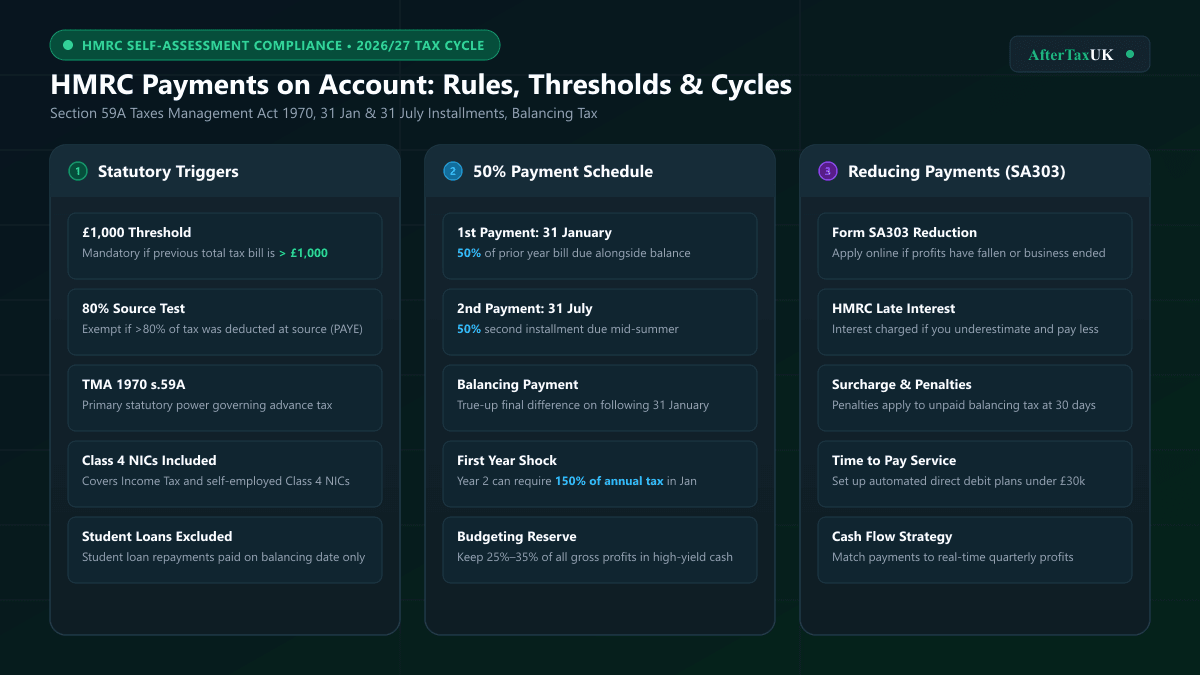
1. What Are Payments on Account? Statutory Authority & Scope
In the UK tax system, employees pay Income Tax and National Insurance contributions continuously throughout the year through PAYE (Pay As You Earn) deductions at source. To establish broad parity with employed workers, Parliament enacted Section 59A of the Taxes Management Act 1970 (TMA 1970), requiring self-assessed taxpayers to pay their tax in advance instalments across the tax year.
Each payment on account is exactly 50% of your previous year's relevant tax liability. HMRC assumes that you will earn an identical amount of taxable profit in the subsequent year, splitting the bill into two equal advance instalments.
What Liabilities Are Included?
Under Section 59A(1) TMA 1970, payments on account are calculated exclusively on:
- Income Tax assessed on trading profits, rental income, dividend income, and untaxed savings interest.
- Class 4 National Insurance contributions payable by self-employed sole traders (6% on profits between £12,570 and £50,270, and 2% above £50,270).
Strict Exclusions: Capital Gains Tax (CGT), Student Loan repayments, voluntary Class 2 NICs, and the High Income Child Benefit Charge (HICBC) do NOT form part of payments on account. They are payable once annually as part of the balancing payment on 31 January.
2. The Two Statutory Exemption Tests
You are automatically exempt from making payments on account if you meet either of two statutory criteria under Section 59A(1)(a)–(b) TMA 1970:
Test 1: The £1,000 Bill Threshold
If your total assessed tax and Class 4 NICs for the tax year was less than £1,000, no payments on account are triggered. You simply pay your balancing bill on 31 January.
Test 2: The 80% Source Deduction Rule
If more than 80% of your total tax bill was already deducted at source (e.g. through your day job via PAYE or CIS contractor deductions), you are exempt from payments on account, regardless of the amount.
If your untaxed bill is £1,000 or greater AND less than 80% was deducted at source, HMRC automatically enters you into the payments on account regime on your Self-Assessment statement.
3. The Payment Calendar: 31 January, 31 July & The Balancing Payment
The payments on account cycle operates on three fixed statutory dates:
| Statutory Milestone | Calendar Deadline | Statutory Payment Description |
|---|---|---|
| 1st Payment on Account | 31 January (Midnight) | 50% of the previous year's relevant tax liability. Due mid-tax year. |
| 2nd Payment on Account | 31 July (Midnight) | 50% second advance instalment. Due almost 4 months after the tax year ends. |
| Balancing Payment | Following 31 January | Final true-up: total actual liability minus payments on account already made, plus CGT and student loans. |
4. The "Year 2 Cliff Edge": A Worked Case Study
The most severe liquidity challenge for newly self-employed individuals is the Year 2 tax shock. Consider this worked statutory scenario:
Case Study: Sarah's First Two Years of Trading
Sarah commenced self-employment as a digital consultant in May 2025 (the 2025/26 tax year). Her first tax return submitted in January 2027 shows a total Income Tax and Class 4 NI liability of £6,000.
1. On 31 January 2027:
• 100% Balancing Payment for 2025/26: £6,000
• 1st Payment on Account for 2026/27 (50% of £6k): £3,000
→ Total Cash Due to HMRC on 31 January 2027: £9,000 (150% of tax bill!)
2. On 31 July 2027:
• 2nd Payment on Account for 2026/27 (50% of £6k): £3,000
3. On 31 January 2028 (Balancing calculation):
• Sarah submits her 2026/27 return, showing actual liability of £7,000.
• Already paid on account: £3,000 + £3,000 = £6,000.
• Balancing payment due: £7,000 − £6,000 = £1,000.
• Plus 1st Payment on Account for 2027/28 (50% of £7k): £3,500.
→ Total Cash Due on 31 January 2028: £4,500.
Without adequate liquidity planning, paying £9,000 in a single month during Year 2 causes severe cash-flow distress. Taxpayers should maintain a dedicated business tax savings reserve.
5. How to Reduce Payments on Account (Form SA303) & The Risk
If your profits drop substantially—for example, due to the loss of a key client, transitioning to an inside-IR35 contract where tax is deducted at source, taking extended parental leave, or business closure—you do not have to pay the full calculated instalments.
Under Section 59A(3) TMA 1970, you can claim to reduce your payments on account:
- Online via HMRC Account: Navigate to "Reduce Payments on Account" inside your Self-Assessment portal.
- Form SA303: Submit HMRC Form SA303 by post or as part of your annual SA100 return (Box 11 on the Tax Calculation Summary page).
The Underestimation Trap: Statutory Interest
Reducing payments on account without accurate forecasting is dangerous. If you reduce your payments and your actual profits end up exceeding your reduced estimate, HMRC charges statutory late-payment interest under Section 101 Finance Act 2009 on the shortfall from the original due date (31 January or 31 July).
Interest is calculated back to the date the money should have been paid. While HMRC does not impose a penalty for an honest reduction, deliberate or negligent under-declarations can trigger investigations.
6. Late Payment Interest, Penalties & Time to Pay
Understanding how HMRC enforces payment deadlines is vital for self-assessed taxpayers:
- Late Payment Interest on Payments on Account: Charged daily from the due date until settlement. HMRC's interest rate tracks the Bank of England base rate plus 2.5%, making overdue tax costly.
- No Surcharge on Payments on Account: Unlike the final balancing payment, payments on account do not attract the 5% late payment penalty under Schedule 56 of the Finance Act 2009. The 5% surcharge only applies if the final balancing payment remains unpaid 30 days after 31 January (with additional 5% penalties at 6 months and 12 months).
- HMRC Time to Pay (TTP) Service: If you cannot pay in full, you can set up a formal "Time to Pay" arrangement online if your tax debt is under £30,000, you have no other existing tax payment plans, and your return is up to date. This stops debt recovery action, though interest continues to accrue.
Estimate Your Self-Employed Tax & Payments
Model your gross trading turnover, allowable expenses, Class 4 NICs, and preview your upcoming payments on account instalments.
Launch the Self-Employed Tax CalculatorFrequently Asked Questions
Frequently Asked Questions
Clear answers based on official HMRC rules and statutory guidance.
Statutory Sources & Primary Legislation
Self-Assessment payments on account are defined by primary UK legislation and HMRC manuals: