How this comparison was prepared
Published UK SIPP charges and official pension guidance. Selected fee terms were checked on 26 October 2026. This guide does not assess personal suitability or predict investment returns.
Provider links are supplied for further research. Inclusion is not an endorsement or a personalised recommendation. Check the latest terms and your own circumstances before acting.
Start with these three checks
- Describe the portfolio: funds versus shares or ETFs, expected pot size, contribution frequency and likely dealing activity.
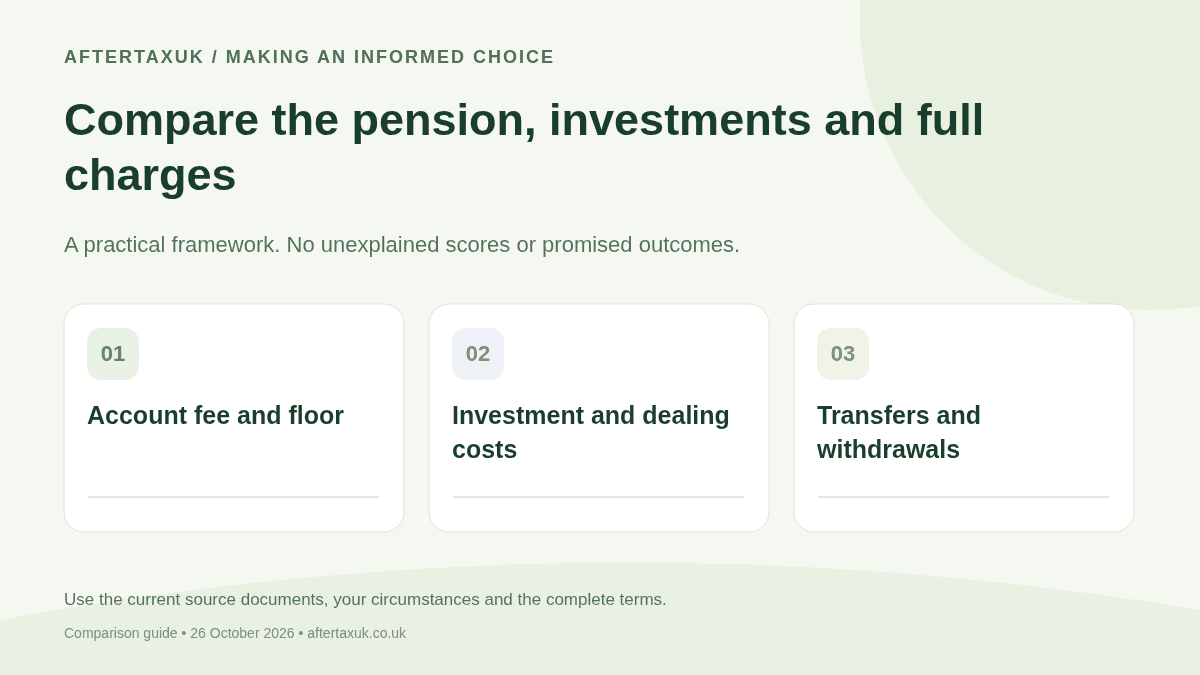
- Calculate account charges using the actual minimums, tiers and caps. Add fund costs, trades, foreign exchange and charges for the services you will use.
- Check transfer protections, supported investments, service and retirement options before choosing. A cheaper account can still be unsuitable.
Options to investigate and what to check
This is a research shortlist, not an ordered league table. Compare the same needs and assumptions in each case.
Vanguard Personal Investor
Someone considering the provider’s available investments in a self-managed account.
Check: Its standard self-managed account fee is £4 a month below £32,000, then 0.15% a year capped at £375. Check exemptions, how account values are combined and additional investment costs.
Published informationAJ Bell SIPP
Someone comparing a wider range of funds, shares and ETFs.
Check: The published schedule distinguishes shares at 0.25%, capped at £10 a month, from tiered fund charges. It also lists dealing fees. Apply the right category to each holding.
Published informationHargreaves Lansdown SIPP
Someone comparing investment choice, retirement services and its charging structure.
Check: The current schedule lists a 0.35% first-tier funds charge and 0.35% for shares/equities capped at £12.50 a month. Fund tiers, dealing and other charges need separate checks.
Published informationInteractive Investor SIPP
Someone investigating a subscription-based account alongside other investments.
Check: Use its current plan schedule for the account combination you intend to hold. Do not reuse an old monthly subscription or assume all retirement and trading services are included.
Published informationWhy a percentage headline can be misleading
A minimum fee changes the cost for small balances; a cap changes it for larger balances. Vanguard’s standard self-managed floor of £48 a year is 0.48% of a £10,000 balance, rather than £15 from a simple 0.15% multiplication. At £50,000, the account fee is £75 under the standard schedule. Applicable exemptions and holdings across accounts can change the calculation.
These are account charges only. The investment fund has its own ongoing costs and transaction costs. A portfolio of shares or ETFs may also incur dealing, foreign exchange or spreads. Compare the same investment and trading assumptions on each platform.
Compare fund holdings and share holdings separately
Some providers charge funds in tiers but cap the custody charge for shares, investment trusts or ETFs. A table applying an uncapped fund rate to an ETF portfolio gives a misleading result. A low custody bill can also be offset by frequent dealing charges.
For a mixed portfolio, work out the account fee for each charge category, apply the relevant limits and then add service costs. Ask for the current key features and charges documents where a provider’s online example does not match your circumstances.
A pension transfer is more than a price switch
Before moving a pension, check for safeguarded benefits, protected tax-free cash, a protected pension age, guarantees, exit costs and employer contributions. A defined-benefit transfer is a different decision from combining ordinary defined-contribution pots and can require regulated advice.
Investments may be sold during a cash transfer, leaving time out of the market. An in-specie transfer may preserve holdings only where both providers support them. Compare the practical transfer process and the retirement options you expect to need.
Tax relief depends on your circumstances and contribution type. The annual allowance and the earnings limit for tax-relieved personal contributions are separate rules; a provider’s pension wrapper does not guarantee relief on any amount paid in.
Worked account-fee comparison, not a provider ranking
The first column models Vanguard’s standard self-managed account fee for a single positive balance, with no exemption and no other holdings. The other columns are hypothetical schedules for comparison, not named provider quotes.
| Balance | Vanguard standard account fee | Illustrative uncapped 0.25% | Illustrative £180 yearly |
|---|---|---|---|
| £10,000 | £48 | £25 | £180 |
| £25,000 | £48 | £62.50 | £180 |
| £50,000 | £75 | £125 | £180 |
| £100,000 | £150 | £250 | £180 |
All columns exclude fund, dealing, foreign-exchange and retirement-service costs. There is no universal £50,000 break-even rule: an uncapped 0.25% fee equals £180 at £72,000.
Sources and further checks
Use these official guidance pages alongside the provider pages linked above. Published charges and terms can change; a quote and full contract are needed for a personal decision.
Found a changed term or an error? Send a correction with the page URL and the relevant source.
Questions about this comparison
Practical points to check before choosing a product or service.