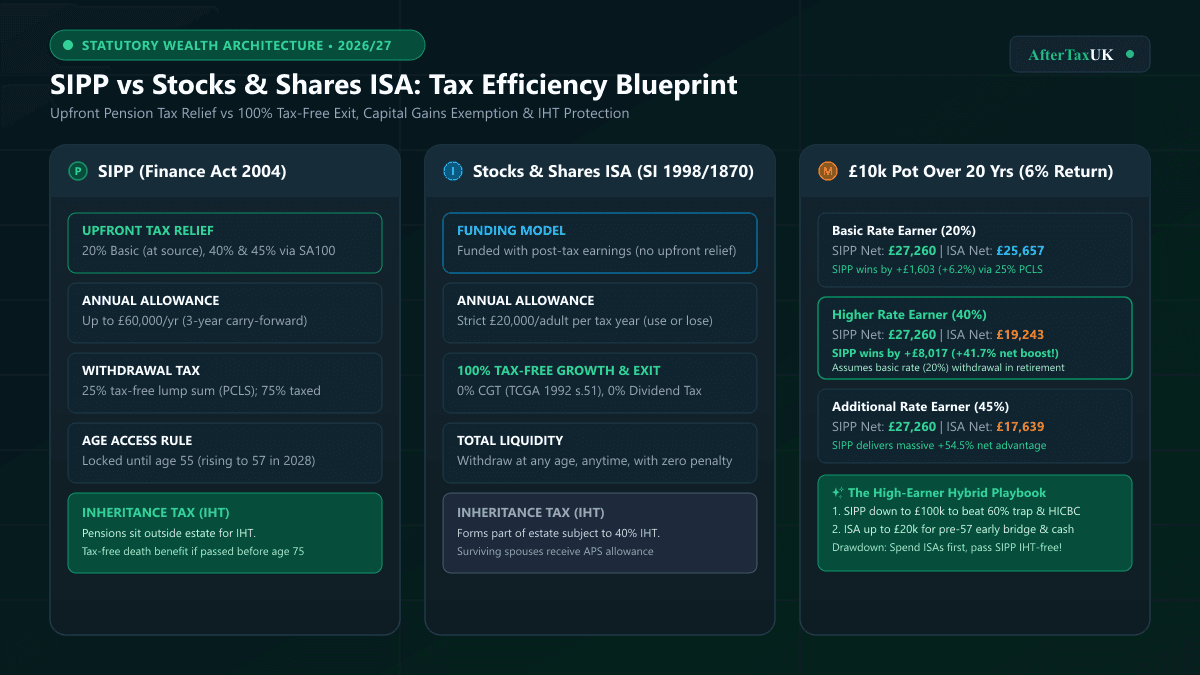
The Core Conflict: Upfront Tax Relief vs Tax-Free Exit
In UK tax jurisprudence, pensions and ISAs represent two distinct fiscal philosophies often classified by economists as **EET** and **TEE**:
Exempt, Exempt, Taxed
- Exempt Contribution: Paid from pre-tax income or boosted with 20% to 45% HMRC tax relief.
- Exempt Growth: Zero Capital Gains Tax (CGT) and zero tax on dividends or fund distributions.
- Taxed Exit: First 25% withdrawn tax-free; remaining 75% taxed at your marginal Income Tax rate in retirement.
Taxed, Exempt, Exempt
- Taxed Contribution: Funded entirely from post-tax earnings (no upfront tax relief).
- Exempt Growth: Zero Capital Gains Tax (TCGA 1992 s.51) and zero UK dividend or interest tax.
- Exempt Exit: 100% tax-free withdrawals at any age, anytime, with zero reporting to HMRC.
SIPP Mechanics: Statutory Rules Under the Finance Act 2004
A Self-Invested Personal Pension is a government-approved defined contribution pension scheme providing full investment control across equities, exchange-traded funds (ETFs), investment trusts, and commercial property.
1. Upfront Tax Relief Ladder
SIPP contributions receive Income Tax relief matched to your highest marginal tax band:
- Basic Rate (20%): An £80 net contribution is topped up with £20 basic rate tax relief directly from HMRC, creating a £100 gross investment pot.
- Higher Rate (40%): You receive the basic 20% in the pot, plus an additional £20 claimed back via Self-Assessment (SA100), reducing the net cost of a £100 investment to just £60.
- Additional Rate (45%): You receive the 20% pot top-up, plus an extra £25 claimed via Self-Assessment, reducing the net cost of £100 down to just £55.
2. The 25% Tax-Free Lump Sum (PCLS)
Under the Lump Sum Allowance established by the Finance Act 2024 (which abolished the Lifetime Allowance), individuals can withdraw up to 25% of their total pension pot completely tax-free, up to a lifetime cap of £268,275. The remaining 75% is placed into flexi-access drawdown or used to buy an annuity, where withdrawals are taxed as ordinary non-savings income.
3. Age Access Rule & Finance Act 2022 Changes
SIPP funds are legally locked until the Normal Minimum Pension Age (NMPA). While currently age 55, Section 10 of the Finance Act 2022 legislates an increase to **age 57 from 6 April 2028**. Unlike ISAs, you cannot access SIPP capital early for house deposits, emergencies, or debt clearance without triggering a 55% HMRC unauthorized payment penalty.
4. Superior Inheritance Tax (IHT) Protection
Under Sections 150 and 151 of the Finance Act 2004, defined contribution pensions like SIPPs are held in trust and **sit outside your legal estate for UK Inheritance Tax**. If you die before age 75, your beneficiaries inherit the pot completely free of Income Tax and free of 40% IHT. If you die at or after age 75, the pot remains free of IHT, and beneficiaries pay Income Tax only as and when they draw income at their personal marginal rate.
Stocks & Shares ISA Mechanics: Rules Under SI 1998/1870
Individual Savings Accounts operate under the Individual Savings Account Regulations 1998 (SI 1998/1870). Designed to encourage personal saving and retail investment, they offer unprecedented simplicity and liquidity:
1. £20,000 Annual Subscription Allowance
Every UK resident aged 18 or over has a statutory £20,000 annual ISA subscription allowance. This allowance is strictly "use it or lose it"—unused capacity cannot be rolled forward into subsequent tax years, unlike pension carry-forward rules.
2. Complete Exemption from Capital Gains & Dividend Tax
All investment growth inside an ISA is permanently sheltered from HM Revenue & Customs:
- 0% Capital Gains Tax: Under Section 51 of the Taxation of Chargeable Gains Act 1992 (TCGA 1992), no CGT is charged regardless of profit size, saving up to 20% on shares.
- 0% Dividend Tax: Under ITTOIA 2005, dividends generated inside an ISA are completely tax-free, saving up to 39.35% for Additional Rate taxpayers.
- Zero HMRC Reporting: You do not need to declare ISA investments, sales, or withdrawals on a Self-Assessment tax return.
3. Absolute Liquidity at Any Age
The fundamental advantage of an ISA over a SIPP is liquidity. You can withdraw £500 or £50,000 at age 25, 45, or 65 with zero tax, zero penalty, and immediate access. Flexible ISAs also allow you to withdraw cash and replace it within the same tax year without reducing your remaining allowance.
4. Inheritance Tax Vulnerability
Unlike SIPPs, ISAs form part of your estate upon death and are fully liable to 40% Inheritance Tax above your nil-rate band. However, surviving spouses or civil partners are entitled to an Additional Permitted Subscription (APS) allowance equal to the deceased partner's ISA value on date of death, preserving tax-free status for the survivor.
Head-to-Head 20-Year Growth Comparison: £10,000 Pot
To understand the mathematical trade-off between upfront tax relief and tax-free withdrawals, consider an investor dedicating **£10,000 of gross earnings** to either an ISA or a SIPP, compounding at an annualised 6% return over 20 years (total portfolio growth factor of 3.207x):
| Tax Band at Investment | Vehicle | Initial Pot | Pot at Year 20 | Tax on Exit | Net Spendable Cash | Winner |
|---|---|---|---|---|---|---|
| Basic Rate (20%)Gross £10k | Stocks & Shares ISA | £8,000 | £25,657 | £0 (0%) | £25,657 | — |
| SIPP (Basic Exit) | £10,000 | £32,071 | £4,811 (15% eff.) | £27,260 | SIPP (+6.2%) | |
| Higher Rate (40%)Gross £10k | Stocks & Shares ISA | £6,000 | £19,243 | £0 (0%) | £19,243 | — |
| SIPP (Basic Exit) | £10,000 | £32,071 | £4,811 (15% eff.) | £27,260 | SIPP (+41.7%) | |
| Additional Rate (45%)Gross £10k | Stocks & Shares ISA | £5,500 | £17,639 | £0 (0%) | £17,639 | — |
| SIPP (Basic Exit) | £10,000 | £32,071 | £4,811 (15% eff.) | £27,260 | SIPP (+54.5%) |
Key Mathematical Insight: The Pension Tax Arbitrage
Notice why the SIPP outperforms so decisively for Higher and Additional Rate earners: you claim tax relief at **40% or 45%** when your earnings are high during your working career, but you withdraw funds in retirement at an effective tax rate of just **15%** (25% tax-free PCLS plus 75% taxed at the 20% Basic Rate). This 25% to 30% tax rate arbitrage delivers an enormous **41.7% to 54.5% boost in spendable net cash**.
The Hybrid Strategy: How Top UK Earners Combine Both
Sophisticated UK financial planners rarely treat SIPPs and ISAs as an either/or choice. Instead, high-earning households deploy a coordinated hybrid allocation strategy:
Step 1: Eliminate the £100k 60% Marginal Tax Trap
If your gross salary falls between £100,000 and £125,140, contribute the excess into your SIPP. Every £1,000 contributed saves £600 in Income Tax and £20 in National Insurance, while restoring your £12,570 Personal Allowance and protecting valuable childcare subsidies.
Step 2: Build the Pre-57 Early Retirement Bridge
Because SIPP funds cannot be touched before age 57 (from April 2028), you must not lock all surplus wealth inside pensions if you desire early retirement or financial independence at age 45 or 50. Maximize your £20,000 Stocks and Shares ISA to fund the critical years between your early retirement date and age 57.
Step 3: The Inheritance Tax Drawdown Waterfall
Once in retirement, prioritize spending down taxable cash and ISA balances first. Because ISAs are subject to 40% Inheritance Tax while SIPPs sit outside the estate for IHT, depleting your ISA while leaving your SIPP pot intact allows you to transfer maximum wealth to your children completely IHT-free.
Frequently Asked Questions: SIPP vs ISA
Frequently Asked Questions
Clear answers based on official HMRC rules and statutory guidance.
Primary Statutory References
All tax relief limits, allowances, and statutory treatment are verified against official UK legislation:
- Finance Act 2004 (Part 4: Pension Schemes & Relief at Source)
- Finance Act 2022 Section 10: Increase in Normal Minimum Pension Age to 57
- Individual Savings Account Regulations 1998 (SI 1998/1870 as amended)
- Taxation of Chargeable Gains Act 1992 (TCGA 1992 Section 51: Exemption for ISAs)
- HM Revenue & Customs (HMRC): SIPP Tax Relief & Lump Sum Allowance guidance