1. What Is Gross Pay?
Gross pay is the total remuneration an employee earns before any statutory deductions, income taxes, or employee pension contributions are removed. It is the legal salary stated on your employment contract or job offer letter.
Under UK employment law and Section 62 of the Income Tax (Earnings and Pensions) Act 2003 (ITEPA 2003), gross pay encompasses all forms of employment emoluments, including:
- Basic contractual salary or hourly wages: Your core rate of pay for standard agreed hours.
- Overtime payments: Enhanced hourly rates (e.g. time-and-a-half or double time) for extra hours worked.
- Performance bonuses & commission: Discretionary or contractual incentive awards.
- Allowances & enhancements: London Weighting (such as NHS High Cost Area Supplement), shift allowances, or on-call pay.
- Statutory payments: Statutory Sick Pay (SSP), Statutory Maternity Pay (SMP), Statutory Paternity Pay (SPP), and Statutory Redundancy Pay above statutory thresholds.
Important Distinction: Gross Pay vs Gross Revenue
For salaried employees, gross pay is your contractual pay before tax. If you are self-employed as a sole trader or limited company director, gross income (or turnover) refers to total business receipts before deducting allowable commercial expenses and capital allowances.
2. What Is Net Pay?
Net pay—commonly called take-home pay—is the actual amount of money transferred into your bank account via Bacs on payday. It represents gross pay minus all mandatory statutory deductions and voluntary workplace deductions.
Under Section 8 of the Employment Rights Act 1996 (ERA 1996), UK employers are legally required to provide an itemised payslip on or before payday clearly setting out gross earnings, every individual deduction amount, and the resulting net pay.
3. The UK Payroll Deductions Ladder (Step-by-Step)
Every pay cycle, payroll software runs your earnings through a precise sequential calculation determined by HMRC regulations. Here is exactly how each pound is treated:
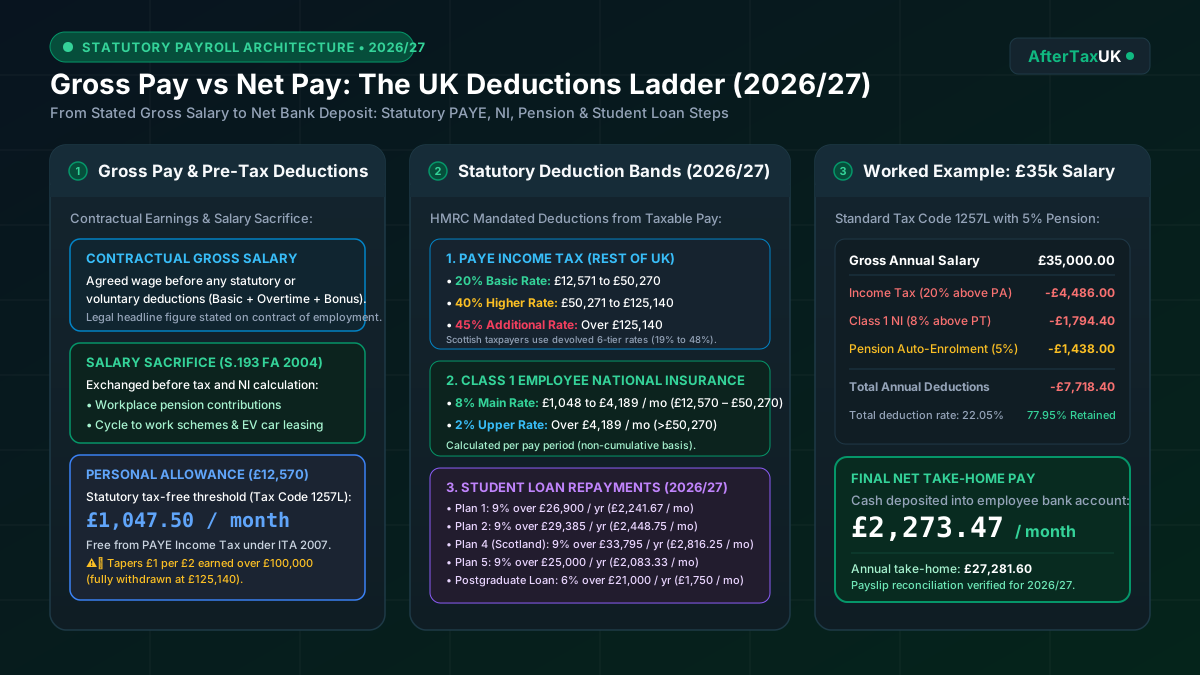
Step 1: Salary Sacrifice & Pre-Tax Deductions
If your employer operates an approved salary sacrifice arrangement under Section 193 of the Finance Act 2004, you agree to exchange a portion of your gross cash salary in return for a non-cash benefit. Common salary sacrifice schemes include:
- Workplace Pension Contributions: Deducted before tax and National Insurance, providing immediate dual savings.
- Cycle to Work Scheme: Purchasing a bicycle and equipment from pre-tax salary.
- Ultra-Low Emission Vehicle (ULEV/EV) Schemes: Electric company car leasing (attracting only 4% Benefit-in-Kind for 2026/27).
Step 2: The Tax-Free Personal Allowance
Under Section 35 of the Income Tax Act 2007 (ITA 2007), UK residents are entitled to a standard tax-free Personal Allowance of £12,570 per tax year (represented by tax code 1257L). This equals £1,047.50 per month or £241.73 per week completely exempt from Income Tax.
The £100k Taper Trap: For adjusted net income exceeding £100,000, your Personal Allowance reduces by £1 for every £2 of income over £100,000, disappearing completely at £125,140 and creating an effective 60% marginal tax rate on income in that band.
Step 3: PAYE Income Tax Bands
Taxable pay above your Personal Allowance is taxed in progressive bands:
| Tax Band (England, Wales, NI) | Taxable Income Range (2026/27) | Income Tax Rate |
|---|---|---|
| Personal Allowance | Up to £12,570 | 0% (Tax-Free) |
| Basic Rate | £12,571 to £50,270 | 20% |
| Higher Rate | £50,271 to £125,140 | 40% |
| Additional Rate | Over £125,140 | 45% |
Step 4: Class 1 Employee National Insurance Contributions (NICs)
Unlike Income Tax, National Insurance is non-cumulative and assessed strictly on earnings within each individual pay period under the Social Security Contributions and Benefits Act 1992:
- 8% Main Rate: Applied to monthly earnings between the Primary Threshold (£1,047.50 / month, £12,570 annually) and Upper Earnings Limit (£4,189.17 / month, £50,270 annually).
- 2% Upper Rate: Applied to monthly earnings exceeding £4,189.17 (£50,270 annually).
Step 5: Student Loan Deductions
If you hold a student loan, repayments are deducted automatically through PAYE once earnings exceed your plan's statutory annual threshold:
- Plan 1: 9% of earnings over £26,900 / year (£2,241.67 / month).
- Plan 2: 9% of earnings over £29,385 / year (£2,448.75 / month).
- Plan 4 (Scotland): 9% of earnings over £33,795 / year (£2,816.25 / month).
- Plan 5: 9% of earnings over £25,000 / year (£2,083.33 / month).
- Postgraduate Loan: 6% of earnings over £21,000 / year (£1,750.00 / month).
4. Real Payslip Case Studies (2026/27 Tax Year)
To see how gross pay translates into net pay in practice, examine three realistic UK salary profiles:
Case 1: £25,000 Gross Salary (Living Wage Earner)
Single employment, standard tax code 1257L, 5% auto-enrolment pension, no student loan.
Annual Take-Home: £20,583.48 (Effective deduction rate: 17.67%).
Case 2: £35,000 Gross Salary (UK Median Benchmark)
Standard code 1257L, 5% auto-enrolment pension, Plan 2 student loan.
Includes £119.83/mo pension and £42.11/mo Plan 2 student loan repayment.
Case 3: £65,000 Gross Salary (Higher Rate Earner)
Higher rate tax band, standard code 1257L, 5% workplace pension, Plan 2 student loan.
Includes £244.83/mo pension and £267.11/mo Plan 2 repayment. Marginal tax rate on extra earnings is 42% (or 51% with student loan).
5. Decoding Your UK Payslip Terminology
Understanding the labels and abbreviations on your monthly payslip helps you detect employer payroll errors immediately:
- Tax Code: Typically
1257Lfor standard allowance. Codes starting withBRtax all earnings at 20% flat without an allowance;0Treflects zero allowance;Kindicates taxable benefits exceeding your allowance. - Gross for Tax (Taxable Pay): Your gross pay minus any pre-tax pension or salary sacrifice deductions.
- Gross for NI: Earnings liable for Class 1 National Insurance. Some benefits that are subject to Income Tax do not attract employee NI.
- NI Category: Most UK employees are Category
A(standard rate). CategoryMapplies to under-21s, and CategoryHapplies to apprentice employees under 25. - Year to Date (YTD): Cumulative running totals of all gross pay, Income Tax, and NI deducted since the start of the current tax year (6 April).
- Employer National Insurance: Secondary Class 1 contributions paid directly by your employer (15.0% above the £5,000 secondary threshold under the NICA 2025). This is paid by the employer and is not deducted from your gross pay.
Calculate Your Exact Take-Home Pay
Enter your salary, tax code, pension contribution, and student loan plan into our verified statutory PAYE engine.
Launch the Take-Home Pay Calculator (2026/27) →Frequently Asked Questions
Clear answers based on official HMRC rules and statutory guidance.
Statutory Sources & Further Reading
All figures and rates are verified against primary UK statutory sources: