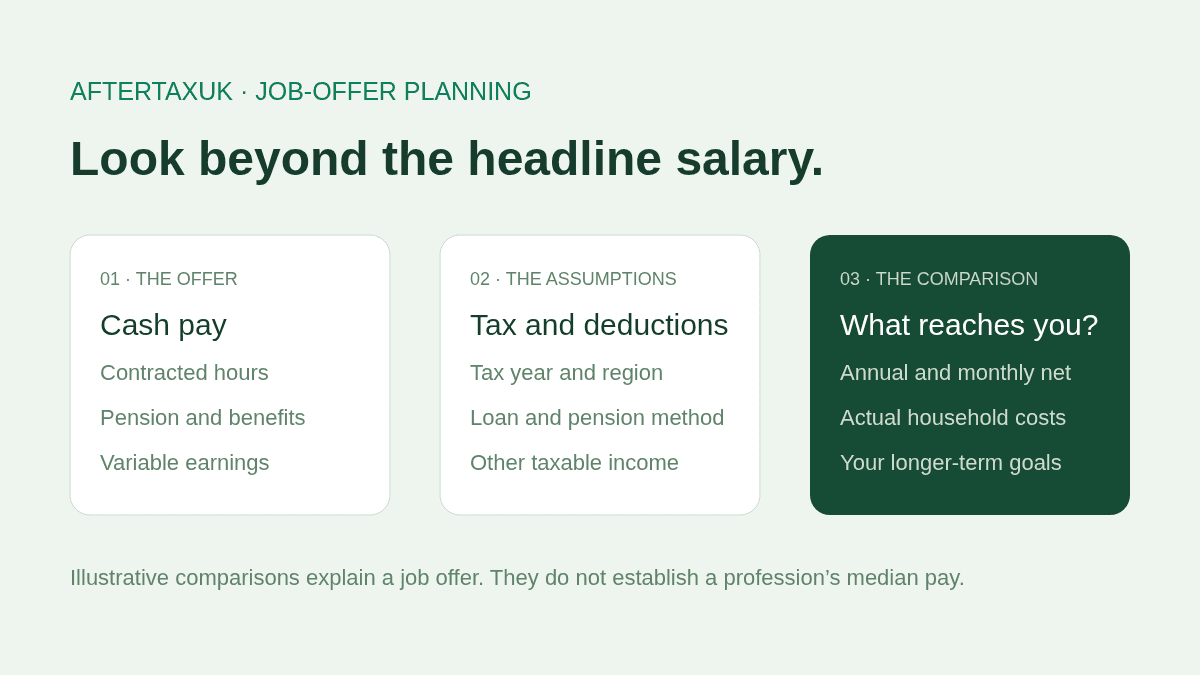
Research earnings before ranking careers
ONS Annual Survey of Hours and Earnings data describes employee earnings for a specified period and population. Occupation medians do not promise a starting salary, and a national figure can conceal regional, seniority and part-time differences.
Read the release year, occupation definition and coverage. A vacancy, a contractor assignment rate and a director dividend distribution are not equivalent earnings measures. Bonuses, commission and overtime may be uncertain rather than contractual cash.
- Use the ONS ASHE releases for the relevant dated dataset.
- Use the National Careers Service for training and entry-route research.
- Check current employer vacancies, contracted hours and the published pay scale where a role has one.
Illustrative salary offers after tax
These are examples of possible annual salaries, not claims about what any named profession earns. The figures are generated from the same annual tax engine as our take-home calculator.
| Annual gross offer | Monthly net | Income Tax / year | Employee NI / year |
|---|---|---|---|
| £60,000.00 | £3,779.78 | £11,432.00 | £3,210.60 |
| £75,000.00 | £4,504.78 | £17,432.00 | £3,510.60 |
| £100,000.00 | £5,713.12 | £27,432.00 | £4,010.60 |
| £120,000.00 | £6,346.45 | £39,432.00 | £4,410.60 |
| £150,000.00 | £7,607.20 | £53,703.00 | £5,010.60 |
| £200,000.00 | £9,815.53 | £76,203.00 | £6,010.60 |
2026/27 England, Wales and Northern Ireland, standard 1257L, no pension, student loan, benefits in kind or other income. Actual payroll timing and rounding can differ.
What the headline salary leaves out
- Contracted hours: compare equivalent hours and unpaid travel or on-call commitments.
- Pension: compare employer contributions and the employee pension method, not just the percentage on the offer letter.
- Variable pay: separate guaranteed base pay from discretionary bonus, commission and shares.
- Costs: use your actual housing, commuting, childcare and professional-registration costs instead of an unsourced national budget.
- Progression: review training time, required qualifications and the actual route to higher pay.
Why £100,000 needs a closer look
Adjusted net income above £100,000 reduces the Personal Allowance by £1 for every £2 above the threshold. This can create a 60% marginal Income Tax rate within the taper range in England, Wales and Northern Ireland, before NI or loan repayments. It does not apply that rate to the whole salary.
Childcare and pension rules have separate conditions. Check the Personal Allowance taper guide and compare the actual offer in the take-home calculator.
Frequently Asked Questions
Clear answers based on official HMRC rules and statutory guidance.