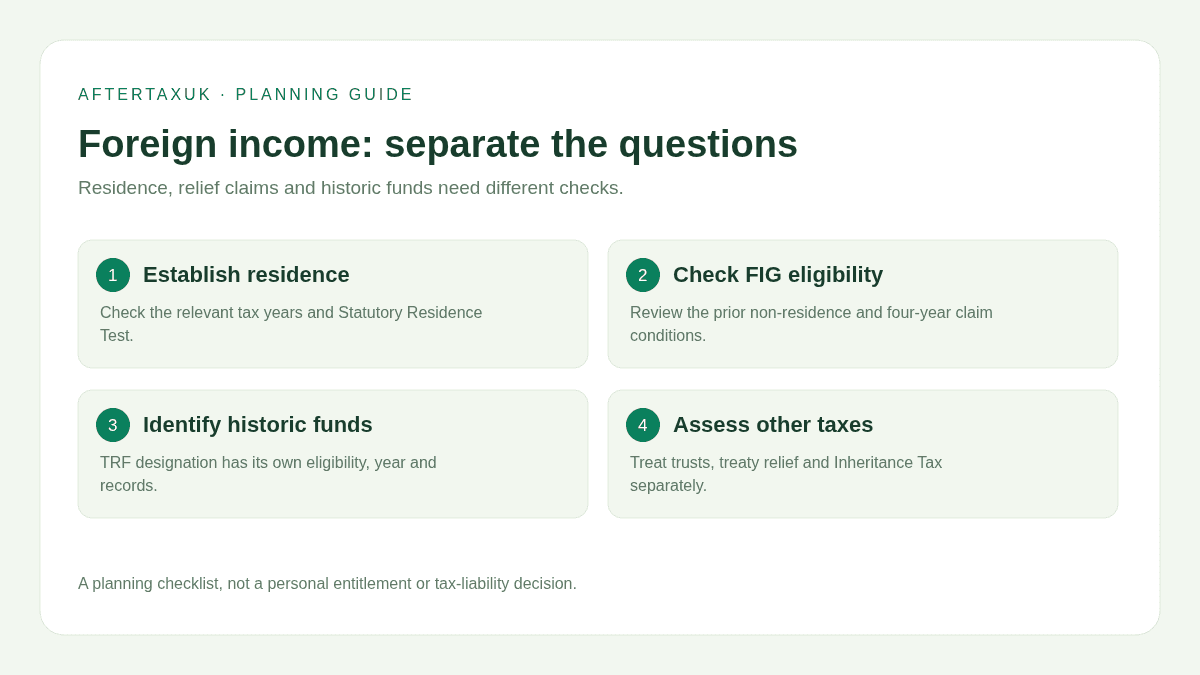
1. The End of the Remittance Basis & Domicile Concepts
For over two centuries, the UK operated the "remittance basis" under Chapter A1 of Part 14 of the Income Tax Act 2007 (ITA 2007). Under that system, individuals living in the UK whose legal domicile was overseas were exempt from UK tax on foreign income and capital gains, provided those funds remained offshore and were never "remitted" into the UK.
Following major cross-party legislative reforms enacted in the Finance Act, the remittance basis regime and the concept of domicile for tax purposes were formally repealed from 6 April 2025.
In its place, the UK has adopted an internationally aligned, residence-based framework centred on the 4-Year Foreign Income and Gains (FIG) Regime. Tax liability is now determined entirely by the number of years an individual resides in the UK under the Statutory Residence Test (SRT, Schedule 45 Finance Act 2013), completely eliminating ancestral domicile investigations.
2. How the 4-Year FIG Regime Works: 100% Exemption & Free Remittance
The 4-year FIG regime offers unprecedented tax flexibility for qualifying new arrivals during their initial 4 tax years of UK tax residence:
Core Statutory Mechanics
- 100% Tax Exemption: Qualifying individuals pay 0% UK Income Tax and 0% UK Capital Gains Tax on foreign income and foreign gains arising during their first 4 UK tax years.
- Complete Freedom to Remit: In a revolutionary departure from the old remittance basis, qualifying FIG arising during these 4 years can be brought to the UK, invested in UK businesses, or spent on UK living expenses with zero additional UK tax liability.
- Annual Formal Election: Relief is not automatic. Taxpayers must make an annual claim on their Self-Assessment return (SA100). Taxpayers can selectively elect which foreign income or gains to shelter.
- Forfeiture of Allowances: Under Section 35 ITA 2007 and Section 1K TCGA 1992, claiming the FIG regime in any tax year results in the total loss of the £12,570 UK Personal Allowance and the £3,000 Capital Gains Tax Annual Exempt Amount.
From Year 5 onwards, the FIG regime expires permanently. The individual is taxed on their worldwide income and gains on the standard "arising basis", exactly like any long-standing UK resident taxpayer.
3. Qualifying Conditions: The 10-Year Non-Residence Test
Eligibility for the 4-year FIG regime is governed by a strict statutory entry criterion:
The 10-Consecutive-Year Rule
An individual is eligible for the 4-year FIG regime only if they have been non-UK tax resident for at least 10 consecutive tax years immediately preceding the tax year in which they become UK tax resident.
Crucially, this means returning British expatriates who have lived abroad for a full decade can claim the FIG regime upon returning to the UK—a privilege historically denied to UK-domiciled individuals under the old remittance regime.
Residence status for each of the 10 preceding years is assessed strictly under the Statutory Residence Test (SRT). If an individual was UK resident for even a single tax year during that 10-year window, they are disqualified from the FIG regime and are taxed immediately on their worldwide income from day one.
4. Overseas Workday Relief (OWR) Reform
Overseas Workday Relief (OWR) has been restructured to integrate seamlessly with the 4-year FIG regime:
- 4-Year Duration: OWR is now available for the first 4 tax years of UK residence (extended from the historical 3-year limit) for employees eligible for the FIG regime.
- No Offshore Account Retention Requirement: Previously, OWR required employment earnings relating to overseas workdays to be paid into an offshore qualifying bank account and never remitted to the UK. Under the reformed regime, employees can bring OWR-relieved earnings directly into the UK tax-free.
- Statutory Financial Cap: Relief is subject to an annual statutory financial ceiling on the proportion of employment income that can be relieved, balancing executive mobility with domestic tax fairness.
5. Transitional Rules: Temporary Repatriation Facility (TRF) & Re-basing
For hundreds of thousands of existing non-domiciled individuals who accumulated untaxed foreign income and gains under the pre-2025 remittance basis, Parliament enacted two vital transitional reliefs:
Temporary Repatriation Facility (TRF)
A designated multi-year statutory window allowing former non-doms to designate unremitted pre-2025 foreign income and gains and pay a flat reduced tax rate (12% in 2025/26 and 2026/27, and 15% in 2027/28).
Once the TRF charge is paid, the designated capital can be remitted to the UK at any time, completely bypassing complex and costly statutory "mixed fund" tracing rules.
CGT Capital Asset Re-basing
Individuals who were non-UK domiciled (and not deemed domiciled) prior to 6 April 2025 and who held foreign capital assets personally on 5 April 2019can elect to re-base the asset's acquisition cost to its market value as of 5 April 2019.
Upon a future disposal, UK Capital Gains Tax is assessed only on the capital appreciation accrued from 5 April 2019 onwards, exempting historic gains.
6. Residence-Based Inheritance Tax (IHT) & The 10-Year Tail
The abolition of domicile fundamentally transforms UK Inheritance Tax (IHT) under the Inheritance Tax Act 1984 (IHTA 1984):
- The 10-Year "Long-Term Resident" Rule: A person becomes subject to UK Inheritance Tax on their worldwide assets once they have been UK tax resident for at least 10 out of the previous 20 tax years.
- Check UK-situated property separately: UK assets can remain within the scope of Inheritance Tax even where a person is not a long-term resident. Scope is not a flat 40% charge on every asset; exemptions, ownership arrangements, nil-rate bands and specific rules still matter.
- The 10-Year IHT "Tail" for Leavers: If a long-term resident leaves the UK, their worldwide estate does not escape UK IHT immediately. Under statutory "tail" provisions, their non-UK assets can remain within the scope of UK IHT for a period of between 3 and 10 tax years after leaving, depending on their total length of UK residence (e.g. individuals resident for over 20 years retain a full 10-year worldwide IHT tail).
- Excluded Property Trusts Reform: The historic IHT protections afforded by offshore trusts settled by non-domiciled settlors have been reformed to align with the settlor's residence status under the long-term resident rules.
Model Take-Home Pay & UK Tax Liabilities
Calculate your net UK employment earnings, PAYE deductions, and explore how domestic salary and benefits interact with international wealth planning.
Launch the UK Take-Home Pay CalculatorFrequently Asked Questions
Frequently Asked Questions
Clear answers based on official HMRC rules and statutory guidance.
Statutory Sources & Primary Legislation
The 4-Year FIG regime and non-dom abolition are governed by UK primary tax statutes and official HMRC technical notes: