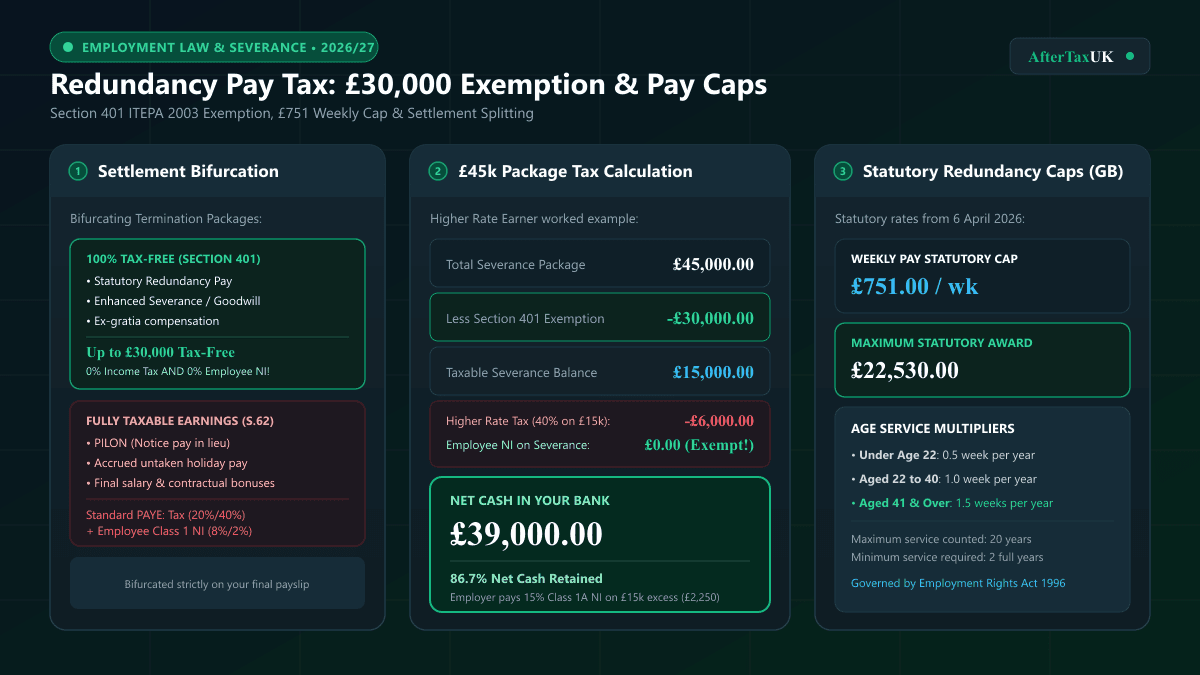
Separate the parts of the settlement
Ask for an itemised breakdown: statutory or enhanced redundancy, compensation, salary, holiday pay, bonus and notice pay. Post-employment notice pay rules can make an amount taxable as earnings even if the agreement describes it differently.
The £30,000 exemption concerns qualifying termination payments, not every payment connected with leaving a job. Certain exemptions and special cases exist. The employer should explain the payroll treatment of each component.
Income Tax and National Insurance differ
Qualifying termination payments above the available £30,000 exemption can attract Income Tax. Genuine qualifying termination awards are generally not subject to employee NI; ordinary earnings and notice pay are treated separately and can attract employee NI.
Employers pay Class 1A National Insurance at 15% on qualifying termination awards above £30,000 in 2026/27. This is an employer liability. Do not apply that percentage as an employee deduction or apply the exemption to ordinary pay.
Statutory redundancy limits from 6 April 2026
For the Great Britain rules described by GOV.UK, eligible employees normally need at least two years of continuous service. Each full year attracts half a week below age 22, one week from age 22 to 40, and one and a half weeks from age 41. At most 20 years count.
For redundancies on or after 6 April 2026, weekly pay is capped at £751 and the maximum statutory award is £22,530. Enhanced contractual schemes can pay more. Northern Ireland has separate rules and limits; check the appropriate service.
Use a realistic example and check advice
Suppose a package contains £35,000 of qualifying termination compensation plus £10,000 notice pay. Subject to the applicable exemption, £30,000 of compensation is exempt and £5,000 is taxable. The £10,000 notice pay is assessed separately as earnings. Its net amount depends on the person’s total income and payroll circumstances.
Employer pension contributions may be worth discussing before an agreement is finalised, but pension limits, deductibility and the terms of the arrangement matter. Do not assume every excess payment can be moved into a pension without a tax consequence.
Explore the next step
Check the tool's supported scenario and assumptions before using its estimate.
Frequently asked questions
Frequently Asked Questions
Clear answers based on official HMRC rules and statutory guidance.
Sources and further checks
Check the source that applies to your circumstances and effective period. Official guidance can change.