Scottish vs English Income Tax 2026/27: The 6-Tier Divide
Tax residence can change your take-home pay. While lower earners in Scotland pay marginally less tax, people earning above about £33,493 under a full standard allowance faces higher tax bills, culminating in a brutal 69.5% marginal tax trap above £100,000.
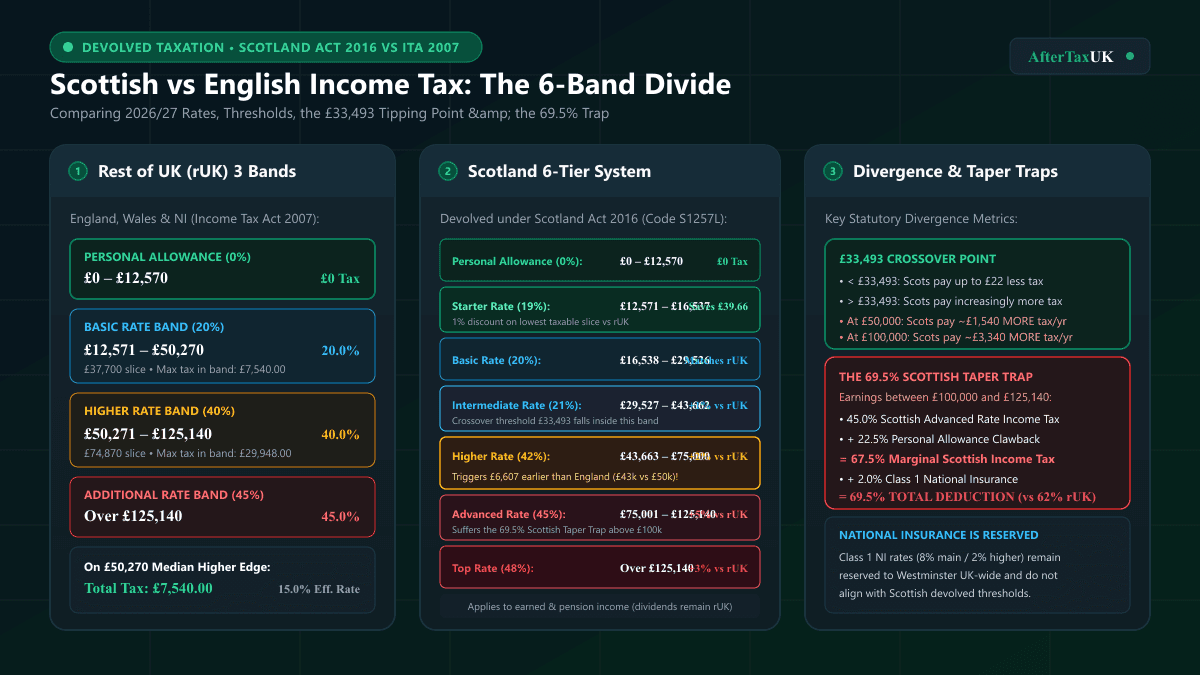
Statutory comparison: England's 3-band structure vs Scotland's 6-band progressive system under the Scotland Act 2016.
Statutory Legal Framework for Devolved Scottish Taxation
Devolution of Income Tax to the Scottish Parliament was enacted under Section 80A of the Scotland Act 1998, as amended by the Scotland Act 2012 and the Scotland Act 2016. Scotland sets its own non-savings, non-dividend rates and bands via annual Scottish Rate Resolutions. Personal Allowance thresholds and taper rules are reserved under Section 35 of the Income Tax Act 2007 (ITA 2007). Real-time payroll withholding is executed using 'S' prefix tax codes under The Income Tax (Pay As You Earn) Regulations 2003 (SI 2003/2682), while National Insurance remains strictly reserved under the Social Security Contributions and Benefits Act 1992 (SSCBA 1992).
Side-by-Side Income Tax Bands (2026/27 Tax Year)
Both nations share the exact same £12,570 tax-free Personal Allowance. However, once your earnings exceed £12,570, the tax trajectories diverge significantly:
| Income Band | Rest of UK (England, Wales, NI) | Scotland (Devolved Rates) |
|---|---|---|
| Personal Allowance | £0 to £12,570 (0%) | £0 to £12,570 (0%) |
| £12,571 to £16,537 | Basic Rate: 20% | Starter Rate: 19% |
| £16,538 to £29,526 | Basic Rate: 20% | Basic Rate: 20% |
| £29,527 to £43,662 | Basic Rate: 20% | Intermediate Rate: 21% |
| £43,663 to £50,270 | Basic Rate: 20% | Higher Rate: 42% |
| £50,271 to £75,000 | Higher Rate: 40% | Higher Rate: 42% |
| £75,001 to £125,140 | Higher Rate: 40% | Advanced Rate: 45% |
| Over £125,140 | Additional Rate: 45% | Top Rate: 48% |
Where Scottish and rUK Income Tax Crosses Over
With a standard £12,570 Personal Allowance, the comparison crosses over at about £33,493 gross income. This is an estimate based on the published 2026/27 bands; a different Personal Allowance or tax code can move the point.
Below about £33,493 (Lower Scottish Income Tax)
The 19% starter band saves up to £39.67 against the rUK 20% basic rate. The Scottish 21% intermediate band begins at £29,527 gross with a full allowance; its additional 1 percentage point gradually offsets the starter-band saving.
Above about £33,493 (Higher Scottish Income Tax)
Above the crossover, the Scottish 21% intermediate band, the earlier 42% higher band, and the 45% and 48% upper bands produce a higher Income Tax bill than under rUK rates at the same income.
The Scottish £100,000 Trap: A 69.5% Marginal Deduction
The most aggressive feature of the UK tax landscape occurs when Scottish tax policy collides with Westminster's statutory Personal Allowance taper under Section 35 of the Income Tax Act 2007.
- Scottish Advanced Rate Income Tax: 45.0% on earnings above £75,000
- Personal Allowance Withdrawal: For every £1 earned over £100,000, 50p of tax-free allowance is lost. At a 45% tax rate, 50p of lost allowance creates an additional 22.5% effective tax charge (45% × 0.50).
- Class 1 National Insurance: 2.0% employee NI on earnings over £50,270 under SSCBA 1992
- Total Marginal Deduction: 45.0% + 22.5% + 2.0% = 69.5%
If an Edinburgh consultant or Glasgow software architect on £100,000 receives a £10,000 bonus, HMRC and Revenue Scotland deduct £6,950, leaving just £3,050 in net cash! (In England, the marginal rate is 62%).
Salary Benchmark Comparison: England vs Scotland (2026/27)
Here is an annualised comparison at benchmark salaries. It assumes standard tax codes, no pension contribution and no student loan; actual PAYE deductions may vary by payroll period and circumstances.
| Gross Salary | England / Wales Net | Scotland Net | Scottish Difference |
|---|---|---|---|
| £25,000.00 | £21,519.60 | £21,559.27 | +£39.67 |
| £35,000.00 | £28,719.60 | £28,704.53 | −£15.07 |
| £50,000.00 | £39,519.60 | £38,023.55 | −£1,496.05 |
| £75,000.00 | £54,057.40 | £52,007.35 | −£2,050.05 |
| £100,000.00 | £68,557.40 | £65,257.35 | −£3,300.05 |
| £150,000.00 | £91,286.40 | £85,355.05 | −£5,931.35 |
How HMRC Determines Your Scottish Tax Residency
Many cross-border remote workers wonder: "If I live in Edinburgh but my employer's head office is in London, which tax system applies?"
Under statutory rules in Section 80D of the Scotland Act 1998, employment location is 100% irrelevant. If your primary residential home is located in Scotland for more than half the tax year (183 days or more), you are legally liable for Scottish Income Tax. HMRC monitors residential postcode records and will issue your employer an S-code via PAYE coding notices under SI 2003/2682.
Scottish Pension Tax Relief: The SIPP Claim Requirement
A critical nuance affects Scottish taxpayers who save into personal pensions or SIPPs under Relief at Source (RAS):
Automatic 20% Relief Only: Because UK pension providers operate under UK-wide HMRC systems, they automatically claim basic rate tax relief of 20% on your personal contributions, regardless of where you reside.
Claiming Higher & Advanced Relief: Scottish taxpayers in the Intermediate (21%), Higher (42%), Advanced (45%), and Top (48%) bands must claim their additional 1%, 22%, 25%, or 28% tax relief directly from HMRC by submitting a Self-Assessment tax return (SA100) or writing to HMRC.
The Salary Sacrifice Superiority:Under salary sacrifice or 'net pay arrangement' schemes, contributions are deducted from gross earnings before Scottish Income Tax is calculated, delivering 100% immediate relief at 42% or 45% on your monthly payslip with zero paperwork required.
Calculate Your Scottish Take-Home Pay
Compare exact monthly net income between English and Scottish tax rates on any salary.
Frequently Asked Questions About Scottish Income Tax
Frequently Asked Questions
Clear answers based on official HMRC rules and statutory guidance.