1. Statutory Framework: Why UK Student Loans Operate as a Graduate Tax
In the United Kingdom, student loans administered by the Student Loans Company (SLC) are established under Section 22 of the Teaching and Higher Education Act 1998 (THEA 1998) and regulated by The Education (Student Loans) (Repayment) Regulations 2009 (SI 2009/470). Under these statutory instruments, student loan debt does not function as commercial bank debt; rather, it operates as an income-contingent statutory graduate tax collected directly through employer payroll via PAYE (Pay As You Earn) under Part 11 of ITEPA 2003.
Unlike commercial mortgages, car finance, or credit cards, UK student loans have zero impact on credit scores, cannot lead to county court judgments (CCJs) for non-payment, and demand £0.00 in monthly repayments if your earnings fall below your statutory threshold. Furthermore, after a specified period of 25, 30, or 40 years, any unpaid balance—including all accrued interest—is 100% written off by HM Treasury with zero tax liability for the borrower.
2. Master Comparison: UK Student Loan Plans (2026/27)
Your repayment rules, monthly deduction thresholds, and write-off rules depend entirely on which statutory plan applies to your course start date and domicile:
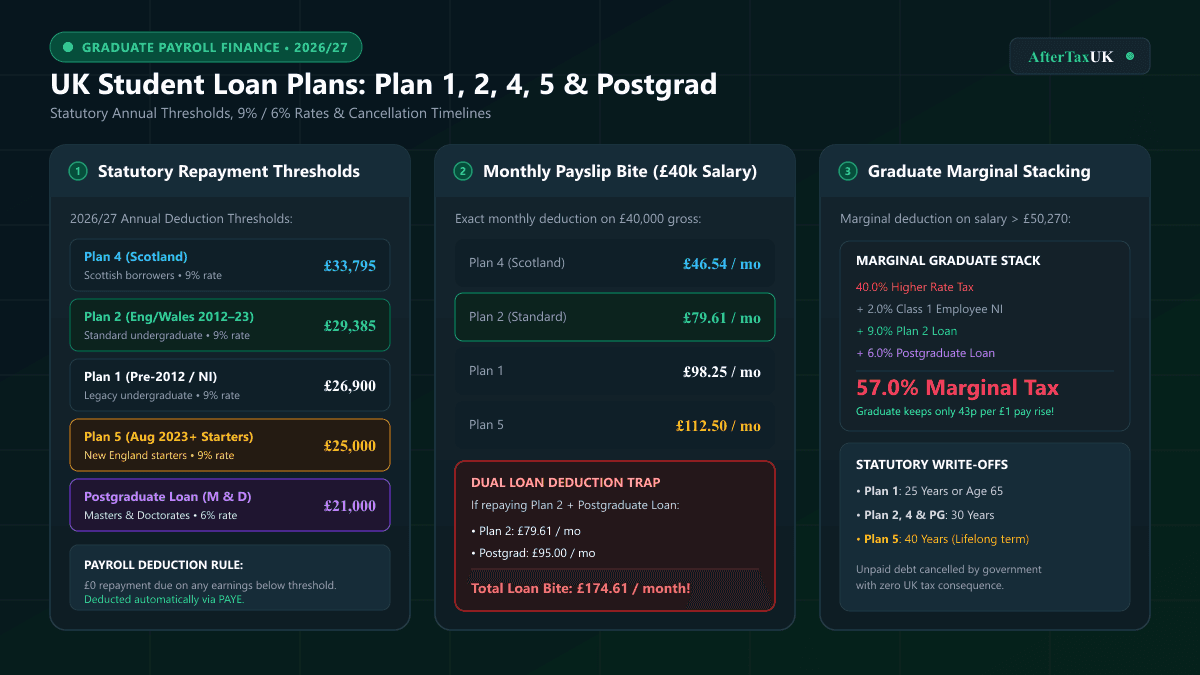
| Loan Plan | Annual Threshold | Monthly Threshold | Deduction Rate | Statutory Cancellation |
|---|---|---|---|---|
| Plan 1 (Pre-2012 / NI) | £26,900 | £2,241.67 / mo | 9% | 25 years or age 65 |
| Plan 2 (2012 to 2023) | £29,385 | £2,448.75 / mo | 9% | 30 years after April following graduation |
| Plan 4 (Scottish Students) | £33,795 | £2,816.25 / mo | 9% | 30 years or age 65 |
| Plan 5 (Aug 2023+ Starters) | £25,000 | £2,083.33 / mo | 9% | 40 years after April following graduation |
| Postgraduate (Master's / PhD) | £21,000 | £1,750.00 / mo | 6% | 30 years after April following graduation |
3. Plan 5 Reforms: The 40-Year Lifetime Repayment Reality
Under the UK Government's higher education funding reform enacted for academic years beginning on or after 1 August 2023, English undergraduate borrowers are subject to Plan 5. This scheme introduced three transformative structural changes:
Reduced Repayment Threshold (£25,000)
In 2026/27, the Plan 2 threshold is £29,385 and the Plan 5 threshold is £25,000. The applicable threshold depends on your loan plan.
Extended 40-Year Cancellation Term
Under Plan 2, unpaid loans are cancelled 30 years after the April following graduation (typically around age 52). Plan 5 extends this liability to 40 years, meaning graduates will make payments until age 62 or 63—effectively lasting for their entire working lifetime.
Zero Real Interest Rate Cap (RPI Only)
On Plan 2, interest scales up to RPI + 3% for higher earners. Plan 5 limits interest strictly to the Retail Price Index (RPI). In real purchasing power terms, borrowers will never repay more than they originally borrowed in inflation-adjusted value.
4. The Graduate Marginal Tax Trap: Deductions Stacking to 71%
When student loan repayments are stacked with PAYE Income Tax and Class 1 National Insurance, British graduates face punishing effective marginal deduction rates on overtime, promotions, and pay rises:
| Income Band | Income Tax | National Insurance | Plan 2 Loan | Total Marginal Deduction |
|---|---|---|---|---|
| Basic rate and Plan 2 repayment (£29,385 to £50,270) | 20% | 8% | 9% | 37% (37p per £1) |
| Basic Rate + Postgrad Loan | 20% | 8% | 9% + 6% | 43% (43p per £1) |
| Higher Rate (£50,271 to £100,000) | 40% | 2% | 9% | 51% (51p per £1) |
| Higher Rate + Postgrad Loan | 40% | 2% | 9% + 6% | 57% (57p per £1) |
| Taper Trap (£100,000 to £125,140) | 60% (PA loss) | 2% | 9% | 71% (77% with Postgrad) |
5. Worked Monthly Deductions Across 4 Salary Benchmarks
These annual estimates use the threshold formula, then divide by 12 to show a monthly equivalent. Actual payroll deductions are calculated by pay period and rounded, so your payslip may differ.
| Gross Salary | Plan 1 (Annual / Mo) | Plan 2 (Annual / Mo) | Plan 4 (Annual / Mo) | Plan 5 (Annual / Mo) |
|---|---|---|---|---|
| £30,000 / yr | £279.00 (£23.25/mo) | £55.35 (£4.61/mo) | £0.00 (£0.00/mo) | £450.00 (£37.50/mo) |
| £45,000 / yr | £1,629.00 (£135.75/mo) | £1,405.35 (£117.11/mo) | £1,008.45 (£84.04/mo) | £1,800.00 (£150.00/mo) |
| £60,000 / yr | £2,979.00 (£248.25/mo) | £2,755.35 (£229.61/mo) | £2,358.45 (£196.54/mo) | £3,150.00 (£262.50/mo) |
| £80,000 / yr | £4,779.00 (£398.25/mo) | £4,555.35 (£379.61/mo) | £4,158.45 (£346.54/mo) | £4,950.00 (£412.50/mo) |
6. Pension Salary Sacrifice: The Legal Student Loan Shield
A salary sacrifice arrangement changes contractual pay and can affect the earnings figure used for payroll student loan deductions. This is different from paying into a personal pension or a net-pay workplace scheme, so check how your employer treats your arrangement before estimating its effect.
Triple Tax Relief on Every Sacrificed Pound:
A Plan 2 graduate in the Basic Rate band who sacrifices £100 into their pension saves £20.00 in Income Tax (20%), £8.00 in National Insurance (8%), and £9.00 in Student Loan repayments (9%). This delivers an immediate 37% cash protection, transforming a £100 pension investment into a net cost to take-home pay of just £63.00.
7. Self-Assessment (SA100) & Dual-Income Calculations
If you are a sole trader, partner, or company director taking dividends, your student loan repayments are not deducted via monthly PAYE. Instead, HMRC assesses your student loan liability on page TR5 of your annual Self-Assessment Tax Return (SA100) under Regulation 29 of SI 2009/470.
The calculation takes your total taxable earned income (trading profits plus employment earnings) plus any unearned income (such as dividends, bank interest, and rental income) if total unearned income exceeds £2,000. The statutory repayment rate—9% for undergraduate loans and 6% for postgraduate loans—is applied to all taxable income exceeding the threshold, and the resulting amount is added directly to your balancing tax bill payable by 31 January.
8. Why Making Early Voluntary Repayments Is Usually a Mistake
Many graduates mistakenly treat student loan debt like a commercial bank loan, throwing personal savings or inheritances at their loan balance. In reality, voluntary repayments do not lower your monthly PAYE deductions next month by a single penny.
Official UK Government forecasts indicate that over 75% of Plan 2 graduates will never repay their balance in full before the 30-year cancellation clock expires. Any voluntary overpayment simply repays debt that HM Treasury would have cancelled anyway, acting as an entirely unnecessary voluntary tax. Only top-tier high earners projected to pay off the entire balance within 10 to 15 years should ever consider voluntary repayments.
Frequently Asked Questions
Clear answers based on official HMRC rules and statutory guidance.