Sole Trader vs Limited Company Calculator UK (2026/27)
Compare your exact take-home pay, HMRC liabilities, and incorporation tipping points for the 2026/27 tax year. Model 19%–25% Corporation Tax, dividend extractions, Class 4 National Insurance, and accountancy overheads side by side.
Compare Sole Trader vs Limited Company Net Take-Home
Sole Trader delivers £713.71 more per year
At £60,000.00 annual profit, trading as a sole trader yields an extra £59.48 each month. Higher Limited Company accountancy costs and the 15% employer NI on director salary outweigh corporate tax savings at this profit tier.
Sole Trader (Self-Employed)
Effective total deductions rate: 22.9% of profit
Statutory Deductions & Taxes
Key Characteristics:
• Zero Companies House public filings; simple annual Self-Assessment (SA100).
• Unlimited personal liability for business debts and commercial contracts.
Limited Company Director
Effective overall tax & compliance: 22.6%
Company Level & Personal Remuneration
Key Characteristics:
• Separate legal entity: limited liability protection shields personal assets.
• Retain surplus profits inside company without triggering personal higher-rate taxes.
Sole Trader: Where Every £1 Goes
Limited Company: Where Every £1 Goes
Why has the Ltd advantage narrowed in 2026/27?
Historically, limited companies offered massive tax savings from £30,000 profit. Under 2026/27 statutory rates, three legislative changes have narrowed the gap:
- Class 4 NI Reduction: Self-employed workers now pay 6.0% (down from 9.0%), significantly reducing sole trader taxes.
- Employer NI Increase: The employer NI rate rose to 15.0% with the secondary threshold lowered to £5,000, adding £1,135.50 in company expenses for a £12,570 director salary.
- Corporation & Dividend Tax Rates: Corporation Tax ranges from 19% to 25% (with a 26.5% marginal relief rate between £50k and £250k), combined with dividend tax rates of 10.75% (basic) and 35.75% (higher).
Statutory Calculation Assumptions & 2026/27 Legislation
Calculations reflect statutory tax rates and thresholds for the 2026/27 UK tax year across England, Wales, and Northern Ireland under the Income Tax Act 2007 (ITA 2007), Corporation Tax Act 2010 (CTA 2010), Social Security Contributions and Benefits Act 1992 (SSCBA 1992), and National Insurance Contributions (Secondary Class 1 Contributions) Act 2025.
Assumes a single director-shareholder with no other personal earned or dividend income, no student loan repayments, and standard £12,570 Personal Allowance. Sole trader Class 2 NICs are treated as paid at £0 under Finance Act 2024 provisions. Limited company employer NI reflects the 15.0% rate above the £5,000 annual secondary threshold; sole director-only businesses are excluded from the £10,500 Employment Allowance under SI 2016/344. This tool provides an estimate for comparative evaluation and does not constitute formal accountancy, legal, or tax planning advice.
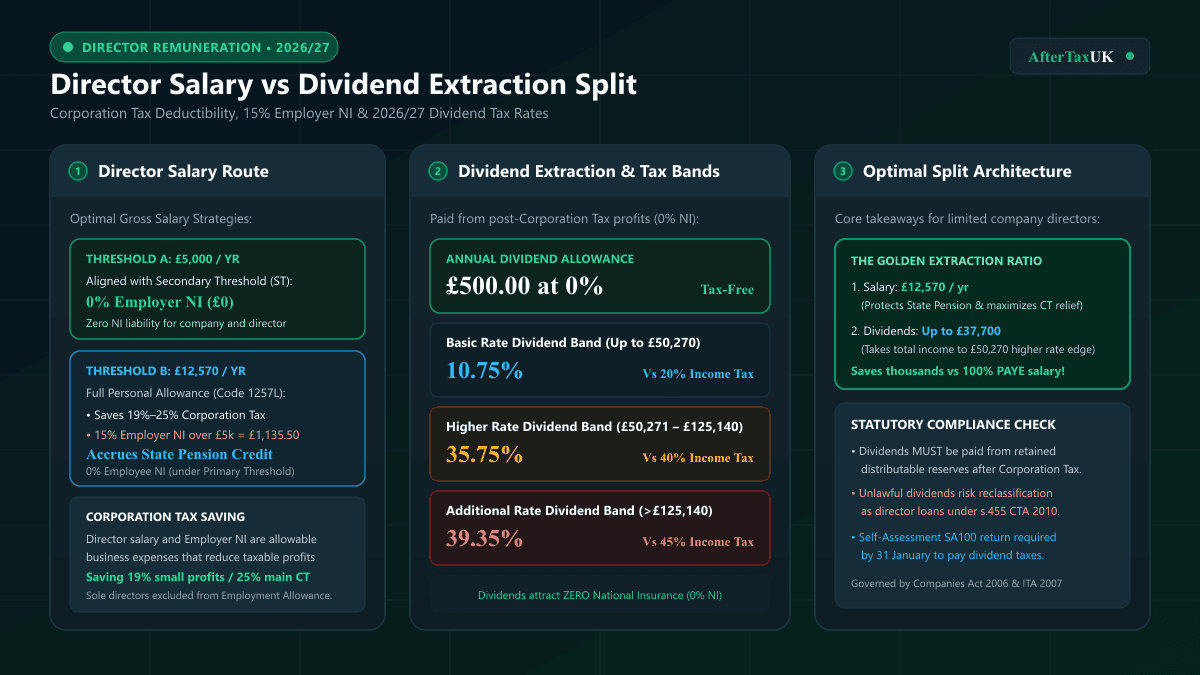
Figure 1: Statutory tax flow for sole trader profits vs limited company director remuneration (2026/27).
The 2026/27 Incorporation Landscape: What Has Changed?
Deciding between operating as a Sole Trader or incorporating a Private Limited Company (Ltd) is one of the most critical financial decisions for UK freelancers, contractors, and business owners. For over a decade, standard business folklore suggested that incorporating once annual profits hit £30,000 was an automatic route to saving thousands of pounds in tax.
However, recent legislative changes across the UK tax code have significantly shifted the statutory equation for the 2026/27 tax year. Three key policy reforms must be factored into your evaluation:
Class 4 NI Reduction
Sole trader Class 4 National Insurance was reduced to 6.0% on profits between £12,570 and £50,270 (down from 9.0% in previous years). This makes sole trading far more tax-competitive.
15% Employer NI
The secondary Class 1 NI threshold was lowered to £5,000 at a rate of 15.0%. A single director taking a standard £12,570 salary incurs £1,135.50 in company employer NI, with sole directors excluded from the Employment Allowance.
CT & Dividend Tiers
Corporation Tax is tiered at 19% (up to £50k) and 25% (over £250k) with a 26.5% marginal relief fraction. Combined with dividend tax rates of 10.75% and 35.75%, the net margin between structures has narrowed.
Statutory Tax Engine Mechanics: Sole Trader vs Limited Company
To understand where your money goes, it is essential to examine the statutory tax rules applied to each business vehicle:
Sole Trader (Unincorporated Business)
As a sole trader, you and your business are legally identical. All trading profits (gross turnover minus allowable business expenses) are treated as your personal taxable income in the tax year they are earned, whether you withdraw them from the bank or leave them in your business account.
- Personal Allowance (Sec 35 ITA 2007): The first £12,570 of profit is 100% tax-free. If profits exceed £100,000, this allowance reduces by £1 for every £2 of excess income, disappearing entirely at £125,140.
- Income Tax Rates: 20% Basic Rate (£12,571 to £50,270), 40% Higher Rate (£50,271 to £125,140), and 45% Additional Rate (over £125,140).
- Class 4 National Insurance (SSCBA 1992): 6.0% on trading profits between £12,570 and £50,270, and 2.0% on profits exceeding £50,270.
- Class 2 National Insurance: Following recent statutory reforms, Class 2 NICs are treated as paid at £0 for self-employed individuals with profits at or above the Small Profits Threshold (£6,725), preserving State Pension entitlement without cash deductions.
Limited Company (Corporate Structure)
A limited company is an independent legal person distinct from its directors and shareholders. Business revenue belongs exclusively to the company. Directors extract funds through an optimal combination of a tax-deductible salary and post-tax dividend distributions:
- Director Salary & Employer NI: The director takes a £12,570 annual salary. Because this consumes the Personal Allowance, it incurs £0 Income Tax and £0 employee NI. The company pays 15.0% employer NI on the slice above £5,000 (£1,135.50). Both salary and employer NI are allowable deductions against Corporation Tax.
- Corporation Tax (CTA 2010): 19.0% Small Profits Rate on taxable company profits up to £50,000. For profits between £50,000 and £250,000, standard marginal relief creates an effective marginal rate of 26.5%. Profits above £250,000 are taxed at the 25.0% Main Rate.
- Dividend Extraction (Sec 13 ITA 2007): The post-tax distributable profit is paid to shareholders as dividends. The first £500 is covered by the 0% Dividend Allowance. Excess dividends are taxed at 10.75% within the basic rate band, 35.75% in the higher rate band, and 39.35% in the additional rate band.
Three Real-World Worked Examples for 2026/27
To evaluate how these statutory mechanics interact across different earnings tiers, examine three typical UK business scenarios (assuming £1,200 company accountancy vs £300 sole trader compliance):
Case 1: £30,000 Net Business Profit (Near Tipping Point)
Sole Trader Wins by ~£420/yr• Taxable Profit: £29,700 (after £300 fee)
• Income Tax (20%): £3,426.00
• Class 4 NI (6%): £1,027.80
Net Take-Home: £25,246.20 (£2,104/mo)
• Director Salary: £12,570 + Employer NI: £1,135.50
• Corporation Tax (19% on £15,094.50): £2,867.96
• Personal Dividend Tax (10.75%): £1,260.60
Net Take-Home: £24,825.94 (£2,069/mo)
Analysis: At £30,000 profit, higher company accountancy costs (£1,200 vs £300) and the £1,135.50 employer NI make sole trading slightly more lucrative when 100% of profit is extracted.
Case 2: £60,000 Net Business Profit (Higher-Rate Boundary)
Competitive Balance• Taxable Profit: £59,700 (after £300 fee)
• Income Tax: £11,312.00 (Basic £7,540 + Higher £3,772)
• Class 4 NI: £2,450.60 (6% to £50.2k + 2% above)
Net Take-Home: £45,937.40 (£3,828/mo)
• Taxable Profit after Salary & Overhead: £45,094.50
• Corporation Tax (19%): £8,567.96
• Personal Dividend Tax (10.75%): £3,872.85
Net Take-Home: £45,223.69 (£3,769/mo)
Analysis: Immediate cash take-home is virtually identical. However, the Limited Company enables the director to retain funds in the company bank account or inject pre-tax profits into an executive pension, unlocking vast tax advantages unavailable to sole traders.
Case 3: £120,000 Net Business Profit (£100k Taper Zone)
Ltd Shields £100k Taper Trap• Profit: £119,700 triggers £9,850 Personal Allowance reduction
• Income Tax: £39,178.00 (Brutal 60% marginal tax rate)
• Class 4 NI: £3,650.60
Net Take-Home: £76,871.40 (£6,406/mo)
• Draw £100,000 personal income (Salary + Dividends)
• Protect full £12,570 Personal Allowance (0% clawback)
• Retain surplus post-tax profit inside company
Total Retained Wealth: Over £81,400+
Analysis: Above £100,000, sole traders suffer an effective 62% marginal tax deduction. A limited company acts as a legal tax shield, allowing directors to cap personal extraction at £100k and preserve surplus profits inside the corporate vehicle at Corporation Tax rates.
Beyond Tax: Legal, Operational & Commercial Realities
While tax calculations are crucial, structure decisions should never be made on numbers alone. The legal and operational framework of your business carries enormous consequences:
1. Limited Liability Protection (Companies Act 2006)
If your business involves physical risks, subcontractors, commercial leases, large supplier debts, or potential professional negligence claims, a limited company provides an indispensable corporate shield. If a company fails or is sued, the personal assets of the directors and shareholders (such as the family home) are protected, provided directors acted lawfully. Sole traders have zero liability separation.
2. Commercial Credibility & Corporate Procurement
Many corporate clients, public sector agencies, and tier-one recruiters have strict compliance policies that prohibit engaging sole traders due to deemed employment liabilities under HMRC IR35 rules. Operating as an incorporated entity conveys longevity, credibility, and commercial standing in B2B markets.
3. Executive Workplace Pension Contributions
A limited company can make direct employer pension contributionsinto a director's SIPP or workplace pension scheme. Employer contributions are an allowable business expense, reducing taxable profit for Corporation Tax. They trigger £0 employee NI, £0 employer NI, and £0 personal Income Tax, up to the annual £60,000 statutory allowance.
4. Privacy & Public Transparency
Sole trader tax affairs are strictly confidential between you and HMRC. In contrast, limited companies are subject to public disclosure at Companies House. Your company accounts, director names, dates of birth, nationality, Persons with Significant Control (PSC), and registered office address are permanently accessible on the public register.
Step-by-Step: How to Transition from Sole Trader to Ltd
If your calculations indicate that incorporating is the optimal strategic move, follow this statutory roadmap to transition smoothly:
- Incorporate with Companies House: Choose a unique company name, appoint directors and shareholders, adopt Articles of Association, and register your company (statutory fee £50 online).
- Open a Dedicated Business Bank Account: Because the company is a separate legal entity, all client billings and business expenses must flow through a corporate account.
- Register for HMRC Corporate Taxes: Register for Corporation Tax within 3 months of starting trading, set up a PAYE scheme for director salary RTI filings, and transfer or register for VAT if annual taxable turnover exceeds £90,000.
- Claim Section 162 Incorporation Relief: Work with a qualified chartered accountant to transfer business assets and goodwill under Section 162 TCGA 1992 to defer capital gains tax liabilities into your new shares.
- Notify Clients and Update Contracts: Novate existing service contracts, inform suppliers of your new registered company number and VAT details, and notify HMRC of your cessation date as a sole trader on your final SA100 return.
Statutory Citations & Primary UK Legislation
- Income Tax Act 2007 (ITA 2007) — Sections 6–10, 13 (Dividends), and 35 (Personal Allowance Taper)
- Corporation Tax Act 2010 (CTA 2010) — Section 18B (Small Profits & Marginal Relief)
- Social Security Contributions and Benefits Act 1992 (SSCBA 1992) — Class 1 & Class 4 NICs
- GOV.UK Guidance: Set up as a sole trader & Self-Assessment registration
- GOV.UK Guidance: Set up a limited company & Companies House registration
- AfterTaxUK Guide: Director Salary and Dividend Tax Optimisation 2026/27
Sole Trader vs Limited Company FAQs
Statutory answers based on official 2026/27 HMRC rates and UK company legislation.
Recommended Resources
Related Calculators, Salaries & Guides
Explore connected UK tax tools, popular salary benchmarks, and statutory HMRC guidance.
Related Calculators
All CalculatorsTake-Home Pay Calculator
Calculate exact net salary with 2026/27 HMRC tax bands.
Hourly Wage Calculator
Convert hourly pay to weekly, monthly, and annual take-home.
Pro Rata Salary Calculator
Part-time, term-time, and holiday pay formulas for 2026/27.
Second Job Tax Calculator
Calculate take-home pay across two jobs with BR tax code.
Compare Common UK Salaries
All Salary BracketsStatutory Tax Guides & Blog
Visit Blog HubCompany and personal tax are different
Corporation Tax applies to company profits. Salary, employer NI, dividends and personal tax are separate stages; cash in a company is not automatically available as a dividend.
Associated companies and short accounting periods can reduce the small-profits and marginal-relief limits. Check distributable reserves and Employment Allowance eligibility; a sole-director-only company does not normally qualify.
Check the rules for your circumstances
Official guidance supports the rules described here; it does not approve or certify this calculator. Confirm dates, eligibility and unsupported cases before making a financial decision.