How this comparison was prepared
Published UK business-account information and FSCS guidance. This is a shortlist for research, not a ranking of customer service or a personal product recommendation.
Provider links are supplied for further research. Inclusion is not an endorsement or a personalised recommendation. Check the latest terms and your own circumstances before acting.
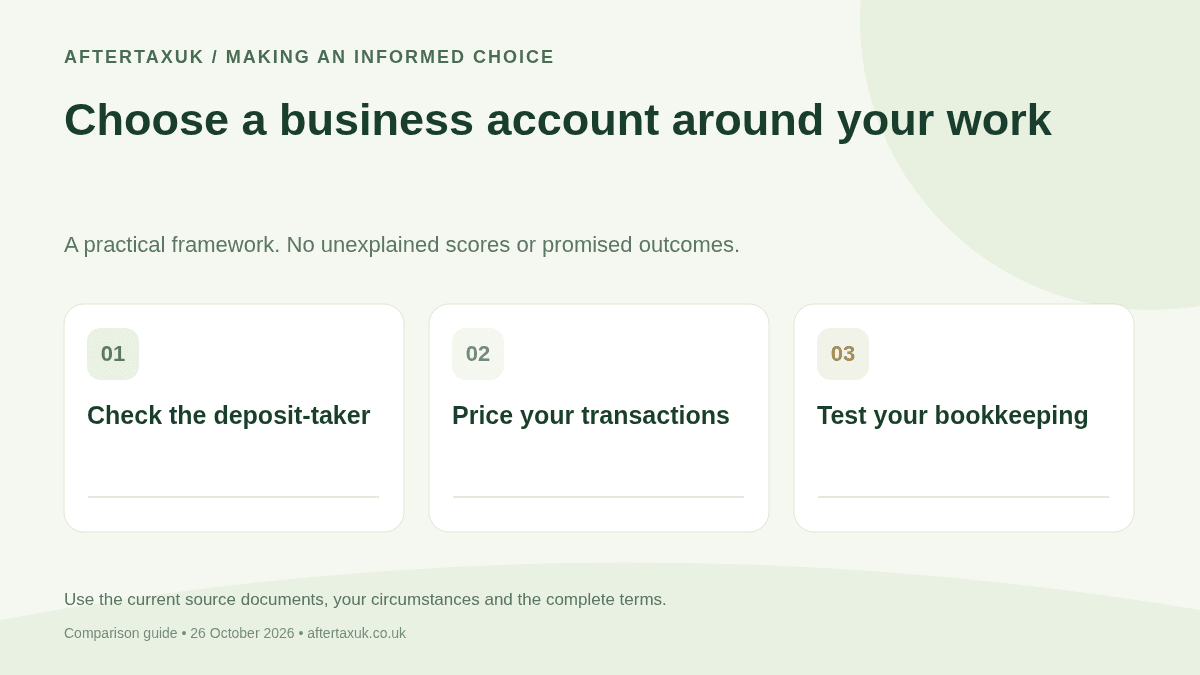
Start with these three checks
- Write down your legal structure, monthly payments, cash deposits and overseas transactions. Eligibility and charges can differ between sole traders and limited companies.
- Identify the regulated bank or e-money provider named in the account terms. Check protection against that legal entity, rather than assuming the app brand has a separate banking licence.
- Compare a normal month and a busy month, including subscriptions, payment fees, cash handling, foreign exchange and the cost of bookkeeping software.
Options to investigate and what to check
This is a research shortlist, not an ordered league table. Compare the same needs and assumptions in each case.
Starling Business
A business wanting to investigate a bank account with digital bookkeeping tools.
Check: Check eligibility for your business, cash-deposit charges, international payment costs and the current terms of any accounting add-on.
Published informationMonzo Business
A business comparing a basic account with paid workflow features.
Check: Compare the exact plan that includes the controls, invoicing or team access you need. A feature on a paid tier should not be priced as free.
Published informationMettle
A sole trader or small company considering an account and accounting-software combination.
Check: Check current eligibility, account limits and the conditions for any bundled software before treating it as a permanent saving.
Published informationTide
A business considering a digital account alongside administrative services.
Check: Read the account terms for the deposit-taker and compare the relevant plan, payment charges and optional services separately.
Published informationDeposit protection: use the current limit and the right legal entity
FSCS states that the standard deposit-protection limit rose to £120,000 on 1 December 2025. It applies to eligible deposits per eligible person or entity, per authorised bank, building society or credit union. Eligibility matters: the existence of a business account is not a promise that every balance or business type is protected.
Accounts operating under the same banking licence share the protection limit. If a trading brand changes its partner bank, check the latest terms and the FSCS protection checker. The treatment of a sole trader can differ from that of a separate limited company.
An e-money account uses a different safeguarding framework. Do not describe safeguarding as identical to FSCS deposit protection, or assume money held in an investment product has the same protection as a bank deposit.
Build an account-cost comparison from real transactions
List the payments you actually make: supplier transfers, card spending, cash deposits, cheques, foreign-currency receipts and payroll. Apply each provider’s tariff to those quantities. Include VAT where it applies and distinguish a temporary promotional price from an ongoing subscription.
Next, compare workflow costs. A bookkeeping bundle can be useful if it is the product your accountant needs and the eligibility conditions suit you. It has little value if you already pay for a different product or must maintain a second subscription for your VAT or payroll process.
Keep business money and personal spending clear
A limited company is a separate legal entity. Use an account suitable for company business and reconcile salary, dividends, reimbursements and director loans correctly. An account labelled business does not decide the tax treatment of a withdrawal.
Sole traders should still check whether their personal-account terms permit business use. Separate records can make tax reporting and correction of errors easier, even where a separate business account is not a universal HMRC requirement.
Before switching, test an export with your bookkeeper, move essential mandates carefully and keep statements from the old account. Avoid closing an account before expected refunds or outstanding payments have cleared.
Illustrative annual cost: compare the whole workflow
These are invented tariffs to demonstrate the calculation; they are not quotes from the providers above. Assume 20 chargeable payments each month and otherwise identical services.
| Cost item | Account A | Account B |
|---|---|---|
| Subscription | £0 a month | £8 a month |
| Payments | £0.20 each × 20 × 12 = £48 | Included in this example |
| Bookkeeping software | £15 a month = £180 | Included in this example |
| Illustrative annual total | £228 | £96 |
Replace every line with current quoted terms. A bundle is not cheaper if it omits a feature you require; foreign exchange and cash costs are excluded here.
Sources and further checks
Use these official guidance pages alongside the provider pages linked above. Published charges and terms can change; a quote and full contract are needed for a personal decision.
Found a changed term or an error? Send a correction with the page URL and the relevant source.
Questions about this comparison
Practical points to check before choosing a product or service.