How this comparison was prepared
Official insurance guidance and provider descriptions. We have not obtained personal quotes or assessed claims handling. No numerical customer-service ratings or cheapest-provider claims are made.
Provider links are supplied for further research. Inclusion is not an endorsement or a personalised recommendation. Check the latest terms and your own circumstances before acting.
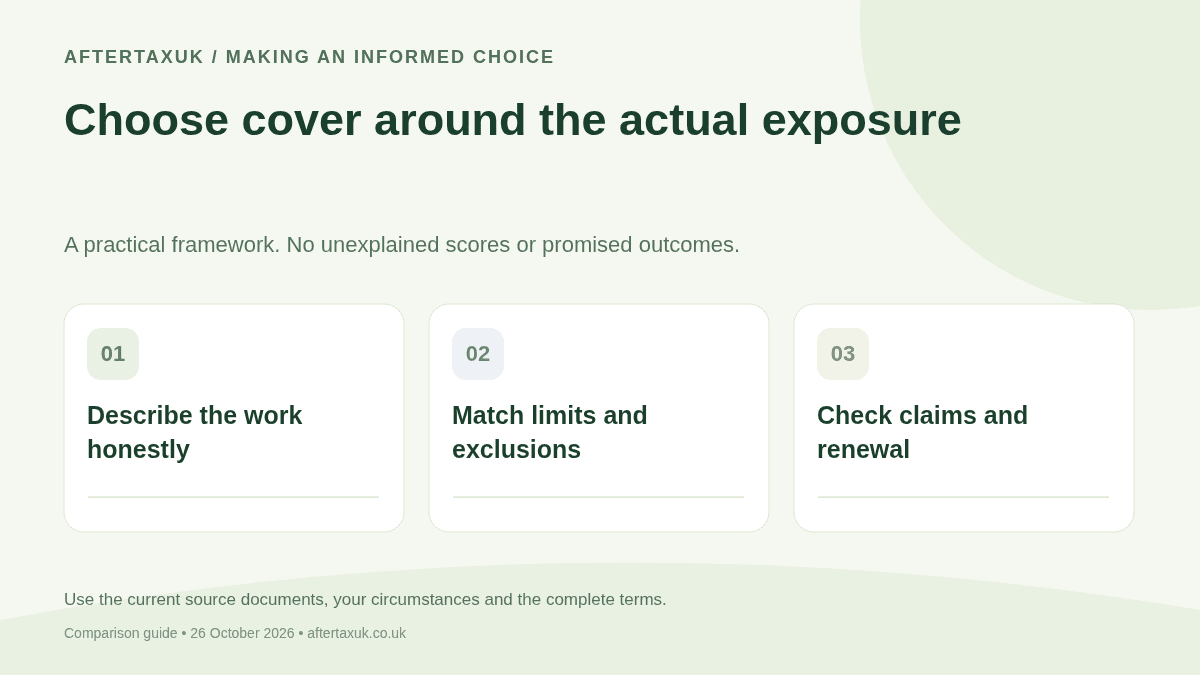
Start with these three checks
- List your activities, employees, client requirements, countries of work and the liabilities in each contract.
- Choose comparable cover limits, excesses, policy periods and key exclusions before requesting quotes.
- Check the insurer/intermediary and read the schedule and wording. Ask how claims are notified and what happens after the policy ends.
Options to investigate and what to check
This is a research shortlist, not an ordered league table. Compare the same needs and assumptions in each case.
Hiscox
A business investigating insurer-provided business cover.
Check: Check the insured activities, exclusions, excess and policy limits for your occupation and contract. Do not assume a general product page is your quotation.
Published informationQdos
A contractor investigating contractor-focused insurance and related services.
Check: Distinguish insurance cover from advice, reviews or other subscriptions. Confirm the insurer, insured event and exclusions for the product you select.
Published informationSimply Business
A business comparing policies through an intermediary.
Check: Check which insurers and products are included in the comparison, the actual policy wording and the intermediary’s role in support and claims.
Published informationA specialist broker
A business with unusual contractual or occupational risks.
Check: Ask about market coverage, fees, insurer selection and whether the broker has understood every activity and jurisdiction you need covered.
Published informationSeparate the risks instead of buying a vague bundle
Professional indemnity can address certain claims about professional advice or services, subject to the wording. Public liability concerns certain injury or property-damage liabilities arising from business activities. Employers’ liability is a separate cover relevant to employees. Cyber, equipment and legal-expenses cover have their own scope.
GOV.UK says employers’ liability insurance is generally required when becoming an employer, with at least £5 million cover from an authorised insurer, subject to exceptions. Do not assume a one-person company or every type of contractor has the same requirement; check the guidance and your employment structure.
A client may require cover that is not a universal statutory requirement. Compare the contract with the policy rather than describing all requested insurance as legally mandatory.
The limit and excess need context
Check whether the limit applies to each claim or in aggregate for the policy period, and whether defence costs reduce that limit. An apparently equal £1 million limit can operate differently under different wordings. Ask about contractual liability, subcontractors, prior work and territorial or jurisdictional restrictions.
An excess is the part you may need to fund yourself. A lower premium may come with a larger excess or narrower insured activities. Describe your work accurately; a policy for a software contractor may not cover unrelated financial advice or site work.
For cover written on a claims-made basis, check retroactive dates, notification requirements and continuity when switching or retiring. Run-off cover can be relevant after the work ends; cancellation does not necessarily leave past services protected.
IR35-related products do not decide employment status
A policy, contract review or tax-enquiry service does not set the legal status of an engagement. Read exactly which investigation costs or liabilities are insured, who is covered, what conditions apply and which decisions remain outside the policy.
Keep the proposal, statement of fact, schedule and full wording. Tell the provider about relevant changes and check the renewal price and terms rather than assuming the previous year’s protection automatically continues.
If you are unsure about a substantial contract liability or an unusual exclusion, obtain appropriate professional advice. This comparison cannot guarantee how an insurer would assess a future claim.
A like-for-like quote checklist
These are comparison fields, not quotations or statements that a named provider includes each item.
| Item | Quote A: record this | Quote B: record this |
|---|---|---|
| Insured activity | Exact description on schedule | Same activity and client contract |
| Professional indemnity limit | Per claim or aggregate; defence costs | Same basis, not just same headline amount |
| Excess and exclusions | Amount and key restrictions | Amount and key restrictions |
| Claims-made terms | Retroactive date and notification | Continuity and run-off needs |
| Annual cost | Premium, tax and intermediary fees | Equivalent period and payment method |
An annual saving is meaningful only after the protection is comparable. A policy’s existence is not a guarantee that a particular loss is covered.
Sources and further checks
Use these official guidance pages alongside the provider pages linked above. Published charges and terms can change; a quote and full contract are needed for a personal decision.
Found a changed term or an error? Send a correction with the page URL and the relevant source.
Questions about this comparison
Practical points to check before choosing a product or service.