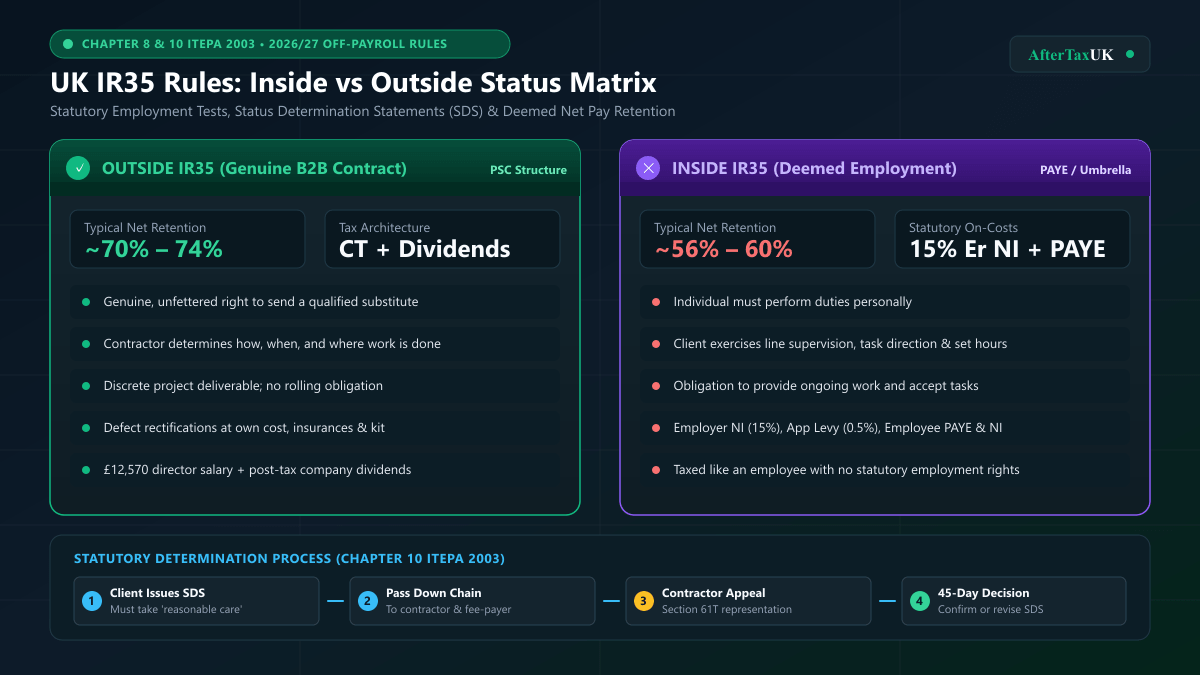
1. The Legislative Landscape: Chapter 8 vs Chapter 10 ITEPA 2003
In UK tax jurisprudence, IR35 is the colloquial term for the anti-avoidance legislation designed to tax "disguised employees" at the same rates as direct employees. When a worker provides services to a client through an intermediary—most commonly a Personal Service Company (PSC)—the law looks through the corporate veil to ask: if the intermediary did not exist, would the worker be an employee of the client for tax purposes?
Crucially, modern UK tax law divides IR35 into two distinct statutory regimes under the Income Tax (Earnings and Pensions) Act 2003 (ITEPA 2003):
Small Private Sector Clients
Governed by Sections 48 to 61 ITEPA 2003. Applies when the hiring client qualifies as "small" under Section 382 of the Companies Act 2006, or is an individual hiring directly.
- Status Assessor: The contractor's PSC determines status.
- Tax Liability: The PSC holds all liability for unpaid PAYE and NICs.
- 5% Deduction: Section 54 allows a statutory 5% deduction from gross fees for general PSC running expenses.
Public & Medium/Large Private Clients
Governed by Sections 61M to 61X ITEPA 2003 (introduced in 2017 for the public sector and 2021 for the private sector).
- Status Assessor: The hiring client must assess status and issue an SDS.
- Tax Collector: The "fee-payer" (agency or client) deducts PAYE and NICs at source.
- No 5% Allowance: The 5% administrative expenses allowance is abolished under Chapter 10.
The Statutory Small Business Exemption Test (Section 382 Companies Act 2006)
A corporate client qualifies as "small" if it meets at least two of the following statutory thresholds in a financial year:
If the client meets these criteria, the engagement reverts to Chapter 8 rules: the contractor retains the legal authority to determine their own status.
2. The Three Holy Pillars of IR35 Status
Neither HMRC nor contractors can simply define status through contractual labels. Under common law principles derived from Ready Mixed Concrete (South East) Ltd v Minister of Pensions and National Insurance [1968] 2 QB 497, tribunals determine employment status by evaluating three fundamental pillars:
1Personal Service & Right of Substitution
An employment contract requires personal service: an employee cannot send someone else to do their work. In a genuine business-to-business contract, the client contracts with the PSC to deliver a service, not with the individual worker.
The Legal Standard: Under Express & Echo Publications Ltd v Tanton [1999], an unfettered right of substitution is inherently incompatible with an employment contract.
Unfettered vs Qualified: An unfettered clause allows the PSC to substitute any worker possessing suitable skills and qualifications without client veto. If the client retains absolute discretion to refuse a substitute (a "qualified right" as in Pimlico Plumbers Ltd v Smith [2018]), personal service remains intact.
Payment Reality: The substitute must be sourced, engaged, and paid directly by the contractor's PSC—never by the client or agency.
2Control and Direction (What, How, Where, and When)
Control examines whether the client possesses the contractual right to direct the worker in the manner of an employer over an employee (Montgomery v Johnson Underwood Ltd [2001]).
- Client dictates exact working hours and daily start/finish times.
- Client moves the worker between different tasks at will ("task reallocation").
- Worker undergoes internal appraisals and line-management supervision.
- Client specifies the detailed methodology of execution.
- Contractor is hired for independent expertise to achieve a defined project outcome.
- Contractor chooses how, when, and in what order tasks are completed.
- Client specifies requirements and milestones, not working methodology.
- Contractor can work remotely without requesting client permission.
3Mutuality of Obligation (MOO)
Mutuality of Obligation refers to the continuing duty of an employer to provide paid work, and the reciprocal duty of the employee to accept and perform whatever work is offered.
The HMRC CEST Blindspot: HMRC's online status tool (CEST) is widely criticized by tax professionals because it presumes MOO exists in any paid engagement. However, the courts have repeatedly rejected this stance.
Tribunal Precedent: In Atholl House Productions Ltd (Kaye Adams) [2022] and PGMOL v HMRC [2024] UKSC 32, the judiciary established that an ongoing obligation beyond the specific project boundaries is essential for employment. A contractor hired for a discrete project who can be terminated immediately without cause or notice lacks employment mutuality.
Secondary Business Reality Factors ("In Business on Own Account")
3. Status Determination Statements (SDS) & The 45-Day Appeal Process
Under Chapter 10 of ITEPA 2003, the hiring client cannot simply tell an agency verbally whether a role is inside or outside IR35. The client is legally bound to issue a formal document called a Status Determination Statement (SDS).
Statutory SDS Requirements (Section 61NA ITEPA 2003)
To be legally valid, an SDS must satisfy two strict legislative tests:
- The Status Conclusion: It must state explicitly whether the worker would be regarded as an employee for tax purposes if engaged directly.
- The Reasons: It must provide comprehensive reasons explaining how the client reached that conclusion across substitution, control, and mutuality tests.
- Dual Delivery: The client must deliver the SDS directly to both the worker and the party with whom the client contracts (e.g. the recruitment agency).
If a contractor believes an SDS is erroneous (for example, if the client issued a blanket determination without reviewing working practices), Section 61T provides a statutory right of appeal:
- Contractor Representation: The contractor submits written representations explaining why the SDS does not reflect the contractual reality or working practices.
- Mandatory 45-Day Clock: The client has exactly 45 calendar days from receipt to review the representations and respond.
- Statutory Outcome: The client must either:a) Issue a revised SDS with updated reasons; orb) Confirm the original SDS with reasoned arguments addressing the worker's points.
- Liability Cascade: If the client fails to respond within 45 days, the client automatically becomes the deemed employer / fee-payer. All statutory liabilities for unpaid PAYE and NICs shift onto the client.
4. Financial Modeling: Inside IR35 vs Outside IR35 Take-Home Pay
The tax difference between inside and outside IR35 is substantial. Below is an exact statutory payroll comparison for a contractor charging £550 per day across 220 billable days (£121,000 gross annual contract revenue) under 2026/27 rates.
| Statutory Line Item | Inside IR35 (Umbrella PAYE) | Outside IR35 (PSC / Limited Co) |
|---|---|---|
| Gross Contract Invoiced | £121,000 | £121,000 |
| Operating Overheads & Accountancy | -£1,100 (Umbrella margin) | -£2,000 (Accountant, insurances, kit) |
| Apprenticeship Levy (0.5%) | -£522 | £0 (Exempt) |
| Employer Class 1 National Insurance | -£14,919 (15.0% above £5k threshold) | -£1,136 (15.0% on £12,570 director salary) |
| Gross Taxable Salary Paid | £104,459 (Taxable PAYE wage) | £12,570 (Personal Allowance salary) |
| Corporation Tax (19% / 26.5% marginal) | N/A (Employment PAYE) | -£24,153 (On £105,295 profit) |
| PAYE Income Tax | -£30,107 (Includes £100k taper) | £0 (Covered by £12,570 PA) |
| Employee National Insurance | -£4,100 (8% & 2%) | £0 (Under £12,570 threshold) |
| Personal Dividend Tax | N/A | -£19,529 (10.75% & 35.75%) |
| Estimated Annual Net Take-Home Pay | £70,252 | £74,182 |
| Net Invoiced Retention Rate | 58.1% | 61.3% (Up to 75%+ with pension sacrifice) |
Why the Outside Advantage Widens Dramatically with Pension Planning
While taking 100% of profits as dividends yields an immediate £3,930 cash advantage, the true financial power of working outside IR35 lies in pre-tax corporate pension contributions:
- Corporation Tax Shield: Company pension contributions into a director SIPP are deductible business expenses, saving Corporation Tax at up to 26.5% marginal relief under Section 18B CTA 2010.
- Zero Personal Tax: Pre-tax employer contributions avoid dividend tax entirely, accumulating in a tax-free wrapper.
- Avoiding the £100k Trap: Keeping personal income under £100,000 protects the contractor's full £12,570 Personal Allowance and prevents the 60% marginal income tax trap.
5. The Finance Act 2024 Offset Reform: Eliminating Double Taxation
One of the most consequential statutory updates to Off-Payroll Working rules in recent years is the IR35 Offset Provision, enacted under Section 61WA of ITEPA 2003 via the Finance Act 2024 (effective from 6 April 2024).
The Historical Problem (2017 to April 2024)
Historically, if HMRC audited a medium/large client or recruitment agency and determined that a contractor engaged outside IR35 was actually inside IR35, HMRC would assess the fee-payer for 100% of the deemed gross PAYE Income Tax and National Insurance. HMRC had no statutory mechanism to give credit for the Corporation Tax and Dividend Tax the contractor and their PSC had already paid to HMRC on that exact same income. This created a punitive, artificial penalty where HMRC collected double tax on the same contract revenue.
The Section 61WA Statutory Remedy
Since 6 April 2024, HMRC is legally required to offset the following taxes already paid by the worker against the fee-payer's PAYE liability:
- Corporation Tax: Paid by the PSC on the engagement profits.
- Income Tax: Paid by the worker on salary and dividends derived from the engagement.
- National Insurance Contributions: Any employee or employer NICs already remitted.
Practical Impact: This reform has substantially reduced client perceived financial risk, encouraging risk-averse UK corporates to re-open genuine outside IR35 engagements.
6. How to Contract Safely Outside IR35: 8-Point Compliance Checklist
Securing an outside IR35 status requires alignment between contractual terms and day-to-day operational reality. Use this 8-point statutory checklist to protect your engagement:
Contract defines specific deliverables and milestones rather than broad ongoing job titles or continuous time periods.
Ensure the contract explicitly allows your PSC to supply a qualified substitute, with client approval limited solely to confirming competency.
Retain total control over how work is carried out. Do not attend staff one-to-ones, internal appraisals, or company meetings unrelated to your project.
Include a mandatory clause requiring your PSC to fix errors, bugs, or substandard work in your own time at zero additional billing.
Maintain active Professional Indemnity (£1m+), Public Liability (£2m+), and Employers' Liability insurance in the name of your PSC.
Use your own corporate laptops, testing equipment, and software licenses whenever client security protocols permit.
Maintain a company website, business email domain, VAT registration, and LinkedIn presence reflecting an independent consultancy.
Obtain an independent professional IR35 review and confirmation of working practices before commencing the contract.
Frequently Asked Questions
Clear answers based on official HMRC rules and statutory guidance.