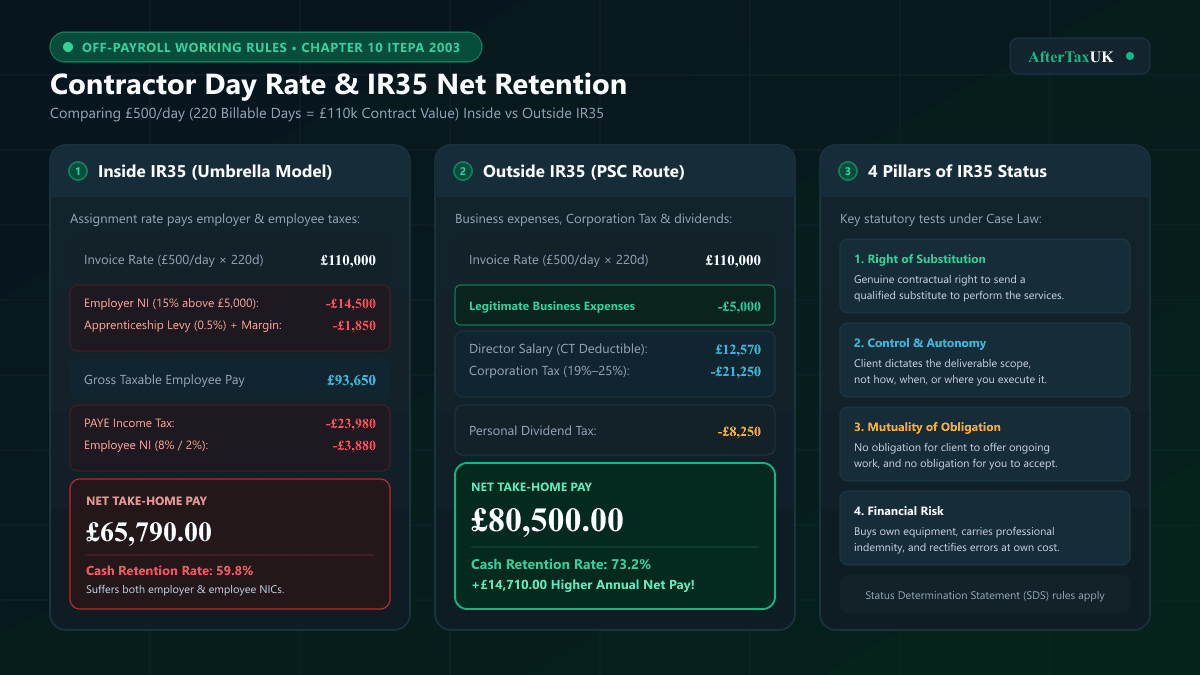
1. Inside vs Outside IR35: The Take-Home Pay Gap
In contractor recruitment, a day rate is the gross invoiced fee paid by the end-client. However, your actual take-home pay varies drastically depending on whether the role falls Inside IR35 (taxed as deemed employment) or Outside IR35 (operated through your own Personal Service Company / PSC).
To demonstrate the statutory reality, here is a complete financial comparison for a typical £500 per day contractor working 220 billable days (£110,000 gross annual contract revenue):
| Statutory Line Item | Inside IR35 (Umbrella PAYE) | Outside IR35 (PSC / Limited Co) |
|---|---|---|
| Gross Contract Invoiced | £110,000 | £110,000 |
| Operating Margin / Accountancy | -£1,100 (Umbrella margin) | -£1,500 (Accountancy & insurance) |
| Apprenticeship Levy (0.5%) | -£475 | £0 (Exempt) |
| Employer National Insurance | -£13,490 (15.0% above £5,000) | -£1,136 (15.0% on £12,570 salary) |
| Director Salary Paid | £94,935 (Gross taxable wage) | £12,570 (Tax-free allowance) |
| Corporation Tax (19% / 26.5%) | N/A (Employment PAYE) | -£21,371 (On company profits) |
| PAYE Income Tax | -£25,406 (20% & 40%) | £0 (Covered by £12,570 PA) |
| Employee National Insurance | -£3,909 (8% & 2%) | £0 (Under £12,570 threshold) |
| Personal Dividend Tax | N/A | -£16,770 (10.75% & 35.75%) |
| Estimated Net Take-Home Pay | ~£64,000 to £65,500 | ~£78,000 |
| Net Retention Rate | ~58.2% of invoiced rate | ~70.9% of invoiced rate |
On the exact same £500/day contract, an outside IR35 contractor takes home approximately £14,000 more per year than an inside IR35 umbrella worker. This gap arises because:
- Employer On-Costs: Inside IR35 umbrella workers indirectly fund the 15.0% Employer NI (£13,490) and Apprenticeship Levy (£475) directly from their assignment rate.
- Dividend Tax Efficiency: Outside IR35 contractors draw remuneration via dividends, which are exempt from National Insurance and taxed at lower rates (10.75% basic, 35.75% higher).
- Company Deductions: Legitimate business costs (accountancy, software, professional insurances) reduce Corporation Tax.
2. Turning Day Rates into Realistic Annual Income
A common trap for new contractors is multiplying daily rates by 260 weekdays (52 weeks × 5 days). In reality, contractors receive no paid holiday, no employer sick leave, and experience bench time between contracts.
Standard 220 Billable Days Breakdown:
- Total calendar weekdays: 260 days
- Statutory holidays & bank holidays: -28 days
- Unpaid illness & training: -7 days
- Contract search & onboarding buffer: -5 days
- Realistic Billable Workdays: 220 days
3. The Three Primary IR35 Status Tests
Under Chapter 10 of the Income Tax (Earnings and Pensions) Act 2003, hiring clients assess employment status using established common law employment tests:
1. Right of Substitution (Personal Service)
Can your company provide a suitably qualified substitute to perform the services if you are unavailable? A genuine, unfettered right of substitution strongly indicates outside IR35 status.
2. Control & Direction
Does the client dictate how, when, and where you complete the deliverables? Independent contractors maintain autonomy over the method of performance, whereas employees are subject to direct supervision and control.
3. Mutuality of Obligation (MOO)
Is the client obligated to offer ongoing work, and are you obligated to accept it? A true outside IR35 engagement is defined by an agreed project deliverable or statement of work (SOW) with no continuous obligation.
4. Contractor Pension Efficiency: Direct Company Contributions
For outside IR35 contractors, employer pension contributions are one of the most effective tax-planning mechanisms in the UK tax system:
100% Pre-Tax Employer SIPP Contributions
When your limited company pays directly into your SIPP:
- It is an allowable business expense that reduces company profits before Corporation Tax (saving 19% to 26.5%).
- No Employer or Employee National Insurance is charged.
- No dividend tax is paid because the cash remains invested in a tax-sheltered pension wrapper.
Compare Your Exact Contractor Daily Rate
Test different day rates (£350, £450, £550, £750/day), billable workdays, and pension sacrifice amounts with our live contractor calculation engine:
Open the contractor daily rate calculatorFrequently Asked Questions: Contractor Rates & IR35
Clear answers based on official HMRC rules and statutory guidance.