How this comparison was prepared
HMRC guidance and a due-diligence framework. We do not certify umbrella companies, provide current membership endorsements or rank providers by unverified take-home promises.
Provider links are supplied for further research. Inclusion is not an endorsement or a personalised recommendation. Check the latest terms and your own circumstances before acting.
Start with these three checks
- Request the Key Information Document and an illustration for your actual rate, hours, tax year, pension and student loan.
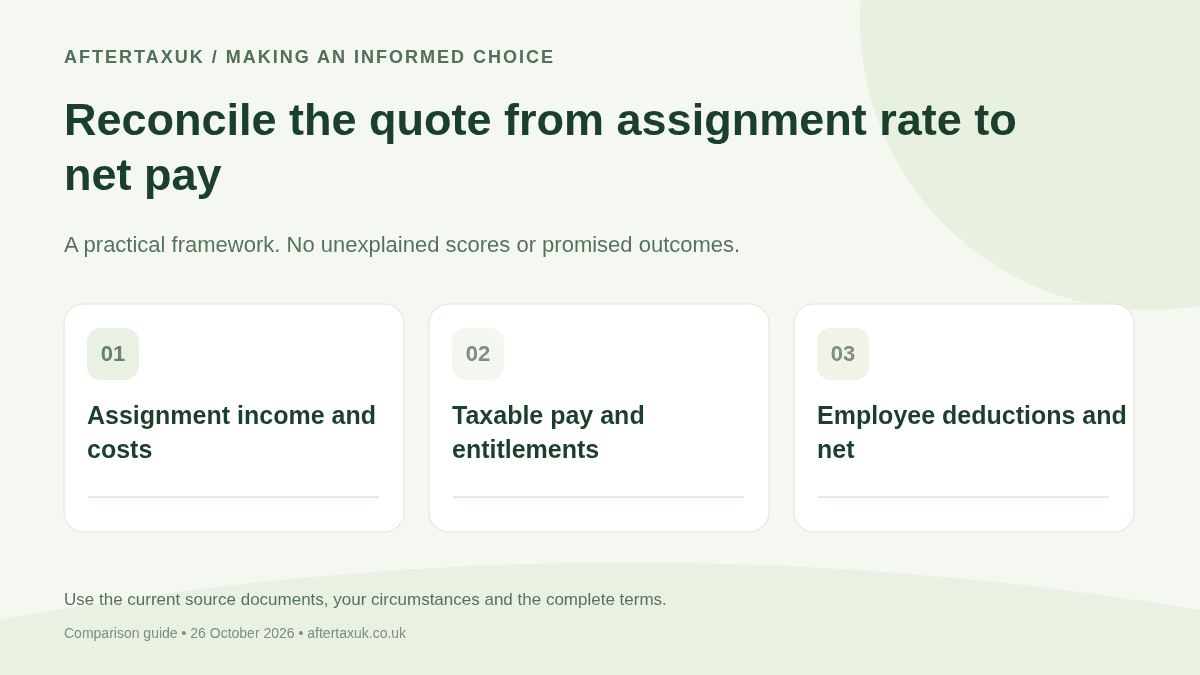
- Reconcile the assignment income, umbrella margin, employer costs, holiday-pay method, taxable gross and employee deductions.
- Verify the legal employer, current accreditation where claimed, contract terms and the first actual payslip. Investigate unexplained loans, advances or non-taxable payments.
Options to investigate and what to check
This is a research shortlist, not an ordered league table. Compare the same needs and assumptions in each case.
An umbrella offered by your agency
A worker checking a permitted employer on an assignment.
Check: Obtain the actual legal employer name, Key Information Document, margin and sample payslip. An agency list is not an HMRC guarantee.
Published informationFCSA membership claims
A worker using accreditation as one due-diligence check.
Check: Look up current membership and its scope directly with FCSA. Membership can change and does not guarantee every individual payment or tax outcome.
Published informationProfessional Passport claims
A worker checking another compliance-assessment route.
Check: Confirm the current listing, legal entity and scope directly. Continue to reconcile your own contract and payslip.
Published informationAgency PAYE where available
A worker offered direct agency payroll as an alternative.
Check: Compare like-for-like worker pay, holiday treatment, employer costs and benefits. An assignment rate and a PAYE hourly rate are not interchangeable.
Published informationUnderstand the difference between an assignment rate and gross pay
The rate paid to an umbrella is not necessarily your taxable salary. It may fund employer National Insurance, employer pension costs, the umbrella margin and other applicable employment costs before your gross pay is calculated. Ask how each item is treated, rather than subtracting only employee tax from the assignment rate.
Employee Income Tax, employee National Insurance, pension contributions and student-loan repayments then affect the amount paid to you. Your tax code, pay frequency and earnings history can change a payslip, so an annual estimate is not a guaranteed weekly result.
Compare quotations on the same assumptions. A calculation omitting an enrolled pension, using a different holiday-pay method or assuming a different number of weeks can appear artificially attractive.
Holiday pay and payslip transparency are part of the comparison
Ask whether holiday pay is accrued, paid when leave is taken or included using an arrangement permitted for your working pattern. It should be clearly explained and identifiable; do not accept a vague statement that the headline rate includes everything.
Check payment timing, expenses policies, pension administration, support routes and contract termination terms. Keep a record of the hours/rate authorised by the agency and compare them with the umbrella statement.
The first actual payment is an important check. Confirm the taxable pay and deductions, investigate differences from the illustration and check information in your HMRC account where appropriate. A document with plausible totals does not by itself establish that the employer has accounted for tax correctly.
Accreditation is evidence to check, not an exemption from tax rules
Use the current accreditation organisation’s own site to verify a claim and the legal entity covered. This guide does not establish that a named company remains accredited, and does not equate FCSA or Professional Passport with approval by HMRC.
Be cautious of schemes promising unusually high take-home through loans, grants, credit arrangements or other amounts described as untaxed earnings. HMRC guidance explains that workers can face tax consequences from avoidance arrangements even when someone else marketed the scheme.
If a quotation cannot be reconciled, ask for a written explanation before accepting the arrangement. Obtain appropriate independent help where an earlier payment may have used a tax-avoidance scheme.
Illustrative umbrella reconciliation
These invented amounts show the order of the calculation only. They are not 2026/27 statutory rates, an employer quote or a personalised payroll result.
| Stage | Illustrative amount | Meaning |
|---|---|---|
| Assignment income | £1,000 | Paid by the agency to the umbrella |
| Margin and employer costs | £180 | Shown separately and explained |
| Taxable gross pay | £820 | Starting point for employee deductions |
| Employee deductions | £210 | Tax, NI and applicable other deductions |
| Illustrative net pay | £610 | Must reconcile to the actual payslip |
Holiday pay and pension treatment must be stated in a real quote. Do not compare this illustrative £610 with a different gross/assignment-rate basis.
Sources and further checks
Use these official guidance pages alongside the provider pages linked above. Published charges and terms can change; a quote and full contract are needed for a personal decision.
Found a changed term or an error? Send a correction with the page URL and the relevant source.
Questions about this comparison
Practical points to check before choosing a product or service.