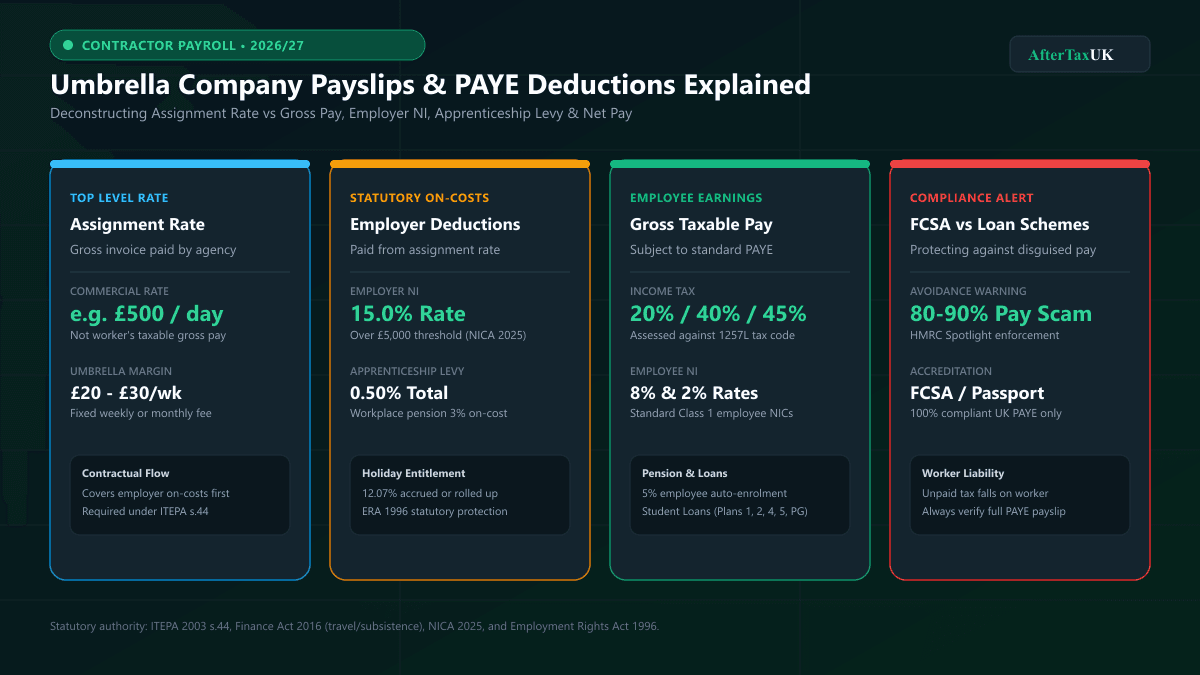
The Core Disconnect: Assignment Rate vs Gross Taxable Pay
The primary source of confusion for contractors transitioning from standard permanent employment or outside-IR35 limited companies is the distinction between the Assignment Rate and your actual Gross Taxable Pay.
1. Assignment Rate
The gross contract rate paid by the recruitment agency or end-client to the umbrella company (e.g. £500 per day or £62.50 per hour).
2. Gross Taxable Pay
Your personal taxable wages that appear on your P60, subject to standard employee Income Tax and Class 1 National Insurance.
Under Section 44 of the Income Tax (Earnings and Pensions) Act 2003 (ITEPA 2003), an agency worker provided through an employment intermediary must be treated for tax purposes as an employee. Because the umbrella company is legally your statutory employer, it is subject to all UK employment taxes. The recruitment agency negotiates an uplifted Assignment Rate specifically so that employer taxes do not eat into your agreed baseline pay.
The Deductions Waterfall: Anatomy of an Umbrella Payslip
Every compliant umbrella company processes pay through a two-stage statutory waterfall. The first stage covers employment business costs, while the second stage covers personal employee deductions:
The only revenue retained by the umbrella company for processing payroll, providing continuous employment contracts, human resources support, and insurances (Professional Indemnity, Public Liability, and Employer's Liability).
- Employer Class 1 NICs (15.0%): Assessed on gross earnings above the Secondary Threshold (£5,000 per annum) under the National Insurance Contributions (Secondary Class 1 Contributions) Act 2025.
- Apprenticeship Levy (0.5%): Imposed on all UK employers with an annual pay bill exceeding £3 million under Part 6 of the Finance Act 2016. Because umbrella companies employ thousands of contractors, their pay bill far exceeds this threshold.
- Employer Workplace Pension (3%): Statutory employer minimum auto-enrolment contributions under the Pensions Act 2008 on qualifying earnings between £6,240 and £50,270.
- Statutory Holiday Pay (12.07%): Ring-fenced entitlement under the Working Time Regulations 1998, either accrued in a pot or rolled up and paid out in cash each pay period.
- Employee PAYE Income Tax: 20% Basic Rate (£12,571 to £50,270), 40% Higher Rate (£50,271 to £125,140), and 45% Additional Rate (over £125,140) under standard 1257L tax code. (Scottish rates apply for Scottish residents).
- Employee Class 1 NICs: 8% on earnings between £12,570 and £50,270; 2% on earnings exceeding £50,270 per annum.
- Employee Workplace Pension (5%): Statutory employee pension deduction on qualifying earnings.
- Student Loan Repayments: 9% above thresholds for Plans 1, 2, 4, 5, or 6% for Postgraduate Loans.
Worked Example: £500/Day Contractor Payslip Breakdown
To illustrate the complete statutory waterfall, consider a software contractor working 20 days in a calendar month at an agreed £500 per day Assignment Rate (£10,000 monthly assignment income) on standard tax code 1257L with rolled-up holiday pay:
Why Umbrella Contractors Cannot Claim Travel Expenses
Prior to 2016, umbrella contractors routinely submitted tax-free mileage and subsistence claims. This practice was effectively abolished by the enactment of Section 339A of ITEPA 2003 (introduced in the Finance Act 2016).
The Supervision, Direction, or Control (SDC) Test:
Under s.339A, where a worker is employed through an intermediary (umbrella company) and is subject to the supervision, direction, or control of the end-client as to the manner in which they provide services, each client assignment is deemed a permanent workplace. Consequently, travel between home and the client site is statutory ordinary commuting and strictly non-deductible for tax purposes.
*Any umbrella claiming to process routine travel or meal allowances without assessing SDC is operating non-compliantly and putting workers at direct audit risk.
Beware Disguised Remuneration: HMRC Spotlight Warnings
In an effort to lure contractors away from legitimate umbrella companies, promoter syndicates market fraudulent schemes promising "85% to 90% take-home pay".
These arrangements route earnings through artificial payment structures, such as interest-free non-repayable loans, offshore trusts, capital advance payments, or cryptocurrency tokens. HMRC aggressively prosecutes these structures under Part 7A of ITEPA 2003 (Employment Income Provided Through Third Parties) and the statutory Loan Charge.
Hallmarks of an Avoidance Scheme (HMRC Spotlight Guidance):
- You receive two separate payments: one small salary subjected to minimum wage PAYE, and a larger payment described as a 'loan', 'advance', or 'grant'.
- Payments originate from offshore jurisdictions (Isle of Man, Jersey, Cyprus, Malta).
- The promoter claims their scheme is "HMRC approved" (HMRC never approves any tax avoidance scheme).
- The Legal Penalty: Under Section 684 ITEPA 2003, HMRC can transfer the entire underpaid Income Tax and National Insurance liability, plus compounding interest and penalties up to 100%, directly to you as the worker.
How to Guarantee Full Compliance: FCSA & Key Information Documents
To safeguard yourself against punitive HMRC enforcement and ensure statutory employment protections, always insist upon two mandatory standards:
Verify that your umbrella provider is an accredited member of the Freelancer & Contractor Services Association (FCSA) or Professional Passport. Accreditation requires independent annual audits by qualified accountants confirming 100% UK PAYE compliance.
Under the Conduct of Employment Agencies Regulations 2003, recruitment agencies must provide you with a KID before you sign a contract, transparently detailing the assignment rate, all employer on-costs, margin fees, and expected net take-home pay.
Compare Daily Contract Rates to Net Pay
Model your day rate against inside-IR35 employer on-costs, National Insurance thresholds, and student loan deductions to forecast exact monthly cash flow.
Open Contractor Daily Rate Calculator →Frequently Asked Questions
Frequently Asked Questions
Clear answers based on official HMRC rules and statutory guidance.
Statutory Authorities & Official References
Review primary UK legislation and HMRC guidance governing agency employment and intermediary payroll: