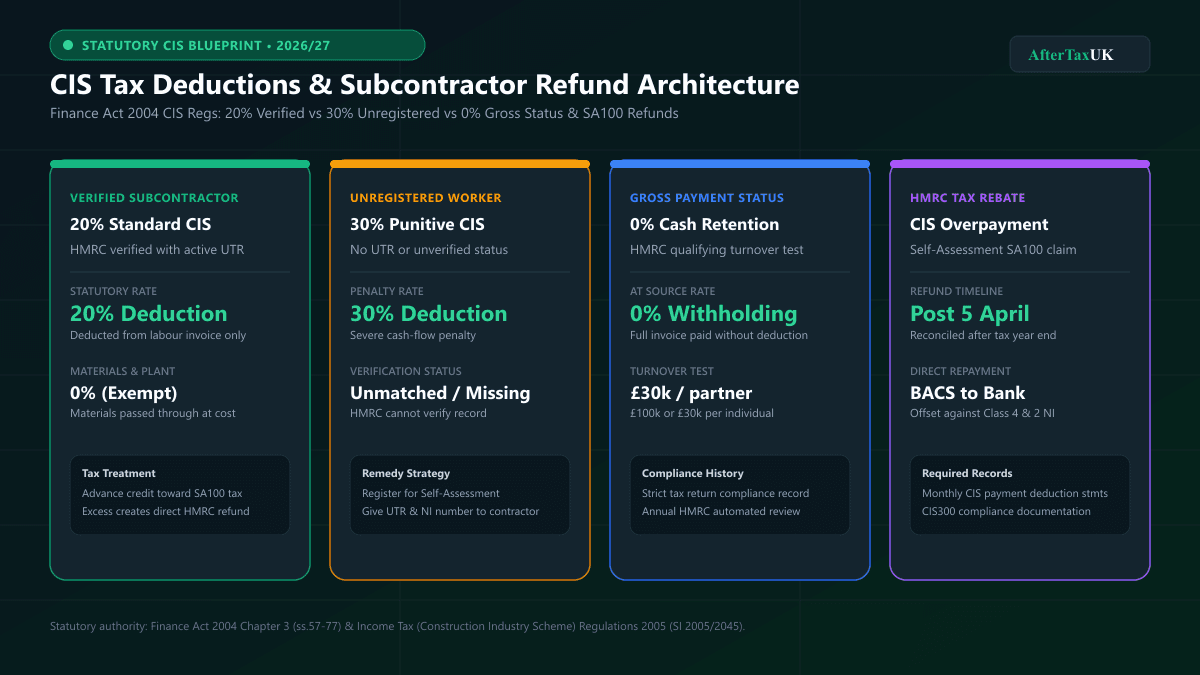
What is the Construction Industry Scheme (CIS)?
The Construction Industry Scheme, codified under Chapter 3, Part 3 of the Finance Act 2004 and the Income Tax (Construction Industry Scheme) Regulations 2005 (SI 2005/2045), was introduced by Parliament to combat informal economic activity in the building sector.
Unlike standard self-employed contractors who receive 100% of their gross invoiced fees and settle their liabilities annually through Self-Assessment, construction subcontractors face mandatory tax withholding at source. Contractors must verify each subcontractor with HMRC before issuing payment and deduct either 20% (for registered subcontractors) or 30% (for unverified or unregistered workers).
Contractor vs Subcontractor Definitions:
- Mainstream Contractor: Any business that pays subcontractors for construction operations (e.g. general building contractors, property developers, civil engineering firms).
- Deemed Contractor (s.59 FA 2004): Any non-construction commercial business, housing association, or local council whose cumulative expenditure on construction operations exceeds £3 million across any rolling 12-month period.
- Subcontractor: Any sole trader, partnership, or limited company contracted to carry out construction operations for a mainstream or deemed contractor.
The Three Statutory CIS Deduction Rates
When a contractor takes on a new subcontractor, Regulation 6 of SI 2005/2045 obliges the contractor to conduct an electronic verification with HMRC using the subcontractor's legal name, Unique Taxpayer Reference (UTR), and National Insurance number (or Company Registration Number). HMRC instantly returns one of three statutory tax statuses:
20% Deduction
Applies to subcontractors registered with HMRC for CIS who possess a verified UTR. Withheld solely from labour and contractor margin.
30% Deduction
Mandatory for unregistered subcontractors, unmatched records, or where verification fails. Severe penalty for non-compliance.
0% Gross Status
Granted to established construction businesses passing HMRC's strict turnover, business, and statutory compliance audits.
What Attracts CIS Deductions: Labour vs Materials
A widespread misconception among tradespeople is that CIS deductions apply to the total invoice figure. Under Section 60 of the Finance Act 2004, CIS deductions must be applied strictly to the gross amount payable less allowable direct non-labour costs.
| Cost Element | CIS Status | Statutory Authority & Conditions |
|---|---|---|
| Labour & Workmanship | Taxable (20% or 30%) | Direct time, trade rates, and subcontractor profit margin. |
| Construction Materials | 100% Exempt (0%) | Timber, bricks, cables, plaster, pipework at actual direct cost. |
| Plant Hire (Without Operator) | 100% Exempt (0%) | Scaffolding, diggers, skips hired directly from third-party suppliers. |
| Plant Hire (With Operator) | Apportioned | Plant machinery hire is exempt; operator labour hours attract 20% CIS. |
| Consumables & Fuel | 100% Exempt (0%) | Fuel used in hired equipment, drill bits, blades used directly on site. |
| Value Added Tax (VAT) | 100% Exempt (0%) | CIS is assessed before VAT or under Domestic Reverse Charge rules. |
Worked Invoice Example: Electrical Contractor
Consider an electrician submitting a £6,000 net invoice to a commercial builder (20% verified CIS rate):
*If the contractor had improperly applied 20% to the total £6,000 invoice, they would have deducted £1,200—depriving the electrician of £500 in working capital.
The VAT Domestic Reverse Charge (DRC) Interaction
Introduced under Section 55A of the Value Added Tax Act 1994 and detailed in HMRC VAT Notice 735/2, the Domestic Reverse Charge applies to VAT-registered businesses providing construction services that fall within CIS.
When supplying services to another VAT-registered contractor, the subcontractor does not charge output VAT on the invoice. Instead:
- The invoice must state: "Reverse charge: Customer to pay the VAT to HMRC" alongside the applicable VAT rate (standard 20% or reduced 5%).
- The contractor pays the subcontractor the net amount (less CIS deductions on labour).
- The contractor accounts for the output VAT and reclaims it as input VAT on their own VAT return.
- Crucial Cash-Flow Note: Subcontractors no longer hold client VAT funds between quarters, making timely CIS refunds even more critical for liquidity.
Why Sole Traders Receive Substantial Tax Repayments
For sole traders, CIS deductions are classified under law as advance payments on account toward your annual Income Tax and Class 4 National Insurance liabilities.
Because contractors deduct 20% flat from every pound of labour with zero allowance for personal tax thresholds, almost every full-time sole trader in the UK experiences an annual overpayment. Consider the statutory mathematical mechanics:
The Statutory Overpayment Mechanism (2026/27 Rates)
1. The £12,570 Personal Allowance: The first £12,570 of taxable profit is completely tax-free under Section 35 of the Income Tax Act 2007. However, CIS deducted 20% (£2,514) on that exact income at source!
2. Allowable Business Expenses:Under Part 2 of ITTOIA 2005, business costs incurred "wholly and exclusively" for trade (van lease, diesel, phone, tools, protective boots, insurance, accountancy fees) reduce your net taxable profit. CIS was withheld before these expenses were factored in.
3. Class 4 National Insurance: Class 4 NICs apply at 6% between £12,570 and £50,270. Combined Income Tax (20%) and Class 4 NICs (6%) is 26% on profit above £12,570, but 0% below £12,570.
In this standard scenario, the subcontractor receives an immediate £2,948.20 refund from HMRC once their SA100 return is processed after 5 April.
Limited Company Subcontractors: Offsets & Year-End Repayments
Unlike sole traders who reconcile via Self-Assessment, a limited company subcontractor faces a completely different statutory mechanism governed by Regulation 56 of SI 2005/2045.
1. Real-Time Monthly In-Year Offsets (EPS)
Each month, your payroll software files an Employer Payment Summary (EPS)reporting the cumulative CIS deductions suffered from your company's sales invoices. This figure is automatically offset against your company's monthly PAYE, Employer Class 1 NICs (15.0%), and employee student loan deductions payable to HMRC.
2. Year-End Cash Repayments Post-5 April
If your company suffered more CIS deductions than its total annual PAYE/NIC liabilities (common for limited companies with few direct PAYE employees), the surplus cannot be offset against Corporation Tax. Instead, after 5 April and following submission of the final month 12 EPS/FPS, the company must apply online to HMRC Specialist PT Operations for a direct bank repayment.
How to Qualify for 0% Gross Payment Status (GPS)
To eliminate cash-flow withholding altogether, established subcontractors can apply for Gross Payment Status under Schedule 11 of the Finance Act 2004. With GPS, contractors pay invoices 100% gross without any CIS deductions.
The business must carry on construction work in the UK and operate through a dedicated commercial UK bank account.
Net construction turnover (excluding materials & VAT) over the prior 12 months must exceed £30,000 per director or a company minimum of £100,000.
Zero late filings or overdue payments for Self-Assessment, Corporation Tax, PAYE, and VAT during the preceding 12 months.
*HMRC conducts an automated annual Tax Treatment (TT) review. A single late Corporation Tax return or missed PAYE deadline can lead to immediate revocation of Gross Payment Status.
Model Your Subcontractor Tax Position
Calculate your net take-home pay, Income Tax bands, and Class 4 National Insurance contributions to estimate your annual CIS tax rebate with statutory precision.
Launch the Self-Employed Tax Calculator (2026/27) →Frequently Asked Questions
Frequently Asked Questions
Clear answers based on official HMRC rules and statutory guidance.
Statutory Authorities & Official References
Always review the authoritative legislation governing CIS obligations, verification, and deduction compliance: