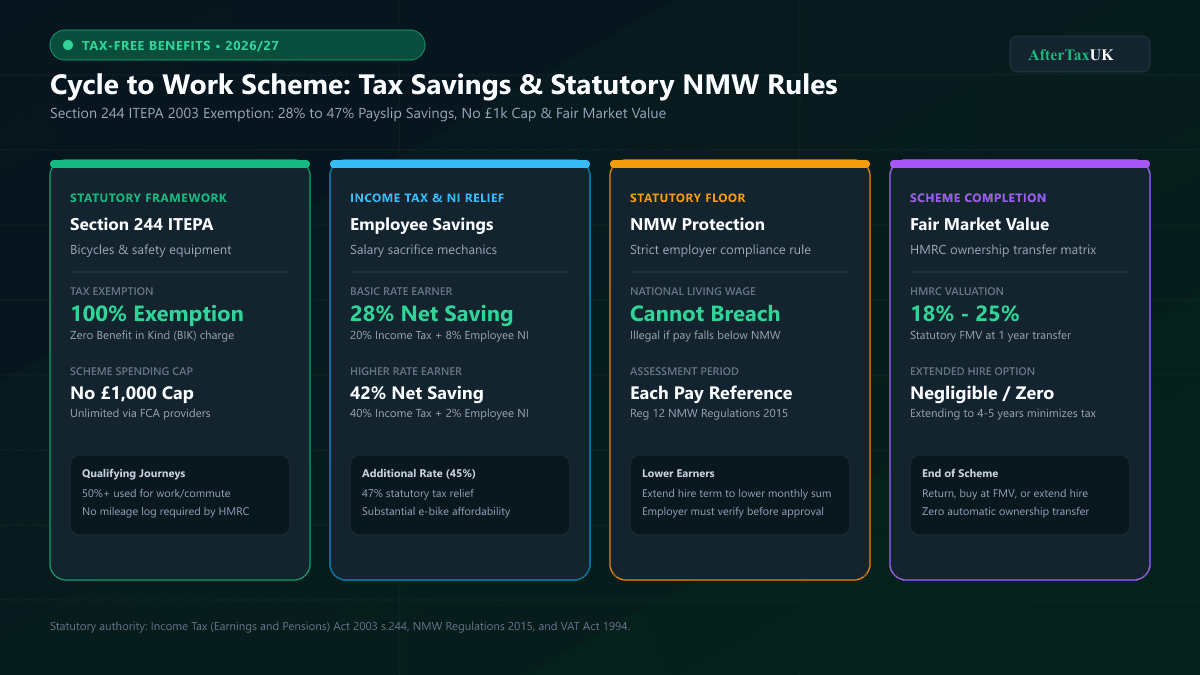
1. Statutory Authority: Section 244 ITEPA 2003 Exemption
The UK Cycle to Work scheme is a government-backed employee benefit introduced under the Finance Act 1999 and codified in Section 244 of the Income Tax (Earnings and Pensions) Act 2003 (ITEPA 2003). Under this legislation, no liability to Income Tax or National Insurance contributions arises when an employer provides an employee with a bicycle and cyclist safety equipment.
Crucially, when the government introduced restrictive Optional Remuneration Arrangements (OpRA) rules under the Finance Act 2017 (Sections 69A and 69B ITEPA 2003) to curb salary sacrifice tax advantages, qualifying cycle-to-work arrangements were granted an explicit statutory exemption. This means that exchanging gross salary for bicycle hire continues to deliver genuine tax and Class 1 National Insurance relief.
- The scheme must be made available to an employer's workforce generally, without selection criteria restricted exclusively to higher-paid executives.
- The employee must use the bicycle and safety equipment mainly (at least 50% of its usage) for qualifying journeys between home and workplace or between work locations.
- Ownership of the equipment must remain with the employer or scheme provider throughout the initial hire period rather than transferring immediately.
2. How Salary Sacrifice Delivers 28% to 47% Net Savings
Under the scheme, your employer purchases or leases the bicycle package and leases it to you over an agreed hire term (normally 12, 18, or 24 months). In return, you agree to a formal contractual salary sacrifice under UK employment law, reducing your gross monthly salary before statutory deductions are applied.
Because your gross salary is lower, you pay less Income Tax and employee Class 1 National Insurance contributions (NICs). The precise net savings depend directly on your marginal tax band:
Basic Rate (20%)
28% Saved
20% Income Tax + 8% Class 1 Employee NI on earnings between £12,570 and £50,270.
Higher Rate (40%)
42% Saved
40% Income Tax + 2% Class 1 Employee NI on earnings between £50,271 and £125,140.
£100k Taper Trap
62% Saved
60% effective Income Tax (via Personal Allowance taper) + 2% Class 1 Employee NI.
In addition, employers save Class 1 Secondary National Insurance contributions at 15.0% on the sacrificed gross salary under the National Insurance Contributions (Secondary Class 1 Contributions) Act 2025.
3. The Statutory Floor: National Minimum Wage Compliance
While employees across all pay levels value the scheme, UK employment law imposes a strict, non-negotiable restriction: a salary sacrifice agreement cannot reduce an employee's contractual cash remuneration below the statutory minimum wage.
From 1 April 2026, the statutory National Living Wage for workers aged 21 and over is £12.71 per hour. Under the National Minimum Wage Regulations 2015, contractual salary sacrifice deductions count as a reduction in pay for minimum wage calculation purposes. Employers who breach this rule face HMRC enforcement notices, public naming, and penalties up to 200% of arrears.
For a full-time employee working 37.5 hours per week across 52 weeks (1,950 annual hours), the absolute statutory wage floor is:
If an employee earns £26,000 per year, their maximum allowable annual salary sacrifice across all schemes (including pension, cycle, and childcare) cannot exceed £1,215.50 (£101.29 per month). Employers must verify payroll headroom before approving applications.
4. Removal of the £1,000 Cap & Electric Cargo Bikes
A common misconception is that Cycle to Work packages are legally limited to £1,000. In reality, the £1,000 figure was never an HMRC tax rule; it was a threshold set by the Financial Conduct Authority (FCA) under the Consumer Credit Act 1974 for employers hiring equipment without a full consumer credit licence.
In June 2019, the Department for Transport (DfT) issued updated statutory guidance. By partnering with FCA-authorised scheme administrators (such as CycleScheme, Bike2Work, or Vivup) or utilising employer group licences, businesses can offer packages with no arbitrary spending cap. This change has transformed accessibility for premium commuting hardware:
- Electric Commuter Bikes (E-Bikes): Quality e-bikes generally retail between £1,800 and £3,500, enabling longer commutes and hilly journeys.
- Electric Cargo Bikes: Family and utility cargo bicycles often retail from £3,500 to £6,000+, allowing parents to combine school drop-offs with low-emission commutes.
- Specialist Safety Equipment: Helmets, high-visibility waterproofs, locks meeting Sold Secure standards, lights, and panniers can all be bundled into the tax-free package.
5. Worked Example: Commuter Bike vs Electric Cargo Bike
The table below illustrates total costs, statutory deductions, and net take-home pay savings across 12-month hire agreements in the 2026/27 tax year:
| Package Cost | Monthly Sacrifice | Basic Rate (28%) | Higher Rate (42%) | Employer NI Saved |
|---|---|---|---|---|
| £1,000 Package | £83.33 / mo | Save £280 (Net £720) | Save £420 (Net £580) | £150.00 (15%) |
| £2,000 E-Bike | £166.67 / mo | Save £560 (Net £1,440) | Save £840 (Net £1,160) | £300.00 (15%) |
| £3,500 Cargo Bike | £291.67 / mo | Save £980 (Net £2,520) | Save £1,470 (Net £2,030) | £525.00 (15%) |
6. End-of-Hire Ownership Transfer & HMRC Fair Market Value
To preserve the tax-free status under Section 244 ITEPA 2003, there must be no automatic contractual clause transferring bicycle ownership to the employee during the hire period. If ownership transfers for free immediately after 12 months, HMRC treats the transfer as a taxable benefit in kind subject to Income Tax and Class 1B or Class 1A NIC.
HMRC publishes a statutory Fair Market Value (FMV) matrix governing bicycle disposal values:
| Age of Bicycle | Original Value < £500 | Original Value £500+ |
|---|---|---|
| 1 Year | 18% | 25% |
| 2 Years | 13% | 17% |
| 3 Years | 8% | 12% |
| 4 Years | 3% | 7% |
| 5 Years+ | Negligible (0%) | Negligible (0% - 2%) |
Best Practice Strategy: The Extended Use Agreement
Rather than paying 25% of the original price after 12 months, modern scheme providers (e.g. CycleScheme, Halfords Cycle2work) place employees on a free or low-deposit "Extended Use Agreement" for up to 36 additional months. At year 4 or 5, the bike is transferred to the employee with zero further tax liability, preserving maximum overall savings.
Frequently Asked Questions
Clear answers based on official HMRC rules and statutory guidance.