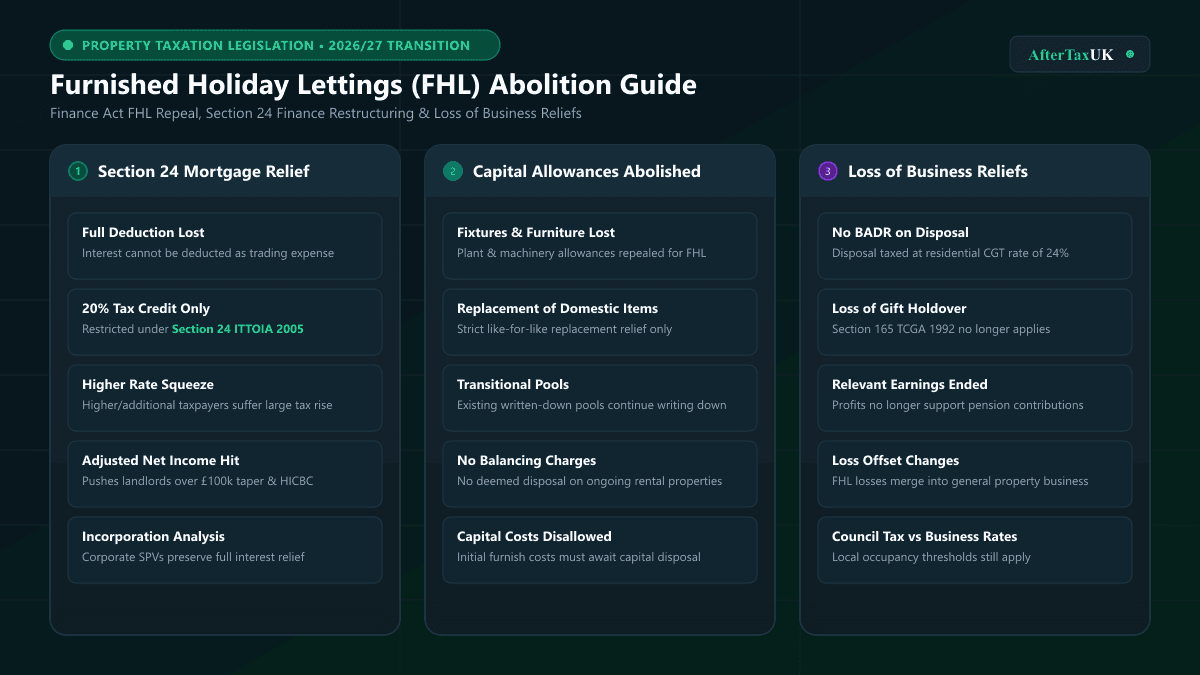
1. The Legislative Repeal: What Was the FHL Regime?
Established under Chapter 6 of Part 3 of the Income Tax (Trading and Other Income) Act 2005 (ITTOIA 2005) for individuals, and the Corporation Tax Act 2009 (CTA 2009) for companies, the Furnished Holiday Lettings regime provided privileged tax status for short-term holiday accommodations that met statutory occupancy tests (available for 210 days, commercially let for 105 days, and no single long-term let exceeding 31 days).
Qualifying properties were deemed to be commercial trading businesses rather than passive investment property businesses. This entitled owners to full mortgage interest deductibility, generous capital allowances, Capital Gains Tax business reliefs, and pension-relieved earnings treatment.
Under the Finance Act, Parliament repealed Chapter 6 Part 3 ITTOIA 2005 with effect from 6 April 2025for individuals (and 1 April 2025 for corporation tax). Holiday let income is now merged directly into the taxpayer's general UK or overseas property business, eliminating the historic tax divide between long-term residential buy-to-let landlords and holiday home operators.
2. Section 24 Finance Cost Restriction: The Higher-Rate Squeeze
The most severe commercial consequence of abolition is the imposition of Section 24 of ITTOIA 2005 on holiday let mortgages:
Before vs After Abolition: Worked Comparison
Consider an individual higher-rate (40%) taxpayer with a holiday cottage generating £35,000 in gross rental income, £7,000 in operational overheads (cleaning, booking platform fees, utilities), and £15,000 in mortgage interest:
Former FHL Treatment (Pre-Abolition)
Gross Income: £35,000
Overheads: −£7,000
Mortgage Interest: −£15,000
Net Taxable Profit: £13,000
Tax at 40%: £5,200
Net Cash In Pocket: £7,800
Post-Abolition Section 24 Treatment
Gross Income: £35,000
Overheads: −£7,000
Taxable Property Profit: £28,000
Gross Tax at 40%: £11,200
Less Section 24 Tax Credit (20% of £15k): −£3,000
Final Tax Due: £8,200
Net Cash In Pocket: £4,800
The abolition causes a £3,000 (58%) tax hike on the exact same financial performance, slashing cash returns from £7,800 to £4,800.
Furthermore, inflating taxable income from £13,000 to £28,000 raises the landlord's Adjusted Net Income (ANI). This can inadvertently trigger the £100,000 Personal Allowance taper (creating a 60% marginal tax trap) or claw back Child Benefit via the High Income Child Benefit Charge (HICBC) between £60,000 and £80,000.
3. Abolition of Capital Allowances & Transitional Pool Rules
Under the former regime, holiday lets qualified for plant and machinery capital allowances under the Capital Allowances Act 2001. Landlords could claim 100% Annual Investment Allowance (AIA) or Writing Down Allowances (WDA) on furniture, soft furnishings, hot tubs, high-end kitchen appliances, and embedded fixtures.
The New Rule: Replacement of Domestic Items Relief
Going forward, holiday lets are restricted to Section 311A ITTOIA 2005 (Replacement of Domestic Items Relief). Under this rule:
- The initial cost of furnishing, decorating, or installing amenities in a new holiday let receives zero income tax deduction.
- Only the subsequent replacement of an existing domestic item (on a like-for-like basis) is deductible as an operational revenue expense.
- Upgrades or additions (e.g. adding a new outdoor sauna where none previously existed) are non-deductible capital expenditures.
Transitional Rules for Existing Pools
HMRC confirmed that landlords with existing capital allowance pools as of 5 April 2025 do not suffer an automatic deemed disposal balancing charge. The remaining written-down value can continue to be written down at standard WDA rates (18% main pool / 6% special rate pool) against post-abolition property business profits until the pool is reduced to zero.
4. Capital Gains Tax Impact: Loss of BADR & Gift Relief
Disposing of a holiday let after abolition triggers substantial Capital Gains Tax consequences under the Taxation of Chargeable Gains Act 1992 (TCGA 1992):
- Loss of Business Asset Disposal Relief (BADR): FHL properties no longer qualify for the preferential 18% BADR rate. All gains are taxed at residential CGT rates: 18% for basic-rate taxpayers and 24% for higher/additional-rate taxpayers.
- Loss of Gift Holdover Relief (Section 165 TCGA 1992): Owners can no longer gift a holiday let to children or trusts without triggering an immediate dry Capital Gains Tax charge based on open market value.
- Loss of Rollover Relief (Section 152 TCGA 1992): Capital gains can no longer be rolled over into the acquisition of new commercial or trading assets.
- 60-Day UK Property CGT Reporting: Because holiday lets are residential property, any capital gain arising on disposal must be reported and the tax paid within 60 days of completionvia HMRC's online Capital Gains Tax on UK property service.
5. Pension Relief, Loss Pooling & Joint Ownership (Form 17)
Abolition alters several ancillary tax provisions:
- Pension Relief (Section 189 Finance Act 2004): FHL profits no longer constitute "relevant UK earnings". Holiday let profits can no longer support tax-relieved personal pension contributions (such as into a SIPP).
- Loss Offset Merging: Under the old rules, FHL losses could only be carried forward against future FHL profits. Following repeal, unused FHL loss carry-forwards are merged into the landlord's ongoing UK property business loss pool under Section 118 Income Tax Act 2007.
- Joint Ownership & Form 17: Under the FHL regime, married couples and civil partners could flexibly allocate profits between themselves to maximise basic-rate tax bands. Under ordinary property rules (Section 836 Income Tax Act 2007), income is strictly taxed 50:50 by default. To alter this split, spouses must hold unequal beneficial shares as tenants in common, execute a valid Declaration of Trust, and lodge HMRC Form 17 within 60 days.
6. Local Authority Council Tax vs Business Rates Distinction
It is vital to distinguish statutory Income Tax treatment from local authority rating valuation:
The abolition of the FHL Income Tax regime does not automatically abolish business rates eligibility for holiday lets. In England, a self-catering property remains eligible for Non-Domestic Business Rates (and potential Small Business Rate Relief) if it is available to let commercially for short periods for at least 140 days in the current and previous year, and actually let for at least 70 days. Properties failing these occupancy thresholds revert to standard domestic Council Tax, which may be subject to local second-home premium council tax multipliers of up to 100% or 200%.
Estimate Section 24 Rental Income Tax
Model your gross holiday rental income, allowable overheads, mortgage interest, and calculate your net post-abolition tax liability.
Open the Rental Income Tax CalculatorFrequently Asked Questions
Frequently Asked Questions
Clear answers based on official HMRC rules and statutory guidance.
Statutory Sources & Primary Legislation
Furnished Holiday Lettings repeal is governed by UK primary tax legislation and official policy papers:
- legislation.gov.uk: Income Tax (Trading and Other Income) Act 2005 (Chapter 6 Part 3 FHL Provisions)
- GOV.UK: Section 24 Residential Landlord Finance Cost Relief Guidance
- HMRC Policy Paper: Abolition of the Furnished Holiday Lettings Tax Regime
- GOV.UK: Capital Gains Tax on Business Assets and Residential Disposals