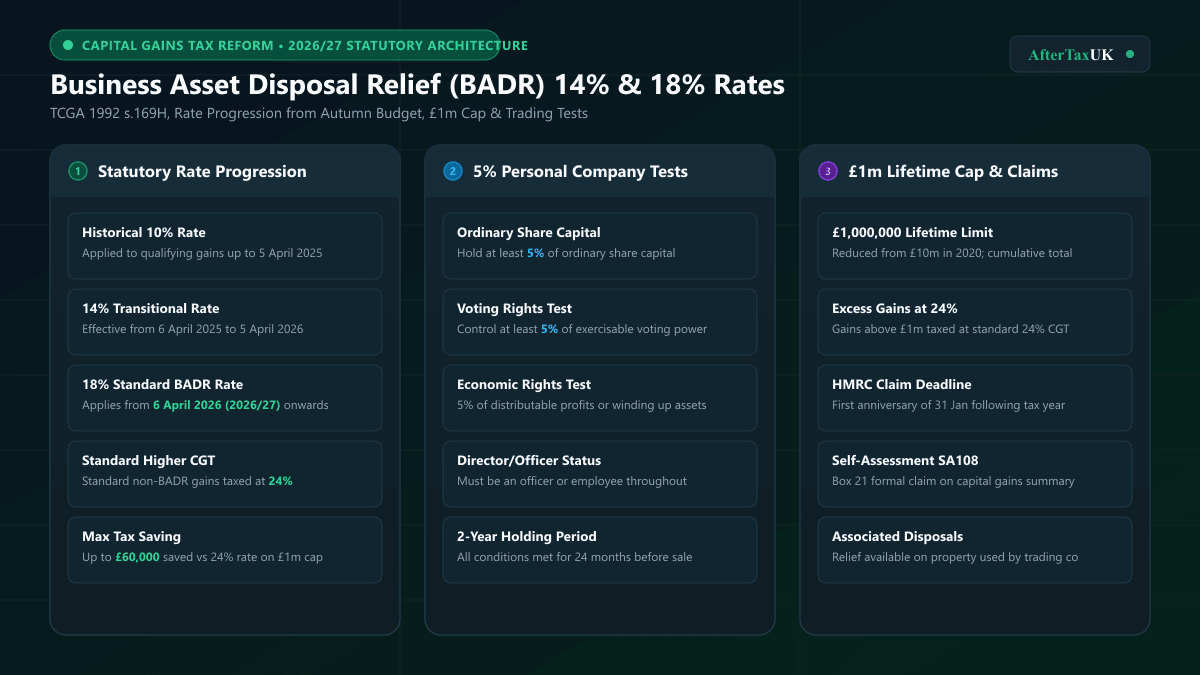
1. The Legislative Evolution: From 10% to 14% and 18%
Originally introduced in the Finance Act 2008 as Entrepreneurs' Relief, the relief was designed to encourage entrepreneurial risk-taking by offering a preferential 10% Capital Gains Tax rate on qualifying business assets. In March 2020, the lifetime allowance was drastically reduced from £10,000,000 to £1,000,000, and the relief was renamed Business Asset Disposal Relief (BADR).
In the Autumn Budget 2024, Parliament passed statutory amendments updating the rate progression under Section 169N TCGA 1992:
| Disposal Period | BADR Tax Rate | Standard Higher CGT Rate | Tax Advantage on £1m Cap |
|---|---|---|---|
| Up to 5 April 2025 | 10% | 20% / 24% | £140,000 saved |
| 6 April 2025 – 5 April 2026 | 14% | 24% | £100,000 saved |
| 6 April 2026 onwards (2026/27) | 18% | 24% | £60,000 saved |
Even at the 18% rate in 2026/27, BADR provides a substantial 6% tax saving compared to the headline 24% higher-rate CGT rate. On a maximum qualifying gain of £1,000,000, the total tax due under BADR is £180,000 versus £240,000 under standard rules—preserving £60,000 in net entrepreneurial wealth.
2. Qualifying Disposals: Shares in a Personal Company
The vast majority of BADR claims arise when company directors and shareholders sell shares in a trading limited company under Section 169I(2)(c) TCGA 1992. To qualify, strict statutory tests must be satisfied continuously throughout the 2 years (24 months) immediately preceding the disposal:
Condition 1: Officer or Employee Status
You must hold a genuine office (such as Director or Company Secretary) or be an employee of the company or a member of the trading group. There is no statutory minimum hour requirement, but the role must be bona fide.
Condition 2: The 5% Personal Company Test (Section 169I(6))
The company must be your "personal company", meaning you must satisfy all of the following requirements:
- Hold at least 5% of the ordinary share capital (measured by nominal share value).
- Possess at least 5% of the voting rights exercisable by virtue of that holding.
- Economic Rights Test: You must satisfy either:
(a) Entitlement to at least 5% of profits available for distribution to equity holders and at least 5% of net assets upon winding up; OR
(b) Entitlement to at least 5% of the disposal proceeds in the event of a sale of the company's entire ordinary share capital.
Condition 3: The Trading Company Requirement (Section 165A)
The company must be a "trading company" or the holding company of a "trading group". Under HMRC guidance and Section 165A TCGA 1992, trading activities must not include non-trading activities (such as passive property investment, substantial cash accumulation, or quoted shares) to a "substantial extent". In practice, HMRC applies a 20% threshold across turnover, asset base, management time, and capital expenditure.
3. Sole Traders & Partnerships: Unincorporated Disposals
Sole traders and partners can claim BADR under Section 169I(2)(a)–(b) TCGA 1992 across two categories:
- Disposal of the Whole or Part of a Business: Selling goodwill, customer lists, premises, and intellectual property as an ongoing commercial concern. Crucially, disposing of an individual piece of plant or equipment while remaining in business does not qualify.
- Disposal of Assets Following Cessation: If a sole trader or partnership permanently ceases trading, qualifying business assets disposed of within 3 years of cessation qualify for BADR, provided the business was owned for at least 2 years prior to closing.
For partners, disposing of all or part of an equity partnership interest satisfies the qualifying disposal test, provided partnership status was held for at least 24 months.
4. Associated Disposals: Property Used by a Business (Section 169K)
Many entrepreneurs personally own commercial premises (such as a factory, warehouse, or clinical office) that they lease to their personal trading company. Under Section 169K TCGA 1992, selling that property can qualify for BADR as an "associated disposal", subject to strict conditions:
- Withdrawal of Participation: The disposal of the property must take place as part of the individual's material disposal of shares or partnership interest (reducing their stake significantly).
- The Commercial Rent Restriction: Under Section 169P TCGA 1992, if the individual charged the company a commercial market rent for using the property, HMRC reduces BADR on a pro rata basis. Full relief is available only if the property was made available rent-free. If full market rent was paid, BADR on the property gain is denied entirely.
5. The £1,000,000 Lifetime Cap & Capital Gains Ordering Rules
The £1,000,000 lifetime allowance is a cumulative statutory limit per individual under Section 169N TCGA 1992:
Ordering and Offset Mechanics
When preparing your Self-Assessment tax return (SA108), the statutory ordering of reliefs is critical:
- Allowable capital losses from the current tax year and brought-forward capital losses are deducted first.
- The Annual Exempt Amount (£3,000 for 2026/27) is deducted. Taxpayers can strategically allocate their £3,000 allowance against non-BADR gains taxed at 24% rather than wasting it on 18% BADR gains.
- Qualifying BADR gains up to the remaining lifetime limit are charged at the 18% rate.
- Any qualifying gains exceeding £1,000,000 spill over into standard Capital Gains Tax and are charged at 24% for higher/additional earners.
Married couples and civil partners each possess their own independent £1,000,000 lifetime BADR allowance. Where both spouses actively participate as employees or officers and each meet the 5% personal company tests for 2 years, up to £2,000,000 of gains can be sheltered at the 18% rate.
6. Claiming BADR: Deadlines & HMRC Form SA108
Relief is never granted automatically by HMRC. Under Section 169M TCGA 1992, a formal claim must be submitted:
- Reporting Route: Report the gain and claim BADR in Box 21 of the Capital Gains Summary pages (SA108) as part of your annual SA100 Self-Assessment tax return.
- Statutory Claim Deadline: The claim must be received by HMRC on or before the first anniversary of the 31 January following the end of the tax year of disposal. For a disposal occurring in the 2026/27 tax year (6 April 2026 to 5 April 2027), the statutory deadline is 31 January 2029.
Missing the statutory deadline irrevocably forfeits BADR, subjecting the entire disposal to standard 24% Capital Gains Tax rates.
Calculate Capital Gains Tax & BADR Savings
Model your gross proceeds, acquisition costs, allowable professional fees, and calculate your exact BADR tax liability versus standard rates.
Launch the Capital Gains Tax CalculatorFrequently Asked Questions
Frequently Asked Questions
Clear answers based on official HMRC rules and statutory guidance.
Statutory Sources & Primary Legislation
Business Asset Disposal Relief is anchored in UK primary legislation and HMRC manuals:
- legislation.gov.uk: Taxation of Chargeable Gains Act 1992 Sections 169H–169V (Business Asset Disposal Relief)
- GOV.UK: Business Asset Disposal Relief — Overview and Eligibility
- HMRC Capital Gains Manual: CG63950 — Business Asset Disposal Relief
- HMRC Helpsheet HS275: Business Asset Disposal Relief Self-Assessment Guidance