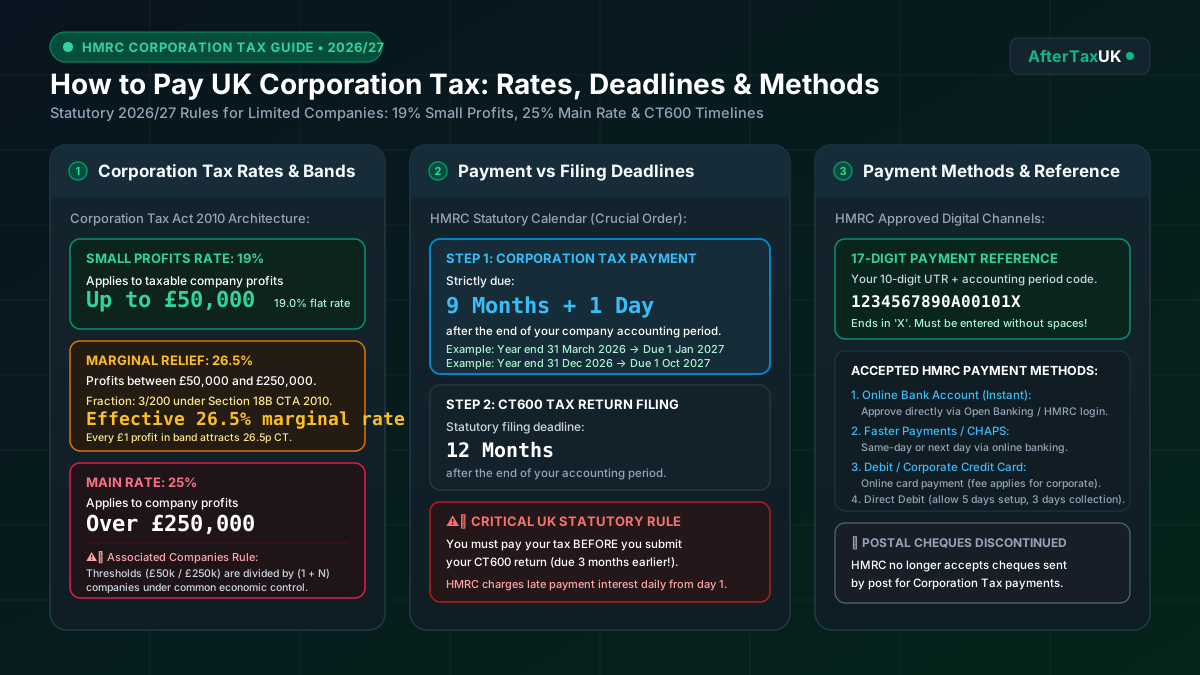
1. Corporation Tax Rates and Marginal Relief (2026/27)
Under the Corporation Tax Act 2010 (CTA 2010), company profits (trading profits plus chargeable capital gains minus allowable business expenses and capital allowances) are taxed under a tiered system:
| Profit Tier | Taxable Profit Range | Applicable CT Rate |
|---|---|---|
| Small Profits Rate | Up to £50,000 | 19% |
| Marginal Relief Band | £50,001 to £250,000 | Effective 26.5% |
| Main Rate | Over £250,000 | 25% |
How Marginal Relief Works in Practice
Under Section 18B CTA 2010, companies with profits between £50,000 and £250,000 calculate tax initially at the 25% Main Rate and then subtract a statutory Marginal Relief deduction calculated as:
Because of this mathematical formula, every additional £1 of profit earned between £50,000 and £250,000 is taxed at an effective marginal rate of 26.5%. Once profits exceed £250,000, the overall effective rate flattens out at 25.0%.
2. Statutory Deadlines: Payment vs Filing
Many first-time company directors assume tax is paid when the annual company tax return is filed. Under UK company tax law, this is incorrect and leads to automatic late payment interest charges:
Your Corporation Tax bill must be paid in full exactly 9 months and 1 day after your accounting period end date.
Your Company Tax Return (Form CT600) and statutory accounts must be submitted to HMRC within 12 months.
Quarterly Instalment Payments (Large Companies)
Companies with taxable profits exceeding £1.5 million do not benefit from the 9-month payment window. Under the Corporation Tax (Instalment Payments) Regulations 1998, large companies must pay tax in four quarterly instalments (months 7, 10, 13, and 16 from the start of the accounting period). Very large companies (profits over £20 million) pay even earlier (months 3, 6, 9, and 12).
3. Your 17-Digit Payment Reference Number
Every payment made to HMRC must quote your company's specific 17-character Corporation Tax payment reference. If you use your personal UTR, PAYE reference, or VAT number, HMRC's automated reconciliation system will fail to allocate the funds, triggering automated debt collection letters and interest.
A00101).X).You can locate your reference on HMRC Form CT603 ("Notice to deliver a company tax return"), on official payment reminders, or by logging into your HMRC online business tax account.
4. Official HMRC Payment Methods Compared
HMRC accepts electronic payments via several channels, each with differing processing times:
Method 1: Online Bank Account (Open Banking / HMRC Portal)
InstantLog into your HMRC business account and select "Pay by bank account". You are securely transferred to your online banking app to authorise the transaction via Open Banking. Payment details and your 17-digit reference are populated automatically.
Method 2: Faster Payments or CHAPS via Online Banking
Same Day / 24hSend a bank transfer directly from your business account using HMRC bank details:
Method 3: Corporate Debit or Credit Card Online
Same DayPay via GOV.UK using your card. Personal debit cards incur no fee. Corporate debit cards and corporate credit cards incur a non-refundable surcharge reflecting interchange fees.
Method 4: Direct Debit
Allow 5 Working DaysSet up a single-payment Direct Debit instruction via your HMRC online account. First-time setup requires at least 5 working days before payment is collected.
5. What to Do If You Cannot Pay on Time
If your business experiences cash flow constraints and cannot settle its Corporation Tax bill in full by the statutory due date, take prompt action before HMRC initiates enforcement proceedings:
- Contact HMRC Payment Support Service: Call HMRC before the payment deadline on 0300 200 3835.
- Request a Time to Pay (TTP) Agreement: HMRC regularly agrees repayment plans allowing solvent businesses to clear liabilities over 6 to 12 monthly instalments.
- Eligibility Criteria: You must demonstrate that your company is currently unable to pay in full, has filed all outstanding returns, and has a credible recovery plan to clear future obligations.
Model Director Tax & Dividends
Calculate Corporation Tax, dividend tax, and director income on profits up to £500,000.
Open the Director Salary & Dividend Calculator (2026/27) →Frequently Asked Questions
Clear answers based on official HMRC rules and statutory guidance.
Statutory Citations & Official HMRC Links
Verified against primary UK tax legislation and HM Revenue & Customs technical manuals: