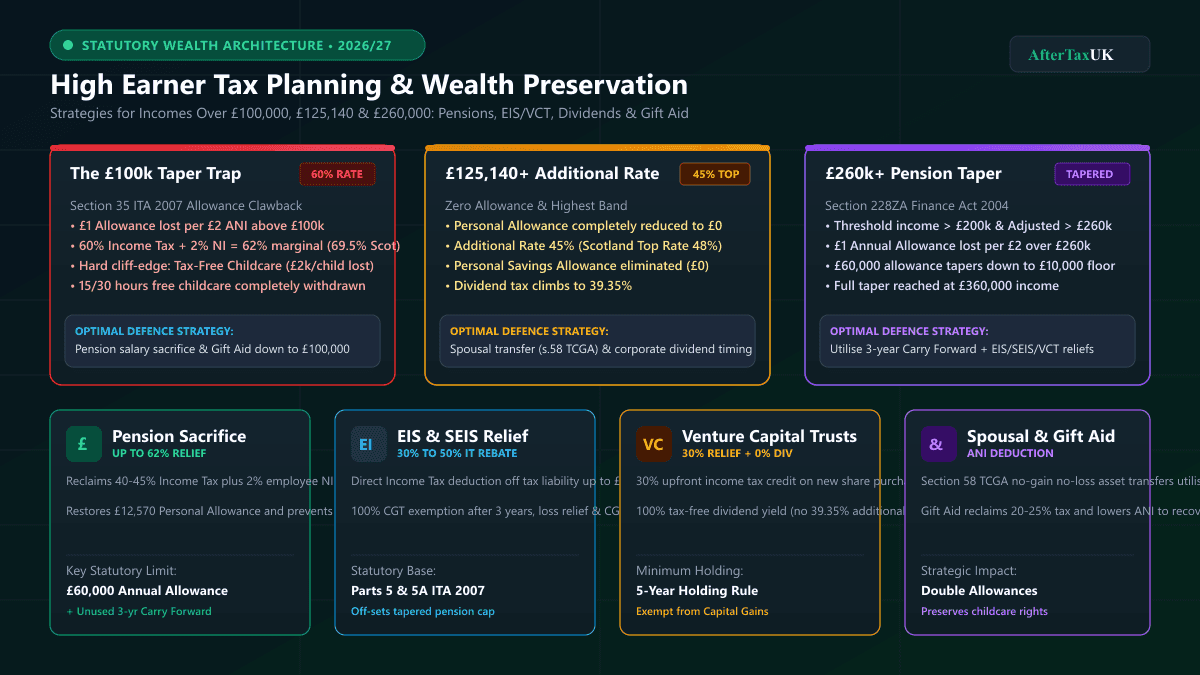
The 2026/27 High-Earner Tax Conundrum
In the UK tax system, progressive headline rates belie the reality of effective marginal taxation. Because personal thresholds have remained frozen while nominal wages and executive bonuses have risen, more professionals than ever find themselves propelled into statutory clawback zones.
Unlike standard PAYE employees whose marginal deduction rate rarely exceeds 42% (40% Higher Rate Income Tax plus 2% Class 1 National Insurance contributions), high earners face multiple structural cliff-edges. An individual earning £110,000 loses 62p of every additional pound earned to statutory deductions. If that individual has young children in nursery, the marginal loss in take-home pay and forfeited government childcare subsidies can easily exceed 100%.
| Statutory Hurdle | Statutory Mechanism | Headline Impact | Core Strategic Defence |
|---|---|---|---|
| £100,000 ANI | Section 35 ITA 2007 (Allowance Taper) | 60%–62% Marginal Tax; Complete Loss of Tax-Free Childcare & 30 Free Hours | Pension Salary Sacrifice, SIPP Top-ups & Charitable Gift Aid |
| £125,140 Earnings | Section 10 ITA 2007 (Additional Rate Entry) | Personal Allowance eroded to £0; 45% Income Tax; £0 Personal Savings Allowance | Inter-spousal transfers, VCTs, Corporate dividend timing & ISAs |
| £260,000 Adjusted | Section 228ZA FA 2004 (Tapered Annual Allowance) | £60,000 Pension Allowance shrinks by £1 per £2 to £10,000 floor at £360k | 3-Year Carry Forward, EIS, SEIS & Family Investment Companies (FICs) |
The £100,000 Taper Trap: Escaping 60% Marginal Tax
The £100,000 threshold represents the steepest statutory tax trap in the UK fiscal code. Under Section 35 of the Income Tax Act 2007, an individual's entitlement to the standard £12,570 Personal Allowance is reduced by £1 for every £2 of Adjusted Net Income (ANI) earned in excess of £100,000.
Section 35 ITA 2007 & The 60% Marginal Tax Mathematics
When an employee earns an additional £100 within the £100,000 to £125,140 bracket:
- Higher Rate Income Tax (40%): £40 is deducted immediately from the extra £100.
- Personal Allowance Clawback: Entitlement to £50 of tax-free allowance is eliminated, exposing £50 of previously exempt income to the 40% Higher Rate: an additional £20 deduction.
- Class 1 Employee NI (2%): Above the Upper Earnings Limit (£50,270), employee National Insurance adds another £2 deduction.
- Combined Statutory Deduction: £40 + £20 + £2 = £62 on every £100 of earnings (an effective marginal rate of 62%).
Scottish Tax Disparity: For taxpayers resident in Scotland, where the Higher Rate is 42% and the Advanced Rate is 45%, the combined marginal Income Tax rate during allowance withdrawal reaches 63% to 67.5%, rising to an astonishing 69.5% once 2% employee NI is included.
The Brutal Childcare Cliff-Edge at £100,000
While the 62% marginal tax rate is severe, the simultaneous loss of statutory family benefits creates an outright cliff-edge. Under the Childcare Payments Act 2014, eligibility for Tax-Free Childcare and 30 hours of government-funded childcare terminates if either parent earns an Adjusted Net Income exceeding £100,000.
A single parent or dual-earner family where one partner earns £100,001 loses:
- Up to £2,000 per child annually in Tax-Free Childcare top-ups (£4,000 for a disabled child).
- 15 to 30 hours per week of funded childcare for children aged 9 months to 4 years during term time (worth between £5,000 and £8,000 per child annually in typical nursery fees).
Earning an extra £100 bonus at £99,950 can cause an immediate cash loss of over £10,000. For this reason, controlling Adjusted Net Income is the single highest-return financial decision a UK parent can make.
Calculating Adjusted Net Income (ANI)
Many high earners mistakenly believe their gross contractual salary is their fixed assessment figure. Under Section 58 ITA 2007, Adjusted Net Income is strictly defined as:
Adjusted Net Income (ANI) =
Total Taxable Income (Salary + Bonus + Taxable Benefits/BIK + Rental Profits + Dividends + Interest)
LESS: Gross Pension Contributions (Relief-at-Source grossed up or Net Pay)
LESS: Gross Charitable Gift Aid Donations (Net donation × 100 / 80)
LESS: Trading Allowance / Qualifying Property Losses
Pension Salary Sacrifice & Relief Optimisation
Pensions represent the most powerful, government-endorsed statutory shield against the £100,000 taper trap and higher tax bands. Understanding the distinction between contribution methods is vital for maximum tax efficiency.
Salary Sacrifice vs Relief at Source vs Net Pay
1. Pension Salary Sacrifice (The Gold Standard)
You enter a contractual agreement under employment law to surrender a portion of your cash salary in exchange for an employer pension contribution. Because contractual gross salary is reduced at source, you save 40%–45% Income Tax AND 2% employee Class 1 NI. Furthermore, your employer saves 15.0% Employer Class 1 NICs (secondary threshold £5,000 in 2026/27). Forward-thinking employers rebate part or all of this 15% saving directly into your pension pot.
2. Net Pay Arrangement (Traditional Workplace Schemes)
Pension contributions are deducted from gross salary before Income Tax is calculated on your payslip. Full higher rate or additional rate tax relief is granted immediately. However, employee NI (2%) is still charged on the unreduced salary, and no employer NI saving is created.
3. Relief at Source (Self-Invested Personal Pensions / SIPPs)
You pay net funds from your personal bank account into a SIPP. The pension administrator claims 20% basic rate relief from HMRC (a £8,000 net contribution becomes £10,000 gross). To claim the additional 20% (or 25% for additional rate earners), you must report the gross contribution on your Self-Assessment tax return (SA100). Crucially, the £10,000 gross amount is deducted in full when calculating your Adjusted Net Income.
Restoring the Personal Allowance: A Worked Example
Case Study: Sarah, Finance Director earning £120,000
Unplanned Position: Sarah earns £120,000. Her £20,000 excess over £100,000 withdraws £10,000 of her Personal Allowance, leaving her with just £2,570 tax-free. On that £20,000 slice, she pays £8,000 in Higher Rate Income Tax (40%), £4,000 due to lost allowance (40% of £10,000), and £400 in NI (2%), totalling £12,400 in deductions (62%).
Strategic Solution: Sarah redirects £20,000 into her workplace pension scheme via salary sacrifice, reducing her contractual earnings to exactly £100,000.
The Result: Her £12,570 Personal Allowance is 100% reinstated. She saves £12,400 in direct tax and NI deductions. Her £20,000 pension investment costs her only £7,600 in foregone net take-home pay: an illustration of current tax and NI relief, not a guaranteed investment return. Pension withdrawals may be taxable and the funds are normally locked away until the applicable access age.
Navigating the £125,140 Additional Rate Threshold
At exactly £125,140 (£100,000 + 2 × £12,570), an individual's Personal Allowance is completely extinguished. Beyond this figure, earners cross into the Additional Rate band (45% in England, Wales, and Northern Ireland; 48% Top Rate in Scotland).
Zero Personal Allowance & 45% Income Tax
For employment earnings above £125,140, the standard England/Wales/Northern Ireland marginal rates are 45% Income Tax and 2% employee NI before other deductions. Sole-trader profits use Class 4 NI rules instead; income types must not be treated as identical. In Scotland, earnings above £125,140 attract 48% Top Rate tax plus 2% NI, yielding a 50% flat deduction on employment income.
The Disappearing Personal Savings Allowance (£0)
Under Section 12 of the Income Tax Act 2007, the Personal Savings Allowance (PSA) provides:
- Basic Rate Taxpayers: £1,000 tax-free savings interest.
- Higher Rate Taxpayers: £500 tax-free savings interest.
- Additional Rate Taxpayers: £0 tax-free savings interest.
The moment your taxable income touches £125,141, you forfeit your £500 savings allowance entirely. Every single penny of interest earned across high-yield savings accounts, notice deposits, or cash holdings is taxed at 45%. A £10,000 interest return yields just £5,500 after tax. Compare the tax treatment, access restrictions, investment risks and your own needs before choosing between cash, ISAs, gilts or Premium Bonds. A tax advantage alone does not make a product suitable.
Dividend Tax Escalation at 39.35%
For company directors and investors holding unwrapped equities, the Dividend Allowance is frozen at an all-time low of £500. Beyond £125,140, dividend income is taxed at the punitive Additional Dividend Rate of 39.35% (compared to 10.75% for basic rate and 35.75% for higher rate).
The £260,000 Tapered Annual Allowance (TAA) Masterclass
While pension contributions solve tax liabilities for earners up to £200,000, executives earning over £260,000 encounter the statutory cap known as the Tapered Annual Allowance under Section 228ZA of the Finance Act 2004.
Threshold Income vs Adjusted Income Rules
The pension taper only applies if a taxpayer breaches both of the following statutory tests in the same tax year:
Test 1: Threshold Income
Statutory Limit: £200,000
Broadly defined as your total net taxable income from all sources LESS personal pension contributions made under Relief at Source. If Threshold Income is £200,000 or below, no taper applies regardless of your Adjusted Income.
Test 2: Adjusted Income
Statutory Limit: £260,000
Comprises total taxable income PLUS employer pension contributions and any salary sacrifice arrangements set up on or after 9 July 2015. This prevents avoiding the taper through corporate pension redirect.
The Taper Formula and £10,000 Statutory Floor
If both thresholds are breached, your standard £60,000 Annual Allowance is reduced by £1 for every £2 of Adjusted Income above £260,000. The allowance reduces until it hits the statutory minimum floor of £10,000, reached at an Adjusted Income of £360,000.
• Adjusted Income £260,000 → Annual Allowance = £60,000
• Adjusted Income £280,000 → Annual Allowance = £50,000 (£20k excess / 2 = £10k reduction)
• Adjusted Income £300,000 → Annual Allowance = £40,000
• Adjusted Income £320,000 → Annual Allowance = £30,000
• Adjusted Income £340,000 → Annual Allowance = £20,000
• Adjusted Income £360,000+ → Annual Allowance = £10,000 (Statutory Floor)
3-Year Carry Forward Rules (Section 228A FA 2004)
If your current-year allowance is restricted to £10,000, you can still inject significant capital into your pension using Carry Forward. Section 228A allows you to utilise unused annual allowances from the previous three tax years:
- 2023/24: Up to £60,000 unused allowance.
- 2024/25: Up to £60,000 unused allowance.
- 2025/26: Up to £60,000 unused allowance.
To qualify, you must have been a member of a registered UK pension scheme during those years, even if no contributions were made. Note that current-year allowances are always exhausted first before tapping prior-year reserves.
Venture Capital Tax Reliefs: EIS, SEIS, and VCT Playbook
When an executive's pension allowance is tapered to £10,000 and carry-forward headroom is depleted, conventional pensions can no longer absorb high earnings. To alleviate 45% Additional Rate liabilities, sophisticated earners turn to government-sponsored venture capital initiatives designed to encourage investment into British enterprise.
Enterprise Investment Scheme (EIS) — Part 5 ITA 2007
EIS provides generous tax incentives for investing in unquoted, higher-risk trading companies:
- 30% Upfront Income Tax Relief: Claim up to £300,000 in direct tax credits against your Income Tax liability on investments up to £1,000,000 per tax year (extended to £2,000,000 for Knowledge Intensive Companies).
- Carry-Back Facility: You can treat all or part of the shares as acquired in the previous tax year, offsetting prior-year tax liabilities.
- 100% Capital Gains Exemption: Any capital gain realised upon selling the shares after a 3-year holding period is completely tax-free.
- Capital Gains Deferral Relief: Gains made on other asset sales (e.g. secondary property, business exits) can be deferred indefinitely by reinvesting into EIS shares within 1 year before or 3 years after the disposal.
- Share Loss Relief (Section 131 ITA 2007): If an EIS investment fails, you can offset the net capital loss (after deducting initial 30% income tax relief) against your general income at your marginal rate (45%), potentially reducing the after-tax loss if all relief conditions are met and sufficient tax is available. These are high-risk investments and loss relief is not a capital guarantee.
Seed Enterprise Investment Scheme (SEIS) — Part 5A ITA 2007
Targeting early-stage start-ups, SEIS provides the highest upfront relief in the UK tax system:
- 50% Upfront Income Tax Relief: Invest up to £200,000 per year to receive up to £100,000 off your Income Tax bill.
- 50% Capital Gains Reinvestment Relief: If you reinvest chargeable capital gains into SEIS shares, 50% of the reinvested gain is permanently exempt from CGT.
- 100% CGT-Free Growth: Zero capital gains tax on disposal after 3 years.
Venture Capital Trusts (VCTs) — Part 6 ITA 2007
Unlike direct unquoted equity in EIS/SEIS, Venture Capital Trusts are London Stock Exchange-listed investment companies managed by institutional fund managers holding diversified portfolios of scale-up businesses:
- 20% upfront Income Tax relief from 6 April 2026: Qualifying new VCT subscriptions up to £200,000 can give up to £40,000 relief, limited by the tax liability and other conditions. A five-year holding period and continuing qualifying conditions normally apply; relief can be withdrawn.
- 100% Tax-Free Dividends: Ordinary dividends paid by VCTs are completely exempt from UK Income Tax. Tax treatment does not guarantee that dividends will be paid or that the investment will retain its value. Fees, liquidity and relief conditions matter.
- Zero Capital Gains Tax: Disposal of VCT shares is exempt from CGT, with no clawback of tax relief if sold after 5 years.
Spousal Transfers & Inter-Spousal Wealth Equalisation
Independent taxation in the UK means every individual is assessed separately. When one partner earns £150,000 while the other earns £20,000 or does not work, household wealth is subjected to severe tax asymmetry.
Section 58 TCGA 1992 No-Gain No-Loss Transfers
Under Section 58 of the Taxation of Chargeable Gains Act 1992, inter-spousal transfers of assets between married couples or civil partners living together take place on a statutory "no gain, no loss" basis. The recipient spouse inherits the original acquisition base cost of the asset, triggering zero Capital Gains Tax, zero Stamp Duty Land Tax (provided no mortgage is assumed), and zero Income Tax.
By gifting income-generating assets (such as buy-to-let properties, dividend-paying shares, or corporate bonds) to the lower-earning spouse, couples can:
- Utilise the lower earner's unused £12,570 Personal Allowance (taxed at 0%).
- Utilise their £37,700 Basic Rate band (taxed at 20% on non-savings or 10.75% on dividends, saving up to 25%–28.6% compared to the Additional Rate).
- Capture their full £1,000 Personal Savings Allowance (which is £0 for the higher earner).
- Capture their £500 Dividend Allowance and separate £3,000 annual Capital Gains Tax exemption.
Form 17 Beneficial Ownership Splitting
For jointly owned property, HMRC automatically presumes income is split 50:50. Under Section 837 of the Income Tax Act 2007, spouses can execute a formal Declaration of Trust establishing unequal ownership (e.g. 99% in the lower earner's name and 1% in the higher earner's name). Submitting HMRC Form 17 within 60 days of the declaration allows rental profits to be taxed in accordance with actual beneficial ownership, shifting rental income out of 45% brackets into basic or zero rate bands.
Charitable Giving & Gift Aid Tax Recovery
Philanthropy is an integral component of high-net-worth wealth planning. Beyond supporting worthwhile causes, Gift Aid serves as an extraordinary statutory tool for clawing back allowances and dismantling cliff-edges.
Expanding Tax Bands and Slashing Adjusted Net Income
Under Section 414 ITA 2007, when an individual makes a Gift Aid donation, the charity reclaims basic rate tax (20%) directly from HMRC. For higher and additional rate taxpayers:
- Higher Rate Taxpayers (40%): Can claim back the 20% differential on their Self-Assessment tax return.
- Additional Rate Taxpayers (45%): Can claim back the 25% differential on their Self-Assessment tax return.
- Scottish Top Rate Taxpayers (48%): Can claim back the 28% differential from HMRC.
Most importantly, the gross donation is deducted in full from total income when calculating Adjusted Net Income. If an executive earns £106,000, a net donation of £4,800 is grossed up to £6,000. Under standard England/Wales/Northern Ireland assumptions with no other adjustments, ANI falls to £100,000. Restoring £3,000 of Personal Allowance saves £1,200 Income Tax and extending the basic-rate band by £6,000 gives another £1,200, for £2,400 additional personal tax relief. The charity also reclaims £1,200. Childcare eligibility depends on both partners and the other scheme conditions; it is not an automatic cash refund.
Donating Listed Shares Under Section 431 ITA 2007
High earners holding shares that have experienced massive capital appreciation should avoid selling them to donate cash. Under Section 431 ITA 2007, gifting qualifying listed shares, securities, or land directly to a registered charity delivers a double tax relief:
- Zero Capital Gains Tax is charged on the disposal, regardless of the gain.
- The full market value of the gifted shares is deducted from your Income Tax liability for the year.
Corporate Structures & Director Profit Extraction
For business owners, consultants, and limited company directors, controlling how and when profit is extracted is the most versatile tax management lever.
Low Salary, High Dividend Timing
In the 2026/27 tax year, the standard optimal director remuneration strategy remains a low salary of £12,570 (which utilises the Personal Allowance with zero employee NI and qualifies for state pension credit), with the remainder taken as dividend distributions. Because dividend extraction is discretionary, directors can smooth distributions across tax years, ensuring earnings never cross the £100,000 or £125,140 hurdles in any single tax year.
Family Investment Companies (FICs)
For ultra-high earners with surplus liquid capital, extracting profits into a personal name triggers 45% Income Tax or 39.35% dividend tax. A Family Investment Company (FIC) is a bespoke private limited company used as a wealth accumulation vehicle:
- Dividends received from underlying trading companies or equity holdings are received tax-free under the UK dividend exemption (Part 9A CTA 2009).
- Retained earnings are reinvested at Corporation Tax rates (19%–25%) rather than personal tax rates, accelerating compound capital growth.
- Different share classes (alphabet shares) allow passing capital growth to adult children without relinquishing voting control, forming an outstanding vehicle for multi-generational Inheritance Tax planning.
Electric Vehicle (EV) Salary Sacrifice in 2026/27
Salary sacrifice for pure battery electric vehicles (BEVs) remains one of the few statutory employee benefits with extraordinary government support. For the 2026/27 tax year, the Benefit-in-Kind (BIK) rate on pure electric company cars is just 4.0%of the manufacturer's P11D list price.
By sacrificing £800 to £1,200 per month of gross salary for an electric vehicle lease package (which includes maintenance, insurance, and road tax):
- You save 40%–45% Income Tax and 2% employee NI on the sacrificed salary.
- Your contractual gross income is lowered, reducing Adjusted Net Income towards the £100,000 threshold.
- You pay a nominal BIK tax on P11D (e.g. a £50,000 EV at 4% BIK = £2,000 taxable benefit; at 40% tax = £800/year or £66.67/month in tax).
High-Earner Tax Planning Matrix: Strategic Comparison
Evaluate each strategy across its target income threshold, statutory tax relief, and liquidity profile:
| Strategy | Applicable Hurdle | Upfront Relief | Ongoing Tax Advantage | Liquidity / Lock-in |
|---|---|---|---|---|
| Pension Sacrifice / SIPP | £100k–£260k | 40%–62% (Relief + PA save) | Tax-free growth, 25% tax-free lump sum | Locked until Normal Minimum Pension Age (57 from 2028) |
| Venture Capital Trusts (VCT) | £125k–£360k+ | 30% direct IT credit | 100% tax-free dividends (saves 39.35%) | 5-year minimum holding for relief retention |
| Enterprise Investment Scheme | £260k+ (tapered) | 30% direct IT credit | 0% CGT on exit, share loss relief against income | 3-year minimum holding; unquoted equity risk |
| Spousal Asset Transfer | Any disparity | 0% CGT / Stamp Duty | Utilises 0% PA, basic rate bands & £1k PSA | Full irrevocable legal ownership transfer |
| Charitable Gift Aid | £100k cliff-edge | 20%–25% tax rebate | Reduces ANI directly, restores childcare & PA | Irrevocable philanthropic donation |
| EV Salary Sacrifice | £100k+ earners | 42%–47% IT & NI save | Ultra-low 4% BIK rate on electric cars | 2 to 4 year contractual lease agreement |
Interactive High-Earner Tax Planning Tools
Model your exact take-home pay, pension contributions, and dividend extraction scenarios with our dedicated statutory calculators:
Frequently Asked Questions
Clear answers based on official HMRC rules and statutory guidance.
Statutory References and Official HMRC Manuals
Official UK statutory legislation and HMRC guidance governing high-earner tax thresholds:
- GOV.UK: Income Tax rates and Personal Allowances (2026/27)
- HMRC: Adjusted Net Income calculation rules (Sections 35 & 58 ITA 2007)
- HMRC Pensions Tax Manual (PTM055100): Tapered Annual Allowance (Section 228ZA FA 2004)
- HMRC: EIS, SEIS and current VCT tax relief rates
- Legislation.gov.uk: Section 58 TCGA 1992 (Transfers between spouses and civil partners)