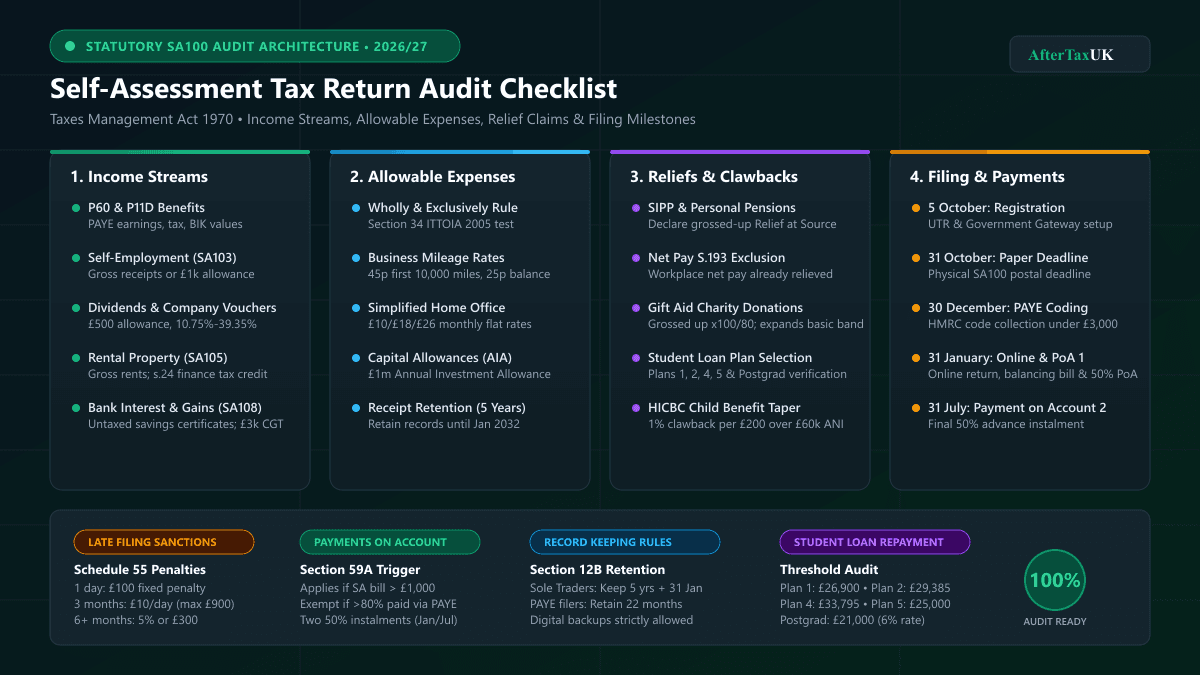
1. The Schedule 55 Penalty Framework: How Late Filing Penalties Escalate
Self-Assessment penalties for late submission of individual tax returns (Form SA100), partnership returns (Form SA104), and trust returns (Form SA107) are governed strictly by Schedule 55 of the Finance Act 2009. Unlike discretionary administrative fines, these penalties are triggered automatically by calendar milestones once the midnight statutory deadline on 31 January expires.
Crucially, the initial penalties do not depend on how much tax you owe. Even if your net taxable profits are £0, your business ran at a loss, or HMRC owes you a substantial tax repayment, late filing penalties will still be assessed automatically unless an appeal or statutory cancellation is granted.
| Delay Milestone | Statutory Authority | Penalty Calculation | Minimum Penalty (£0 Tax) |
|---|---|---|---|
| 1 Day Late (1 February) | FA 2009 Sch 55 Para 3 | Fixed penalty of £100 | £100 |
| 3 Months Late (1 May) | FA 2009 Sch 55 Para 4 | £10 per day for up to 90 days | Up to £900 |
| 6 Months Late (1 August) | FA 2009 Sch 55 Para 5 | Greater of 5% of tax liability or £300 | £300 |
| 12 Months Late (Following 31 Jan) | FA 2009 Sch 55 Para 6 | Greater of 5% of tax liability or £300* | £300 |
| Maximum Cumulative Late Filing Penalties (Zero Tax Due, 12 Months Late) | £1,600 | ||
Under Paragraph 6(3) and 6(4) of Schedule 55, if HMRC determines that a taxpayer deliberately withheld information to conceal their tax liability, the 12-month penalty escalates from 5% to 70% of the tax liability (for deliberate non-concealed withholding) or up to 100% (for deliberate and concealed withholding).
2. Late Filing vs Late Payment: Penalties and Statutory Interest Compared
Many taxpayers conflate late filing penalties with late payment penalties. Under UK legislation, these are two distinct legal regimes governed by separate schedules of the Finance Act 2009 and Section 59D of the Taxes Management Act 1970 (TMA 1970).
Late Filing Penalties (Schedule 55)
Punishes failure to lodge administrative information by 31 January. Applies even if your tax liability is £0.
- Day 1: £100 fixed fine
- 3 Months: £10/day (max £900)
- 6 Months: 5% of tax or £300
- 12 Months: 5% of tax or £300
- Defence: Reasonable excuse or withdrawal of notice to file under s.8B TMA 1970.
Late Payment Surcharges (Schedule 56)
Punishes failure to settle balancing payments due by 31 January under Section 59D TMA 1970.
- 30 Days Late (early March): 5% of unpaid tax
- 6 Months Late (August): Further 5% of balance
- 12 Months Late (February): Further 5% of balance
- Defence: Formal Time to Pay (TTP) agreement arranged before the 30-day deadline.
In addition to penalties, HMRC charges statutory interest on unpaid tax balances starting on 1 February under Section 87A of the Taxes Management Act 1970 and Sections 101–103 of the Finance Act 2009. The statutory interest rate is set at the Bank of England base rate plus 2.5%.
Crucial distinction:You cannot appeal late payment interest on the grounds of a “reasonable excuse”. In UK tax jurisprudence, interest is not considered a penalty; it is commercial restitution for the taxpayer holding Crown funds. HMRC can only waive statutory interest in rare circumstances where the delay was caused directly by an unreasonable administrative failure by HMRC staff.
3. What Constitutes a Statutory “Reasonable Excuse”?
Under Schedule 55 Paragraph 23 of the Finance Act 2009, liability to a penalty does not arise if the taxpayer satisfies HMRC (or, on appeal, the First-tier Tribunal) that there was a reasonable excuse for the failure, and that the failure was remedied without unreasonable delay after the excuse ceased.
The legislation does not exhaustively define what constitutes a reasonable excuse. Instead, the legal standard is governed by binding Upper Tribunal case law, most notably the leading decision in Perrin v The Commissioners for HM Revenue and Customs [2018] UKUT 156 (TCC).
The 4-Stage Perrin Test Applied by HMRC and Tax Tribunals
When evaluating an appeal, tax officers and tribunal judges must apply the four distinct stages established in Perrin:
Establish the Underlying Facts
Identify exactly what events or circumstances the taxpayer claims gave rise to the reasonable excuse (e.g. emergency hospital admission on 29 January, flood damage, digital portal outage).
Verify Evidence on the Balance of Probabilities
Determine whether the claimed facts are proven to have occurred based on contemporaneous supporting documents (hospital discharge letters, death certificates, IT error logs, police reports).
The Objective Prudence Test
Ask objectively: would a reasonable person, in the same position, experiencing those identical attributes, circumstances, and difficulties, have acted in the same way and defaulted?
Remedied Without Unreasonable Delay
Assess whether the taxpayer remedied the failure (i.e. submitted the return) promptly once the excuse ceased. If an illness ended in February but the return was not filed until October, the appeal fails stage 4.
Accepted vs Rejected Excuses: Statutory Grounds Comparison
The table below contrasts circumstances that routinely succeed before HMRC and the First-tier Tribunal against arguments that are explicitly barred by statute or dismissed as invalid:
| Valid Grounds (Generally Accepted) | Invalid Grounds (Rejected by Statute / Case Law) |
|---|---|
Severe or Sudden Illness: Emergency hospitalisation, serious life-threatening medical events, or acute mental health crisis occurring immediately prior to the deadline, supported by medical notes. | Lack of Funds / Cash Shortage: Barred by Schedule 55 Paragraph 23(2)(a). Inability to pay cannot justify failing to submit the administrative tax return paperwork on time. |
Bereavement: The death of a spouse, partner, child, parent, or close dependent in the weeks or months leading up to 31 January. | Reliance on an Accountant or Agent: Barred by Schedule 55 Paragraph 23(2)(b). The legal duty to file sits with the taxpayer. Blaming an accountant fails unless sudden incapacitation occurred. |
Catastrophic Unforeseen IT Outage: Severe software failure or HMRC online system outage immediately before the deadline, supported by error codes, timestamped screenshots, or incident references. | Finding the System Too Complex:“I found the tax return too difficult” or “I didn’t understand the questions” is rejected; taxpayers have a positive legal duty to seek professional or HMRC advice. |
Destruction of Records: Unavoidable loss of primary records due to fire, flood, criminal burglary, or natural disaster shortly before the deadline where reconstruction took time. | No Reminder from HMRC:“HMRC didn’t send me a letter or email reminder” is invalid. The obligation to file stems from primary statute (TMA 1970 s.8), not reminder notifications. |
Documented Postal Delays: For paper filers (31 October deadline), postal loss or industrial postal strikes documented under Section 7 of the Interpretation Act 1978 with proof of postage. | Forgetting the Deadline / Pressure of Work: Being busy with client work, travelling on holiday, or overlooking the 31 January date is universally dismissed by tribunals as lack of reasonable care. |
4. The Golden Escape Route: Section 8B TMA 1970 (Withdrawal of Notice to File)
Thousands of UK taxpayers receive penalty letters each year for tax returns they were never legally obligated to complete. For instance, you may have registered for Self-Assessment intending to start a freelance business that never launched, or you may be an employee taxed entirely under PAYE whose child benefit claim ceased.
If this applies to you, do not appeal claiming a “reasonable excuse”. Instead, invoke Section 8B of the Taxes Management Act 1970.
Under Section 8B(1) TMA 1970, HMRC has statutory authority to withdraw an issued notice to file an SA100 return if they agree the taxpayer does not meet any of the statutory filing triggers (e.g. trading profits, untaxed dividends above £500, or property income over allowable limits).
Section 8B(3) TMA 1970 states that when a notice is withdrawn:
“The notice is treated as if it had never been given, and no penalty under Schedule 55 to the Finance Act 2009 is payable in respect of any failure to comply with it.”
This means that if HMRC agrees to withdraw your notice to file, your £100 fine, any daily penalties, and 6-month surcharges are extinguished by law. You do not need to prove an illness, an IT crash, or any personal emergency.
How to Request a Section 8B Notice Withdrawal
Contact HMRC directly by telephone (0300 200 3310) or through the digital assistant on your Personal Tax Account. State clearly that you had no untaxed income for the tax year in question and request that the notice to file be withdrawn under Section 8B TMA 1970. Note that HMRC cannot withdraw a notice if you have already submitted the return for that year.
5. Step-by-Step Appeal Process: Online vs Paper Form SA370
If you were required to file an SA100 return and missed the deadline due to an unexpected event, you must formally appeal within the statutory time limit. Under Section 31A of the Taxes Management Act 1970, your notice of appeal must be submitted within 30 days of the date printed on the penalty assessment notice.
Never submit an appeal while your tax return remains unsubmitted. Both HMRC and the First-tier Tribunal will dismiss appeals if the taxpayer has not remedied the default. Filing your return proves that you have remedied the failure without unreasonable delay as required by Perrin v HMRC Stage 4.
Method A: Appealing Online (Personal Tax Account / Government Gateway)
The fastest way to appeal an initial £100 late filing penalty is via your HMRC online account. This route is recommended if your excuse is straightforward (e.g. short medical issue, digital service failure) and you are only appealing the initial fixed penalty:
- Log in to your Government Gateway account: Navigate to your Personal Tax Account or Self-Assessment dashboard.
- Locate the Penalty Notice:Select “More Self Assessment details” followed by “Penalties and appeals”.
- Select “Appeal a penalty”: Choose the relevant tax year and the specific penalty charge reference shown on your notice.
- Select your Reasonable Excuse category: Select from the pre-defined options (e.g. serious illness, bereavement, computer breakdown, other).
- Enter Chronological Dates: Specify the exact date the excuse began, the date it ceased, and the date the tax return was filed.
- Submit Supporting Text: Provide a concise, factual narrative explaining why you could not file and confirming the steps you took to submit as soon as possible.
Method B: Appealing by Post Using Paper Form SA370
If you are appealing escalated penalties (daily penalties, 6-month or 12-month charges under Schedule 55), late payment penalties under Schedule 56, or if you need to submit comprehensive documentary exhibits (medical reports, death certificates, insurance claims), you must use Form SA370(“Appeal against penalties for late filing and late payment”).
Key Sections of Form SA370:
- Box 1 to 4: Your full name, address, 10-digit Unique Taxpayer Reference (UTR), and National Insurance number.
- Box 5: Tax year the penalty relates to (e.g. 2026/27).
- Box 6: Type of penalty being appealed (tick Late Filing, Daily Penalties, 6-Month, 12-Month, or Late Payment).
- Box 7 & 8: The exact date the event occurred, the date you filed the return, and the full narrative of your reasonable excuse.
- Box 9:Enclosed documentary evidence (label your attachments clearly, e.g. “Exhibit A: Hospital Discharge Letter”).
HMRC Postal Address for Form SA370:
Self Assessment, HM Revenue and Customs, BX9 1AS, United Kingdom
Tip: Always send your appeal via Royal Mail Signed For or Special Delivery Guaranteed and retain your proof of posting receipt. Under Section 7 of the Interpretation Act 1978, this proves statutory service within the 30-day appeal window.
6. What Happens Next? Statutory Reviews and the First-tier Tribunal
Once HMRC receives your appeal, a caseworker will review your grounds and supporting evidence. Typically, HMRC issues a written response within 30 to 60 days:
If the Appeal is Upheld (Accepted)
HMRC cancels the penalty notice and updates your statement of account. If you already paid the penalty to prevent collection action, HMRC will credit your balance or issue a refund with statutory repayment interest.
If the Appeal is Rejected (Refused)
HMRC will issue a formal “Notice of Refusal” detailing why your excuse failed the statutory test. You have strictly 30 days from the date of this letter to escalate the dispute.
Escalation Option 1: Independent Statutory Review (Section 49B TMA 1970)
You can request an Internal Statutory Review under Section 49B of the Taxes Management Act 1970. This review is conducted by an independent HMRC review officer who had no involvement in the initial refusal. Statutorily, the review officer must provide a written decision within 45 days. This step is free, often results in overturned decisions when new evidence is supplied, and does not restrict your right to proceed to tribunal later.
Escalation Option 2: The First-tier Tribunal (Tax Chamber) (Section 49D TMA 1970)
If the review upholds the penalty (or if you choose to bypass internal review), you can appeal directly to the First-tier Tribunal (Tax Chamber) under Section 49D TMA 1970 within 30 days of the review decision.
- No Court Fees: There are no court application fees for filing a penalty appeal in the First-tier Tribunal (Tax Chamber).
- Paper Determinations:Late filing penalty cases are categorised as “Basic” or “Default Paper” proceedings. In most instances, an independent judge evaluates the documentary evidence submitted by both sides without requiring an in-person hearing.
- Judicial Independence: Tribunal judges are entirely independent of HMRC and strictly apply the four-stage Perrin test. If your evidence satisfies the objective test, the tribunal has full statutory power under Schedule 55 Paragraph 22 to discharge the penalties completely.
7. Paragraph 16 “Special Reduction”: Relief When Reasonable Excuse Fails
Even if your circumstances do not technically qualify as a statutory “reasonable excuse” under Paragraph 23, UK tax law provides a secondary statutory safety valve under Schedule 55 Paragraph 16 of the Finance Act 2009 known as Special Reduction.
Paragraph 16 grants HMRC statutory discretion to reduce, remit, or stay a penalty if they consider there to be “special circumstances”. While statute does not define special circumstances, judicial precedent establishes that they must be “exceptional, abnormal, or unusual” (HMRC v Advance Radiators Ltd [2015] UKUT 0241).
Under Paragraph 22(3) of Schedule 55, if an appeal reaches the First-tier Tribunal, the judge can review HMRC’s decision regarding Special Reduction. If HMRC failed to consider Special Reduction, or arrived at a decision that was legally flawed in an administrative sense (unreasonable in the Wednesbury sense), the tribunal has statutory power to substitute its own decision and reduce the penalty to nil.
Practical Tip: When drafting your appeal letter or Form SA370, always include a concluding paragraph: “In the alternative, if HMRC does not consider that the facts disclose a reasonable excuse within Paragraph 23, the taxpayer requests that HMRC exercise its discretion to reduce the penalty to nil under Paragraph 16 of Schedule 55 on the grounds of special circumstances.”
8. Summary Action Checklist: What to Do Right Now
No appeal will be granted while the return is outstanding. Submitting stops daily £10 penalties from accumulating and proves you remedied the default without delay.
If your untaxed income was under statutory thresholds, contact HMRC to request a Section 8B TMA 1970 notice withdrawal to cancel all penalties automatically.
Collate medical records, death certificates, IT portal error logs, or crime reference numbers dating to the period immediately surrounding the deadline.
Use the HMRC online portal for £100 fines, or post Form SA370 via Royal Mail Special Delivery to BX9 1AS for daily or multiple penalty notices.
If you cannot settle your tax bill, establish a Time to Pay arrangement before the 30-day payment deadline to prevent 5% Schedule 56 late payment surcharges.
Frequently Asked Questions
Clear answers based on official HMRC rules and statutory guidance.
Recommended Resources
Related Calculators, Salaries & Guides
Explore connected UK tax tools, popular salary benchmarks, and statutory HMRC guidance.
Related Calculators
All CalculatorsSelf-Employed Tax Calculator UK
Calculate your sole trader Income Tax, Class 4 National Insurance, and final take-home earnings.
HMRC Tax Refund Calculator
Estimate your tax rebate from emergency codes, CIS deductions, or overpaid PAYE.
Take-Home Pay Calculator
Calculate exact net salary with 2026/27 HMRC tax bands.
Hourly Wage Calculator
Convert hourly pay to weekly, monthly, and annual take-home.
Compare Common UK Salaries
All Salary BracketsStatutory Tax Guides & Blog
Visit Blog HubSelf-Assessment Tax Return Checklist
Complete SA100 audit guide covering trading income, allowable expenses, and filing deadlines.
Payments on Account Guide (2026/27)
Master the 31 January and 31 July advance tax instalments and learn how to claim an SA303 reduction.
How UK Income Tax Works
Personal allowances, tax bands, and HMRC PAYE rules.