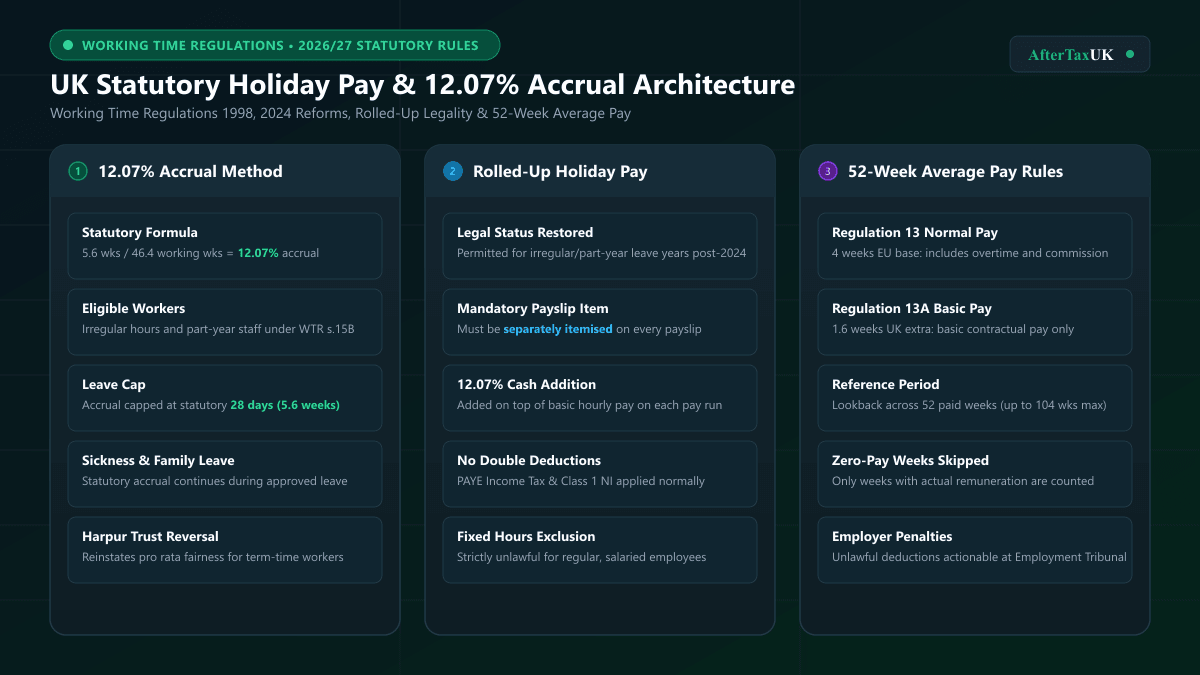
1. The Statutory Framework: WTR 1998 and the 2024 Reforms
Under the Working Time Regulations 1998 (SI 1998/1833), all UK workers—including zero-hours workers, agency staff, and casual contractors—are entitled to a minimum of 5.6 weeks (28 days) of paid annual statutory leave per leave year.
For decades, calculating holiday entitlement for staff working irregular patterns was fraught with legal dispute. In July 2022, the Supreme Court handed down its decision in Harpur Trust v Brazel [2022] UKSC 21. The court ruled that under the unamended regulations, part-year permanent staff (such as visiting music teachers working only during school terms) were entitled to a full 5.6 weeks of holiday pay based on their average weekly pay during working weeks, without any pro rata reduction for weeks when no work was performed. This produced anomalous outcomes where term-time staff received holiday pay representing a far higher percentage of their earnings than standard full-time workers.
To restore equity and commercial viability, the Government introduced the Employment Rights (Amendment, Revocation and Transitional Provision) Regulations 2023 (SI 2023/1426). For holiday leave years starting on or after 1 April 2024, two new statutory definitions were established:
- Irregular Hours Worker: Under Regulation 15F(1)(a), a worker whose paid hours of work in that leave year are wholly or mostly variable under the terms of their contract.
- Part-Year Worker: Under Regulation 15F(1)(b), a worker contractually required to work only part of the leave year, with periods within that year of at least one week where they are not required to work and receive no remuneration.
For these specific qualifying groups, Parliament introduced Regulation 15B, reinstating the statutory 12.07% accrual method, and Regulation 16A, which re-legalised rolled-up holiday pay.
2. The 12.07% Accrual Method: Mathematical & Statutory Logic
For irregular hours and part-year workers, holiday entitlement accrues at the end of each pay period at the exact statutory rate of 12.07% of the hours worked during that pay period.
The Statutory Accrual Formula
The statutory 12.07% accrual rate is calculated directly from the standard statutory entitlement:
Accrual Rate = 5.6 ÷ (52 − 5.6) = 5.6 ÷ 46.4 = 0.120689... ≈ 12.07%
Because 5.6 weeks are spent on paid statutory leave, an employee only works 46.4 weeks in a full calendar year. Holiday therefore accrues at 12.07% of hours worked, up to a statutory ceiling of 28 days (5.6 weeks) in any single leave year.
Suppose a worker on a zero-hours contract works 120 hours during a monthly pay period. Their statutory holiday entitlement accrued during that month is:
120 hours × 12.07% = 14.484 hours of accrued paid holiday.
Under Regulation 15B(3), if a worker takes statutory maternity leave, paternity leave, adoption leave, or sick leave, they continue to accrue holiday based on an average taken over the 52-week lookback period to ensure statutory leave protections are preserved.
3. Rolled-Up Holiday Pay: Rules, Legality & Payslip Requirements
Prior to 1 April 2024, the European Court of Justice (ECJ) ruling in Robinson-Steele v R D Retail Services Ltd (C-131/04) rendered rolled-up holiday pay unlawful because it was deemed to disincentivise workers from taking physical time off.
Under Regulation 16A of the amended Working Time Regulations, rolled-up holiday pay is now fully lawful for employers across Great Britain, provided strict statutory requirements are met:
- Qualifying Worker Status: The worker must satisfy the statutory definition of an irregular hours worker or a part-year worker under Regulation 15F. It cannot be applied to salaried or regular-hours workers.
- The 12.07% Uplift Calculation: The employer must calculate holiday pay as an additional 12.07% of the worker's total earnings for the pay period.
- Mandatory Payslip Itemisation: The holiday pay addition must be itemised as a distinct, separate line item on the worker's payslip. It is an unlawful deduction of wages under Section 13 of the Employment Rights Act 1996 to combine basic pay and holiday pay into a single composite rate without transparent itemisation.
- Payment Timing: Rolled-up holiday pay must be paid in the same pay period in which the hours were worked.
If an employer uses rolled-up holiday pay, the worker is still legally entitled to take physical annual leave, but their time off is unpaid because their statutory holiday remuneration has already been disbursed in real time.
4. Calculating Holiday Pay: Regulation 13 vs Regulation 13A
Where an employer does not use rolled-up holiday pay and instead pays holiday pay when leave is taken, the rate of pay depends on which tranche of annual leave is being accessed:
| Leave Tranche | Statutory Amount | Remuneration Rule | Included Pay Elements |
|---|---|---|---|
| Regulation 13 (EU Retained) | 4.0 weeks (20 days for 5-day worker) | Normal Remuneration | Basic pay, guaranteed & regular non-guaranteed overtime, commission, shift premiums. |
| Regulation 13A (UK Additional) | 1.6 weeks (8 days for bank holidays) | Basic Pay | Contractual basic salary only. Discretionary bonuses and variable overtime excluded. |
Under established case law including Williams v British Airways plc [2011] and Bear Scotland Ltd v Fulton [2015], "normal remuneration" under Regulation 13 encompasses all payments intrinsically linked to the performance of contractual duties. If an employee regularly works overtime or earns sales commissions, excluding these from the 4.0-week Regulation 13 tranche violates statutory employment rights.
5. The 52-Week Reference Period Mechanics
Under Sections 221–224 of the Employment Rights Act 1996, when calculating a week's pay for an employee with irregular hours or variable pay who takes leave, employers must apply a 52-week reference period:
- Count Only Paid Weeks: Any week in which no work was performed and no remuneration was paid must be excluded from the calculation.
- Statutory 104-Week Maximum Lookback: Employers must look back past unpaid weeks to find earlier weeks with remuneration, up to a maximum statutory cap of 104 weeks prior to the leave date.
- Calculating the Weekly Average: The total gross taxable pay received across those 52 paid weeks is divided by 52 to establish one statutory week's holiday pay.
If a worker has only been employed for 24 weeks, the average is calculated by dividing total remuneration by 24 weeks.
6. Payroll Processing: PAYE & National Insurance Deductions
Holiday pay is classified as general employment earnings under Section 62 of the Income Tax (Earnings and Pensions) Act 2003 (ITEPA 2003). It is treated identically to basic wages for UK statutory payroll purposes:
- PAYE Income Tax: Deducted at the employee's marginal rate (20% Basic, 40% Higher, 45% Additional in England, Wales, and Northern Ireland; or Scottish graduated bands).
- Class 1 National Insurance: Employee contributions are deducted at 8% between £12,570 and £50,270, and 2% thereafter. Employer Secondary Class 1 NICs apply at the statutory rate.
- Workplace Pension Auto-Enrolment: Qualifying earnings calculations under the Pensions Act 2008 include statutory holiday pay and rolled-up additions.
- Student Loan Repayments: Processed automatically whenever pay period gross earnings exceed the weekly or monthly repayment threshold (Plan 1, Plan 2, Plan 4, Plan 5, or Postgraduate).
Failure to pay statutory holiday pay constitutes an unlawful deduction from wages under Section 13 of the Employment Rights Act 1996. Workers can bring claims before an Employment Tribunal within three months less one day from the date of the deduction.
Calculate Take-Home Pay & Hourly Rates
Model your gross hourly wages, rolled-up holiday uplifts, and exact net take-home pay after statutory PAYE and National Insurance deductions.
Open the Hourly Wage & Take-Home Pay CalculatorFrequently Asked Questions
Frequently Asked Questions
Clear answers based on official HMRC rules and statutory guidance.
Statutory Sources & Primary Legislation
Statutory holiday pay rules are grounded in UK primary legislation and official employment guidance: