1. Statutory Foundations: The PAYE System & RTI
The UK Pay As You Earn system is governed by the Income Tax (Pay As You Earn) Regulations 2003 (SI 2003/2682). Under PAYE, employers act as unpaid tax collectors for HM Revenue & Customs (HMRC), deducting Income Tax and employee Class 1 National Insurance contributions directly from employee wages before paying net take-home pay.
Under Real Time Information (RTI), employers must transmit payroll data digitally to HMRC on or before each payment date:
- Full Payment Submission (FPS): Dispatched every pay run detailing gross pay, tax code applied, Income Tax deducted, employee and employer National Insurance, student loan repayments, and pension contributions for every worker paid.
- Employer Payment Summary (EPS):Submitted by the 19th of each month to claim statutory parental pay recoveries, report Construction Industry Scheme (CIS) deductions suffered, or notify HMRC of a "nil payment" month where no workers received pay.
2. Operating PAYE for Single-Director Companies
For owner-directors running a single-person limited company, payroll serves a strategic dual purpose: generating Corporation Tax deductions while maintaining State Pension qualifying years.
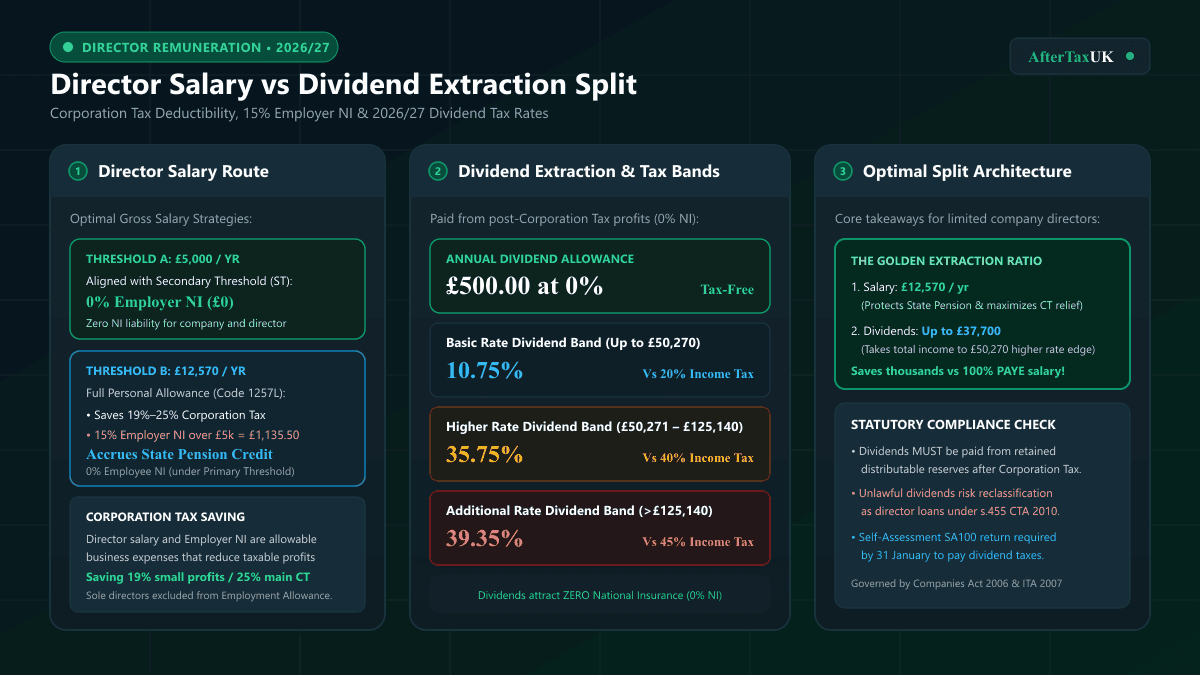
The 2026/27 Director Thresholds:
- Lower Earnings Limit (LEL): £6,500/yr (£125/wk): Earning at or above this level earns a qualifying NI credit towards the UK State Pension at 0% employee NI cost.
- Class 1 Secondary Threshold: £5,000/yr (£96.15/wk): Employers pay 15.0% Secondary Class 1 NI on earnings exceeding £5,000 per year under the National Insurance Contributions (Secondary Class 1 Contributions) Act 2025.
- Primary Threshold: £12,570/yr (£241.73/wk): Employees pay 0% Class 1 NI up to £12,570.
Under SI 2016/344, single-director companies cannot claim the Employment Allowance. Therefore, if a director pays themselves the full £12,570 salary, the company incurs an employer NI liability of 15.0% on the £7,570 excess above £5,000 (£1,135.50/yr). However, this salary and employer NI are 100% deductible against Corporation Tax, providing significant corporate tax savings.
3. Directors' Cumulative NI Rules (Regulation 8 SI 2001/1004)
Unlike standard employees whose National Insurance is calculated per discrete pay period (weekly or monthly), company directors are legally subject to an Annual Cumulative Earnings Period under Regulation 8 of the Social Security (Contributions) Regulations 2001.
| Method | How It Works | Best Suited For |
|---|---|---|
| Standard Annual Method | NI thresholds apply cumulatively across the full tax year. No NI is paid until total annual earnings pass annual thresholds. | Directors receiving irregular bonuses or annual lump sums |
| Alternative (Pro-Rata) Method | NI is deducted each month using standard employee monthly thresholds, with an annual statutory reconciliation in Month 12 (March). | Directors taking regular, identical monthly salary draws |
4. Onboarding Employees: Starter Checklists & Tax Codes
When hiring employees, employers must gather accurate payroll details:
- Form P45: If a new starter provides a P45 from their previous employer, input their leaving date, total pay to date, total tax to date, and tax code into your payroll software.
- HMRC Starter Checklist: If the employee has no P45, they must complete a Starter Checklist selecting Statement A (first job since 6 April), Statement B (only job now), or Statement C (have another job or receive state/occupational pension). Statement C triggers code
BR(Basic Rate 20% on all earnings). - Emergency Tax Codes: Assigned when HMRC cannot determine an employee's personal circumstances. Denoted by suffix
W1(Week 1) orM1(Month 1), calculating tax solely on pay in that single period without cumulative previous pay adjustments.
5. Statutory Deadlines & HMRC Payment Calendar
Failing to adhere to statutory PAYE deadlines results in automatic late filing penalties under Schedule 55 Finance Act 2009 and daily interest charges:
| Statutory Event | Filing / Payment Deadline | Statutory Reference |
|---|---|---|
| Full Payment Submission (FPS) | On or before the pay date | Reg 67B SI 2003/2682 |
| Monthly PAYE / NI Electronic Payment | 22nd of the following tax month | Reg 69 SI 2003/2682 |
| Employer Payment Summary (EPS) | 19th of the following tax month | Reg 70 SI 2003/2682 |
| Issue Form P60 to Employees | 31 May following tax year end | Reg 61 SI 2003/2682 |
| Submit Form P11D and P11D(b) | 6 July following tax year end | Reg 85 SI 2003/2682 |
| Pay Class 1A Employer NI (15.0%) | 22 July (electronic payment) | Reg 80 SI 2001/1004 |
6. Workplace Pension Auto-Enrolment Duties
Under the Pensions Act 2008, every UK employer with at least one eligible employee must set up and maintain a qualifying workplace pension scheme (such as NEST, Smart Pension, or The People's Pension):
- Eligibility: Employees aged between 22 and State Pension age earning over £10,000/yr (£833/mo or £192/wk) must be automatically enrolled.
- Statutory Minimum Contributions: A total minimum contribution of 8% on qualifying earnings (£6,240 to £50,270), with the employer legally obligated to contribute at least 3%.
- Declaration of Compliance: Employers must complete a formal Declaration of Compliance with The Pensions Regulator (TPR) within 5 months of their duties start date, re-enrolling eligible opt-outs every 3 years.
Calculate Exact PAYE Deductions
Model employee net pay, employer Class 1 National Insurance, and statutory pension contributions with our PAYE calculator.
Launch the PAYE CalculatorFrequently Asked Questions
Frequently Asked Questions
Clear answers based on official HMRC rules and statutory guidance.
Statutory Sources & Primary Legislation
- legislation.gov.uk: The Income Tax (Pay As You Earn) Regulations 2003 (SI 2003/2682)
- legislation.gov.uk: The Social Security (Contributions) Regulations 2001 (SI 2001/1004)
- legislation.gov.uk: Pensions Act 2008 (Workplace Pension Auto-Enrolment)
- GOV.UK: Running Payroll — Employing People & Operating PAYE