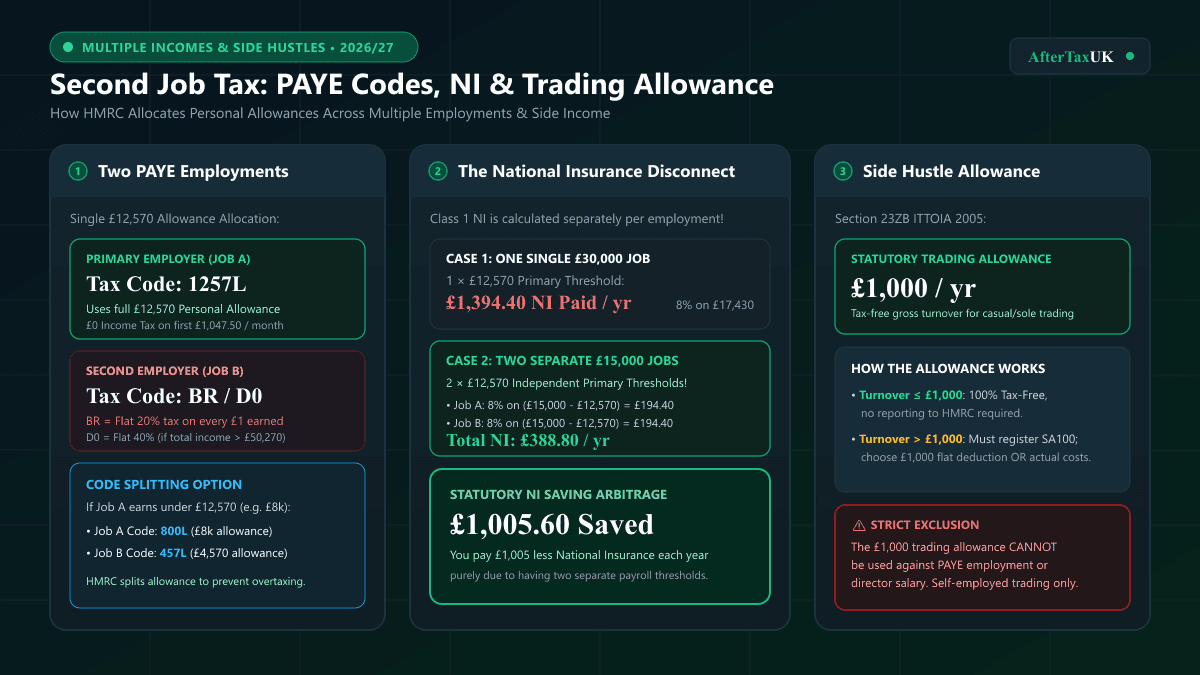
Executive Summary: Key Side Hustle Rules for 2026/27
£1,000 / year
Gross trading income up to £1,000 in a tax year is 100% tax-free under Section 23ZB ITTOIA 2005. No registration or reporting required if total turnover is £1,000 or below.
30 sales / €2,000
Platforms (Vinted, eBay, Etsy, Depop) must report seller records to HMRC once a user completes 30+ transactions or exceeds €2,000 (approx. £1,700) in calendar proceeds.
💡 The Golden Rule: Decluttering vs Commercial Trading
Selling personal, secondhand possessions from your home at a loss (such as outgrown children's clothing or pre-owned furniture) is NOT trading. Even if your platform sales trigger an automated report to HMRC, you do not owe Income Tax on non-trading personal disposals. Income Tax applies only when you buy or produce items with an intention to realise a commercial profit.
The Statutory £1,000 Trading Allowance (Section 23ZB ITTOIA 2005)
Introduced under Schedule 3 of the Finance (No. 2) Act 2017 and codified into Chapter 33B of the Income Tax (Trading and Other Income) Act 2005, the statutory trading allowance provides tax relief for individuals earning small amounts from casual trades, side hustles, and micro-commercial activities.
The allowance operates on two statutory tiers based on your gross trading income (total sales revenue before any deductions for postage, materials, platform fees, or operating expenses):
Tier 1: Full Relief (Gross Trading Income ≤ £1,000)
If your total gross receipts from all self-employed activities, side hustles, and casual services combined are £1,000 or less during the tax year (6 April 2026 to 5 April 2027):
- Your trading income is 100% exempt from Income Tax.
- You do not need to register as a sole trader with HMRC.
- You do not need to complete or submit an SA100 Self-Assessment tax return (unless you must file for other reasons, such as high PAYE earnings over £150k or untaxed dividend income).
Tier 2: Partial Relief (Gross Trading Income > £1,000)
If your total gross trading receipts exceed £1,000 in the tax year, you have a statutory obligation under Section 7 TMA 1970 to register for Self-Assessment. However, you are entitled to choose the most tax-efficient method to calculate your taxable profit on your tax return:
- Method A (Actual Allowable Expenses): Deduct your genuine, wholly and exclusively incurred business expenses (e.g. stock purchases, platform commission, postage, packaging) from your gross turnover. This is optimal when your business expenses exceed £1,000.
- Method B (Statutory £1,000 Deduction): Deduct the fixed £1,000 trading allowance from your gross turnover instead of claiming actual expenses. This is optimal when your genuine expenses are lower than £1,000.
Method Comparison: Actual Expenses vs £1,000 Trading Allowance
| Scenario Metric | Method A: Actual Expenses | Method B: £1,000 Allowance | Statutory Advantage |
|---|---|---|---|
| Gross Turnover | £3,000 | £3,000 | Identical revenue |
| Business Costs | £400 (Low expenses) | £400 (Ignored) | Allowance ignores actual bills |
| Allowable Deduction | -£400 | -£1,000 | Method B saves £600 more |
| Taxable Profit | £2,600 | £2,000 | £120 lower tax (at 20% basic rate) |
| Alternative Scenario | £3,000 gross, £1,600 costs | £3,000 gross, £1,600 costs | High-expense craft or resale |
| Allowable Deduction | -£1,600 | -£1,000 | Method A saves £600 more |
| Taxable Profit | £1,400 | £2,000 | Method A wins when expenses > £1,000 |
Online Platform Reporting Rules: The Truth About the 'Side Hustle Tax'
In early 2024, widespread media headlines claimed that HMRC had introduced a “new side hustle tax” targeting sellers on Vinted, eBay, Etsy, and Depop. In statutory terms, no new tax was created. The underlying tax rules governing trading income and capital gains remained unchanged.
What did change was statutory reporting obligations for digital platform operators. Under The Platform Operators (Due Diligence and Reporting Requirements) Regulations 2023 (SI 2023/1260), which enacted the OECD Model Rules for Digital Platforms (the UK equivalent to EU Directive DAC7), UK-connected digital platforms must automatically collect and share seller transaction data with HMRC.
Statutory Platform Reporting Triggers (SI 2023/1260)
Platforms are legally mandated to report seller accounts to HMRC if, within a single calendar year (1 January to 31 December), the user meets either of the following criteria:
Trigger 1
30 or more completed sales
Regardless of total monetary value.
Trigger 2
Gross sales > €2,000
Approximately £1,700 in total proceeds.
What Information Do Platforms Share with HMRC?
If your account reaches either reporting threshold, the platform operator (including Vinted, eBay, Etsy, Depop, Amazon Marketplace, Airbnb, and Deliveroo) reports the following details to HMRC by 31 January following the calendar reporting year:
- Seller Identification: Full legal name, residential address, date of birth, and primary email address.
- Tax Identification: National Insurance Number (NINO) or Unique Taxpayer Reference (UTR).
- Financial Details: Bank account numbers and sort codes used to receive platform payouts.
- Transaction Aggregates: Total gross consideration paid to the seller and the exact number of transactions completed per calendar quarter.
- Platform Fees: Any commissions, service charges, or advertising fees withheld by the platform.
HMRC cross-matches these reports against personal Self-Assessment tax returns using its high-capacity Connect data-matching engine.
Decluttering vs Commercial Trading: The 9 Badges of Trade
The critical legal distinction that determines your tax liability is whether your activities constitute trading under UK tax law or the private disposal of personal chattel possessions.
To resolve whether an activity amounts to a trade, HMRC inspectors, First-tier Tax Tribunals, and courts apply the established 9 Badges of Trade (derived from the 1955 Royal Commission on the Taxation of Profits and Income):
| Badge of Trade | Decluttering (Non-Taxable) | Commercial Trading (Taxable) |
|---|---|---|
| 1. Profit-Seeking Motive | Selling items to recover space or partial initial cost. | Acquiring or creating stock specifically to sell at a profit. |
| 2. Frequency of Transactions | Occasional clear-outs or irregular wardrobe updates. | Systematic, continuous, and repeated transactions weekly. |
| 3. Nature of the Asset | Everyday personal goods, clothing, toys, books, furniture. | Wholesale quantities, identical inventory, or bulk stock. |
| 4. Existence of Similar Trade | Unrelated to your daytime profession. | Closely related to your primary trade (e.g. fashion buyer reselling clothes). |
| 5. Modification to Enhance Value | Sold in original condition as used personal property. | Repaired, modified, restored, or repackaged to increase market price. |
| 6. Manner of Sale | Standard personal listings on secondhand apps. | Branded packaging, promotional discounts, marketing spend. |
| 7. Source of Finance | Items originally purchased with personal savings for use. | Short-term borrowings or revolving trade credit to fund stock. |
| 8. Interval of Time | Held for months or years and used before being sold. | Flipped quickly within days or weeks of purchase. |
| 9. Method of Acquisition | Inherited, received as gifts, or purchased for domestic use. | Purchased at liquidation auctions, thrift stores, or wholesalers. |
Practical Scenarios: Who Needs to File an SA100?
Emma – Selling Wardrobe on Vinted
Emma sold 45 items of clothing and shoes on Vinted during 2026/27, generating £2,400 in gross sales. Because she exceeded 30 transactions and €2,000, Vinted reported her data to HMRC under SI 2023/1260. However, all clothes were her own pre-owned garments purchased over several years for an original cost of over £5,000.
HMRC Tax Status: Zero Tax Due. No Registration Required. Emma was disposing of personal chattels at a capital loss, not trading. Even if HMRC issues an automated compliance check letter, she can easily confirm these were pre-owned personal belongings.
Liam – Thrifting & Flipping Vintage Jackets on eBay
Liam spends weekends scouring charity shops and car boot sales for vintage leather jackets, which he cleans, photographs, and flips on eBay and Depop. Over the tax year, he generated £3,800 in revenue from 50 sales, spending £1,600 on stock and £300 on postage and fees.
HMRC Tax Status: Commercial Trading. Self-Assessment Mandatory. Liam acquired items with an explicit profit motive. His gross revenue (£3,800) exceeds the £1,000 trading allowance. Under Method A, his actual expenses are £1,900, leaving a taxable net profit of £1,900 to declare on Form SA100.
Sarah – Handmade Ceramics on Etsy
Sarah creates ceramic mugs in her spare time and sells them on Etsy. In the 2026/27 tax year, she completed 22 sales and earned £850 in total gross revenue, spending £250 on clay and glaze.
HMRC Tax Status: Trading, but 100% Tax-Exempt. Although Sarah is engaged in commercial trade, her total gross turnover (£850) is below the statutory £1,000 trading allowance. She qualifies for Tier 1 Full Relief under Section 23ZB ITTOIA 2005. She owes £0 in tax and does not need to register with HMRC.
Self-Assessment Deadlines and Failure-to-Notify Penalties
If your gross trading revenue exceeds £1,000 in a tax year, you are legally required under Section 7 of the Taxes Management Act 1970 to notify HMRC that you have untaxed trading income.
You must register for Self-Assessment as a sole trader with HMRC by 5 October following the end of the 2026/27 tax year. HMRC will issue your 10-digit Unique Taxpayer Reference (UTR).
If you submit your Self-Assessment return via physical paper forms, it must reach HMRC by midnight on 31 October 2027.
If you owe less than £3,000 in tax and want HMRC to collect it automatically through your employer PAYE payroll tax code across 12 monthly instalments, you must submit your online tax return by 30 December 2027.
The statutory deadline to file your online SA100 return and pay any balancing Income Tax and National Insurance is midnight on 31 January 2028.
⚠️ HMRC Penalties for Non-Compliance
Failing to register on time triggers a statutory “Failure to Notify” penalty under Schedule 41 Finance Act 2008, calculated as a percentage of potential lost revenue (ranging from 0% to 100% depending on whether the error was non-deliberate or deliberate). Missing the 31 January filing deadline incurs an immediate automatic £100 fixed penalty under Schedule 55 Finance Act 2009, even if no tax is owed.
How Side Hustle Income is Taxed Alongside a PAYE Job
A widespread misconception is that side hustle income is taxed at a special flat rate or enjoys a separate £12,570 Personal Allowance. In reality, you receive one Personal Allowance (£12,570 for 2026/27) across all your earnings.
If your full-time employed job already uses your £12,570 Personal Allowance via your `1257L` tax code, every single pound of taxable side hustle profit sits directly on top of your employment salary and is taxed at your highest marginal Income Tax band:
20% Tax
On side hustle profits when combined income is between £12,571 and £50,270.
40% Tax
On side hustle profits when combined income is between £50,271 and £125,140.
60% Marginal Tax
If salary is £100k+, side hustle profits trigger a £1 allowance loss per £2 earned, creating an effective 60% rate.
Class 4 National Insurance & Student Loans on Side Hustle Profits
In addition to Income Tax, side hustle profits may attract statutory deductions:
- Class 4 National Insurance: Charged at 6% on self-employed net profits between £12,570 and £50,270, and 2% on profits above £50,270. If your net side hustle profits are under £12,570, zero Class 4 NI is due.
- Student Loan Repayments: If your total combined income (PAYE salary + side hustle profits) exceeds your plan threshold (e.g. £29,385 for Plan 2 or £25,000 for Plan 5), you repay an additional 9% (or 6% for Postgraduate loans) on your side hustle profits via your SA100 return.
Allowable Expenses: What Can You Deduct?
If you elect Method A (claiming actual expenses instead of the flat £1,000 trading allowance), your deductions must satisfy Section 34 of ITTOIA 2005: expenses must be incurred “wholly and exclusively” for the purposes of the trade.
✅ Allowable Business Deductions
- Cost of stock or raw materials purchased for resale or manufacturing.
- Online platform seller fees, payment processing charges, and listing fees.
- Packaging materials, cardboard boxes, bubble wrap, and label printing.
- Royal Mail, courier, and postage delivery costs.
- Dedicated advertising, promoted listings, and social media ads.
- Business mileage for stock collection (55p/mile up to 10,000 miles).
- Reasonable apportionment of home office heating, lighting, and broadband.
❌ Disallowable Personal Costs
- Purchases of clothes or personal items originally bought for your own use.
- Ordinary commuting between your home and primary full-time workplace.
- Personal mobile phone contracts without itemised business usage logs.
- General wardrobe clothing suitable for everyday wear.
- Meals, drinks, or standard domestic subsistence while working from home.
- Parking fines, driving penalties, or late delivery fees.
- Capital expenditures without correct capital allowances claims.
Record-Keeping Best Practices (Section 12B TMA 1970)
Under Section 12B of the Taxes Management Act 1970, self-employed individuals and sole traders are legally required to retain all business and financial records for at least 5 years after the 31 January submission deadline of the relevant tax year. For the 2026/27 tax year, records must be preserved until at least 31 January 2033.
Recommended Record-Keeping Workflow:
- Download Annual Platform CSVs: At the end of every calendar and tax year, export full transaction summaries from Vinted, eBay, Etsy, Depop, and PayPal.
- Open a Dedicated Bank Account: Keep side hustle revenues and expenses segregated from your personal domestic spending to create a clean, indisputable audit trail.
- Store Digital Expense Receipts: Retain electronic receipts or photos of physical receipts for all postage, packaging, and inventory purchases.
- Maintain a Mileage Log: If travelling to thrift stores, auctions, or suppliers, record the date, destination, purpose, and exact mileage.
Estimate Your Side Hustle Take-Home Pay
Use our interactive tools to calculate your exact Income Tax, Class 4 National Insurance, and Student Loan deductions across dual PAYE and self-employed earnings.
Frequently Asked Questions
Clear answers based on official HMRC rules and statutory guidance.
Statutory Authorities & Official References
This guide is compiled in accordance with primary UK legislation and HMRC technical manuals:
- Income Tax (Trading and Other Income) Act 2005 (ITTOIA 2005) – Chapter 33B, Section 23ZB (Statutory Trading Allowance)
- The Platform Operators (Due Diligence and Reporting Requirements) Regulations 2023 (SI 2023/1260) (OECD Digital Platform Rules / DAC7 equivalent)
- Taxes Management Act 1970 (TMA 1970) – Section 7 & Section 12B (Notice of Liability to Income Tax & Duty to Keep Records)
- HMRC Business Income Manual: BIM20050 (Meaning of Trade & Badges of Trade)
- HMRC Official Guidance: Tax-Free Allowances on Property and Trading Income