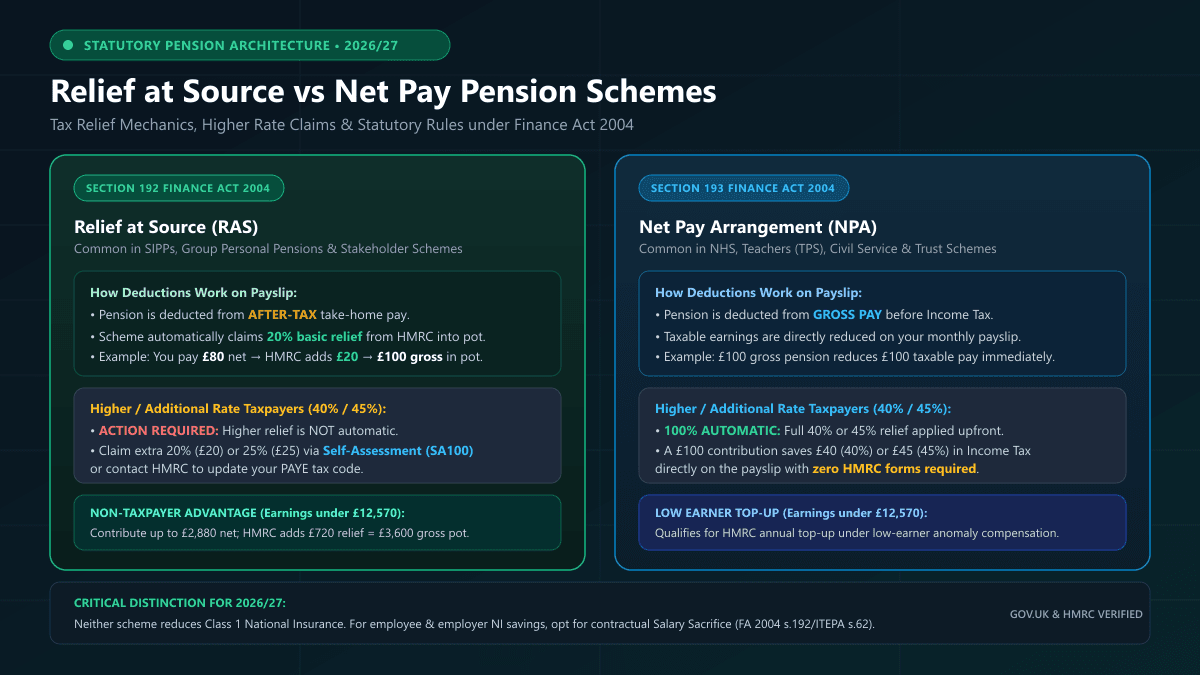
1. Statutory Foundations: How UK Pension Tax Relief Operates
In the United Kingdom, retirement savings are governed by Part 4 of the Finance Act 2004. To incentivise citizens to build independent retirement funds, the government provides Income Tax relief on qualifying contributions up to the Annual Allowance (standard £60,000 or 100% of relevant UK earnings, whichever is lower).
However, Parliament enacted two completely different administrative channels through which this tax relief is delivered to individual savers:
Relief at Source (RAS)
- Deduction: Deducted from post-tax pay (net take-home).
- Basic Relief: Scheme provider claims 20% basic rate relief from HMRC into the pot.
- Higher Relief: Taxpayer must manually claim the extra 20% to 25% from HMRC.
- Low Earners: Non-taxpayers still receive a 20% government boost on up to £2,880.
Net Pay Arrangement (NPA)
- Deduction: Deducted from gross pay before Income Tax is computed.
- Basic Relief: Instant relief at 20% directly on your payslip.
- Higher Relief: 100% automatic upfront relief at 40% or 45% with zero HMRC claims.
- Low Earners: Non-taxpayers qualify for HMRC annual top-up payments.
2. Relief at Source (Section 192 Finance Act 2004)
Relief at Source is the statutory standard for all Self-Invested Personal Pensions (SIPPs), personal stakeholder pensions, and many modern workplace defined contribution plans (such as Group Personal Pensions administered by Aviva, Standard Life, Scottish Widows, Royal London, and Fidelity).
The Mechanics: The 80/100 Basic Rate Claim
Under Section 192, your employer or pension provider deducts your contribution from your salary after PAYE Income Tax and National Insurance have already been deducted. You physically pay 80% of the target investment.
Example: Building a £100 Gross Pension Pot
- You contribute £80 from your net take-home salary into your pension.
- Your pension administrator submits an electronic claim to HMRC under the Relief at Source regulations.
- HMRC pays £20 (representing 20% basic rate tax relief) directly into your pension scheme, bringing the total pot to £100.
This process takes between 6 and 11 weeks depending on your provider’s claiming schedule with HMRC.
The Statutory Bonus for Non-Taxpayers (Section 190 FA 2004)
The standout statutory benefit of Relief at Source is its application to low earners and non-taxpayers. Under Section 190 of the Finance Act 2004, anyone who is a UK resident under age 75 can contribute up to £2,880 net per tax year into a registered pension scheme, regardless of whether they have any earnings.
HMRC adds £720 in basic rate tax relief, boosting the pot to £3,600 gross. This provides a guaranteed 25% immediate return on cash invested, making it an invaluable statutory planning mechanism for non-working spouses, children, or part-time workers earning beneath the £12,570 Personal Allowance.
3. The Higher Rate Relief Black Hole: Reclaiming Your Extra 20% to 25%
Under Relief at Source, HMRC does not automatically grant Higher Rate (40%) or Additional Rate (45%) tax relief. If you earn over £50,270 in England, Wales, or Northern Ireland (or over £43,662 in Scotland) and contribute to a personal SIPP or a Relief at Source workplace scheme, you must actively claim your extra tax relief. Failure to claim means you are subsidising HMRC with your own hard-earned money.
The Exact Mathematics of Higher Rate Relief
Consider a Higher Rate taxpayer (earning £75,000 per year) who wishes to invest £10,000 gross into a SIPP:
| Stage | Amount | Mechanism |
|---|---|---|
| Net Out-of-Pocket Payment | £8,000 | Paid from post-tax bank account to SIPP |
| Basic Rate Relief (20%) | +£2,000 | Claimed by provider, credited to pension pot (£10k total) |
| Extra Higher Rate Relief (20%) | -£2,000 | Reclaimed from HMRC via tax return or PAYE tax code |
| True Net Out-of-Pocket Cost | £6,000 | You secure a £10,000 pension asset for just £6,000 net! |
For Additional Rate (45%) taxpayers on earnings over £125,140, the extra claim is 25% (£2,500), bringing the net out-of-pocket cost down to £5,500 for a £10,000 pot.
How to Claim Your Extra Relief from HMRC
You have two approved statutory methods to reclaim this money:
Method 1: Self-Assessment Tax Return (SA100)
If you already file a tax return, navigate to page TR4 of the main SA100 return, under “Tax reliefs > Paying into registered pension schemes and overseas pension schemes”.
In Box 1, enter the gross value of your contributions (i.e. your net payment divided by 0.80). If you paid £8,000 net, enter £10,000. HMRC expands your basic rate band (£50,270) by £10,000 up to £60,270, reducing your tax bill or issuing a direct cash repayment into your bank account.
Method 2: Contact HMRC Directly (No Tax Return Needed)
If you are an employed PAYE worker and do not complete Self-Assessment, you do not need to register for a tax return simply to claim pension relief. Instead:
- Log into your official HMRC Personal Tax Account or the HMRC mobile app and submit your pension contribution certificates.
- Alternatively, call HMRC Taxes Helpline on 0300 200 3300 with your National Insurance number and annual pension statement.
- HMRC will either issue an immediate P800 tax calculation repayment check or adjust your PAYE Tax Code (e.g. increasing 1257L to a higher number), giving you higher take-home pay each month through your payroll.
Backdating Unclaimed Relief: The 4-Year Statutory Rule
Under Section 34 of the Taxes Management Act 1970 (TMA 1970), UK taxpayers have statutory authority to reclaim overpaid Income Tax for up to four preceding tax years.
In the current 2026/27 tax year, you can backdate claims for:
- 2022/23: Deadline to claim is 5 April 2027.
- 2023/24: Deadline to claim is 5 April 2028.
- 2024/25: Deadline to claim is 5 April 2029.
- 2025/26: Deadline to claim is 5 April 2030.
If you have paid into a workplace SIPP or GPP while earning over £50,270 over the last four years without claiming, you can contact HMRC now to reclaim several thousand pounds in lump-sum refunds.
4. Net Pay Arrangement (Section 193 Finance Act 2004)
The Net Pay Arrangement is the traditional framework for occupational and trust-based employer pensions. It is the mandatory scheme architecture across the UK public sector, including:
- NHS Pension Scheme (England, Wales, and Scotland)
- Teachers' Pension Scheme (TPS)
- Civil Service Pension (Alpha)
- Universities Superannuation Scheme (USS)
- Police, Firefighters & Armed Forces Schemes
The Mechanics: Gross Pay Reduction
Despite the confusing statutory name “Net Pay”, contributions are actually deducted from your gross salary before PAYE Income Tax is assessed.
Because your taxable pay is reduced at source, you immediately receive full tax relief at your marginal rate right on your monthly payslip:
- Basic Rate (20%): A £100 pension deduction reduces taxable earnings by £100, saving £20 in Income Tax. Net take-home drops by only £80.
- Higher Rate (40%): A £100 pension deduction reduces taxable earnings by £100, saving £40 in Income Tax. Net take-home drops by only £60.
- Additional Rate (45%): A £100 pension deduction saves £45 in Income Tax. Net take-home drops by only £55.
Under Net Pay, Higher Rate and Additional Rate taxpayers do not need to contact HMRC, file Self-Assessment returns, or adjust tax codes. The relief is 100% automatic and instantaneous.
The Historic Low-Earner Anomaly & HMRC Top-Up Scheme
Historically, the Net Pay Arrangement suffered from an unfair legislative flaw known as the “Net Pay Anomaly”. Employees earning under the £12,570 Personal Allowance paid zero Income Tax, meaning a gross pension deduction yielded £0 in tax relief. Meanwhile, an identical worker in a Relief at Source scheme received an extra 20% top-up from the government.
Under Section 28 of the Finance Act 2023 and secondary regulations, the UK Government resolved this disparity. HMRC now runs an automated data-matching programme using Real-Time Information (RTI) payroll submissions. HMRC identifies non-taxpaying workers enrolled in net pay arrangements and pays direct top-up cash payments into their bank accounts, ensuring equity across both scheme types.
5. Comprehensive Comparison: Relief at Source vs Net Pay
| Statutory Feature | Relief at Source (s.192 FA 2004) | Net Pay Arrangement (s.193 FA 2004) |
|---|---|---|
| Deduction Point | Post-tax net pay (after PAYE & NI) | Pre-tax gross salary (before PAYE) |
| Typical Schemes | All SIPPs, stakeholder, personal & GPPs | NHS, TPS, Civil Service, USS, trust schemes |
| Basic Rate (20%) Relief | Claimed by provider from HMRC (takes 6-8 wks) | Immediate 20% savings on payslip |
| Higher Rate (40%) Relief | Manual claim required via SA100 or HMRC | 100% automatic upfront on payslip |
| Additional Rate (45%) | Manual claim required via SA100 | 100% automatic upfront on payslip |
| Non-Taxpayers (<£12,570) | Automatic 20% bonus on up to £2,880 net | HMRC annual data-matched top-up payment |
| National Insurance Saving | 0% (No NI saving) | 0% (No NI saving) |
| Backdating Window | 4 tax years under s.34 TMA 1970 | Not applicable (relief applied real-time) |
6. What About Salary Sacrifice? (The Third, Superior Route)
Many employees confuse Relief at Source and Net Pay with Salary Sacrifice (Salary Exchange).
Salary sacrifice is legally distinct from both systems. Under Section 62 of the Income Tax (Earnings and Pensions) Act 2003 (ITEPA 2003), you contractually amend your employment agreement to give up a portion of your gross cash salary in exchange for your employer making an equivalent direct employer contribution into your pension.
Why Salary Sacrifice Beats Both Relief at Source & Net Pay
Neither Relief at Source nor Net Pay Arrangements reduce your Class 1 National Insurance contributions. Both employee NI (8% or 2%) and employer NI (15.0% for 2026/27) are calculated on your earnings before pension deductions.
Under Salary Sacrifice, your gross contractual salary itself is reduced. You save both Income Tax (20%, 40%, or 45%) AND Class 1 employee National Insurance (8% on earnings up to £50,270; 2% thereafter). Furthermore, your employer saves 15.0% employer NI, which many employers share back into your pension pot.
If your employer offers Salary Sacrifice, it is almost universally more tax-efficient than standard Relief at Source or Net Pay.
7. How Scottish Taxpayers are Affected (Devolved 6-Tier System)
Under the Scotland Act 2016, the Scottish Parliament sets devolved Income Tax rates on non-savings and non-dividend income across six distinct tax bands for 2026/27:
- Starter Rate (19%): £12,571 to £16,537
- Basic Rate (20%): £16,538 to £29,526
- Intermediate Rate (21%): £29,527 to £43,662
- Higher Rate (42%): £43,663 to £75,000
- Advanced Rate (45%): £75,001 to £125,140
- Top Rate (48%): Over £125,140
The Scottish Relief at Source Anomaly
HMRC systems are built on standard UK tax rules. When a Scottish taxpayer contributes to a Relief at Source scheme, the pension provider still claims the standard UK basic rate of 20% from HMRC.
- Starter Rate (19%): Scottish taxpayers get 20% basic relief in their pension pot. Under HMRC extra-statutory concessions, HMRC does not claw back the 1% difference.
- Intermediate Rate (21%): You are legally entitled to 21% relief. You must claim the extra 1% from HMRC via Self-Assessment or PAYE code adjustment.
- Higher Rate (42%): You must claim the extra 22% from HMRC.
- Advanced Rate (45%): You must claim the extra 25% from HMRC.
- Top Rate (48%): You must claim the extra 28% from HMRC.
In contrast, under a Net Pay Arrangement, Scottish PAYE tax codes (prefixed with ‘S’) automatically apply the correct 19%, 20%, 21%, 42%, 45%, or 48% rate at source with zero claims required.
8. Payslip Audit: How to Identify Your Scheme in 60 Seconds
Follow these three simple diagnostic steps on your latest workplace payslip:
Check Taxable Gross Pay vs Total Gross Pay
If your “Taxable Pay” on the payslip equals your “Gross Pay”, your pension is being deducted after tax. You are in a Relief at Source scheme.
Look for Pre-Tax Deductions
If your pension contribution is listed under “Pre-Tax Deductions” and your taxable pay is lower than your gross pay by that exact sum, you are in a Net Pay Arrangement.
Examine National Insurance Gross Pay
If both your Taxable Pay and your “NI Gross Pay” are reduced by the pension amount, your employer uses Salary Sacrifice.
9. Summary & Action Checklist for 2026/27
Recommended Steps Based on Your Circumstances:
- Higher Rate Earning in Relief at Source: Check your contributions across the current year and the last four tax years (2022/23 onwards). Submit an SA100 or phone HMRC (0300 200 3300) to claim your 20% rebate.
- Public Sector Worker: You are almost certainly under Net Pay. Rest assured you are already receiving full, instant higher-rate relief on your monthly payslip.
- SIPP Investor: All SIPP personal payments are Relief at Source. Always track your gross contributions and declare them on Self-Assessment.
- Ask for Salary Sacrifice: If your employer offers standard Relief at Source or Net Pay, request Salary Sacrifice to capture 8% or 2% employee National Insurance savings.
Frequently Asked Questions
Clear answers based on official HMRC rules and statutory guidance.
Recommended Resources
Related Calculators, Salaries & Guides
Explore connected UK tax tools, popular salary benchmarks, and statutory HMRC guidance.
Related Calculators
All CalculatorsPension Deduction Calculator UK
Calculate your take-home pay impact, statutory tax relief, and net pension contributions across all scheme methods.
Take-Home Pay Calculator UK
Model complete PAYE Income Tax, Class 1 National Insurance, and net payslip income for the 2026/27 tax year.
Tax Breakdown Calculator
Visualise your exact deductions across basic, higher, and additional tax bands with statutory precision.
Pay Rise & Tax Trap Calculator
See how much of a salary increase you keep after pension deductions, Higher Rate tax, and NI contributions.
Compare Common UK Salaries
All Salary BracketsStatutory Tax Guides & Blog
Visit Blog HubThe £100k Tax Trap UK Guide
Master strategic pension contributions to recover your tapered £12,570 Personal Allowance and avoid 60% tax.
SIPP vs ISA Tax Efficiency Guide
Compare upfront pension tax relief against tax-free ISA withdrawals and inheritance tax protections.
HMRC Salary Sacrifice Rules 2026/27
Understand National Minimum Wage compliance, employer NI savings, and pension salary exchange frameworks.