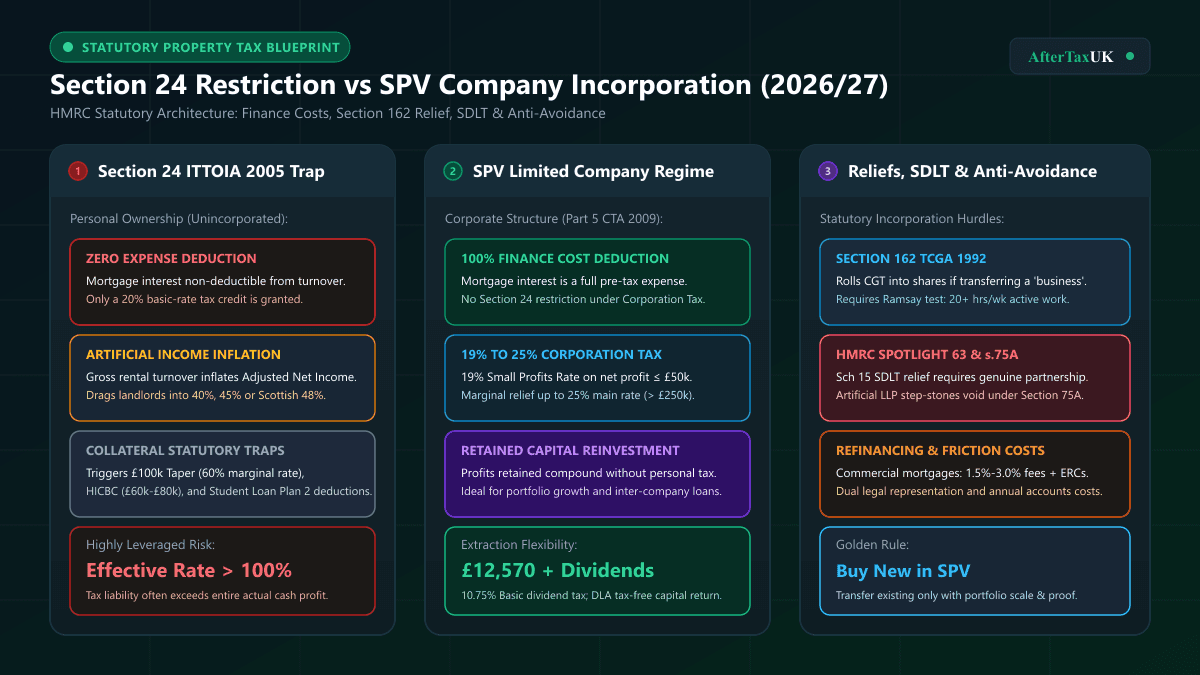
1. The Section 24 Problem: Turnover Taxing Landlords
Prior to April 2017, UK residential landlords operated on standard accounting principles: rental income minus mortgage interest and operating costs equalled net taxable profit.
Under Section 272A of the Income Tax (Trading and Other Income) Act 2005 (ITTOIA 2005), mortgage interest is no longer an allowable expense. Landlords are taxed on their total turnover less physical running expenses. They then receive a basic rate tax reduction capped at 20% of the finance costs.
The Section 24 Paradox Example:
A higher-rate landlord receives £40,000 annual rent and pays £32,000 in mortgage interest with £3,000 running costs. Net cash in hand is £5,000.
Under s.24, taxable profit is £37,000 (£40k - £3k). Tax at 40% is £14,800. The 20% tax credit is £6,400 (20% of £32k). Net tax payable is £8,400.
Result: The landlord made £5,000 cash profit, but owes HMRC £8,400—suffering a net cash deficit of -£3,400!
2. Why SPV Limited Companies Provide Immunity
Section 24 is codified specifically within Income Tax legislation. Limited companies are governed exclusively by the Corporation Tax Act 2009 (CTA 2009).
For a corporate Special Purpose Vehicle (SPV)—typically registered with SIC code 68100 (Buying and selling of own real estate) or 68209 (Other letting and operating of own or leased real estate):
- 100% Mortgage Interest Deductibility: Every penny of mortgage interest and commercial loan arrangement fees is deducted as a legitimate expense before arriving at taxable profits.
- Lower Headline Tax Rates: Company profits are taxed at 19% (small profits rate up to £50,000), marginal relief (effective 26.5% between £50k and £250k), and 25% above £250,000.
- Gross Profit Reinvestment: Retained profits inside the company can be reinvested into acquiring further properties without suffering personal dividend tax or income tax.
3. The Transfer Hurdles: CGT and Section 162 Relief
You cannot simply "switch" property deeds into a company. Legally, transferring property to an SPV is a disposal at open market value under Section 17 of the Taxation of Chargeable Gains Act 1992 (TCGA 1992), potentially triggering immediate Capital Gains Tax (18% basic / 24% higher rate).
To avoid an immediate CGT bill, landlords look to Section 162 Incorporation Relief:
- Rollover of Gains: Capital gains are deferred by rolling them into the base cost of the shares issued by the new company. No cash CGT is payable on incorporation.
- The "Business" Test (Ramsay Case Law): Section 162 strictly requires the transfer of a business as a going concern, not merely passive investments.
- Under the precedent set in Ramsay v HMRC (2013), the landlord must demonstrate active personal management. Spending 20+ hours per week inspecting properties, interviewing tenants, doing repairs, and managing books without an agency is the standard benchmark accepted by HMRC.
4. The Stamp Duty (SDLT) Barrier & Partnership Routes
Under Section 53 of the Finance Act 2003, transferring property to a connected company triggers Stamp Duty Land Tax (SDLT in England/NI, LBTT in Scotland, LTT in Wales) based on market value, including the 3% or 5% higher rates for additional dwellings.
On a £1,500,000 portfolio, standard corporate SDLT can easily exceed £100,000 upfront.
The Schedule 15 FA 2003 Partnership Relief Route
If the properties have been operated as a genuine commercial partnership (governed by the Partnership Act 1890 and registered with HMRC as an SA800 partnership for at least two to three years), Schedule 15 provides a special statutory formula:
Chargeable Proportion = Market Value × (100 - Sum of Lower Proportions)%
When partners incorporate and take identical share ownership in the new company, the "Sum of Lower Proportions" equals 100%, reducing the chargeable proportion to zero (0% SDLT payable).
CAUTION: Setting up a sham partnership immediately prior to incorporation purely to avoid SDLT is aggressively challenged by HMRC under General Anti-Abuse Rules (GAAR).
5. Commercial Mortgage Costs & Director Guarantees
Before incorporating, landlords must calculate the commercial financing realities:
| Feature | Personal Buy-to-Let | SPV Limited Company Buy-to-Let |
|---|---|---|
| Mortgage Interest Deductibility | Restricted (20% basic credit) | 100% Tax Deductible |
| Typical Interest Rates | Standard rates (4.5% - 5.5%) | Higher commercial rates (5.5% - 6.5%) |
| Arrangement / Setup Fees | £999 to £1,999 flat | 1.5% to 3.0% of loan balance |
| Director Personal Guarantees | Direct personal liability | Mandatory personal guarantee |
| Legal & Refinancing Costs | Standard conveyancing | Dual representation / commercial legal fees |
6. When Does Incorporation Make Financial Sense?
Incorporation is generally viable when:
- You are a Higher Rate (40%) or Additional Rate (45%) taxpayer.
- Your portfolio has substantial mortgages (leverage over 50% LTV).
- You plan to retain and reinvest profits to purchase more properties rather than withdrawing all income for personal living costs.
- You have sufficient scale (typically 4+ properties) to justify annual corporate accountancy and commercial finance costs.
Calculate Your Section 24 Tax Exposure
Compare your current personal tax liability against an SPV limited company structure using our landlord tax engine.
Launch the Buy-to-Let Tax CalculatorFrequently Asked Questions
Frequently Asked Questions
Clear answers based on official HMRC rules and statutory guidance.
Statutory Sources & Primary Legislation
- legislation.gov.uk: ITTOIA 2005 Section 272A (Restriction on Deductions for Finance Costs)
- legislation.gov.uk: TCGA 1992 Section 162 (Roll-Over Relief on Transfer of Business)
- legislation.gov.uk: Finance Act 2003 Schedule 15 (Stamp Duty Land Tax: Partnerships)
- HMRC Capital Gains Manual CG65700: Incorporation Relief